
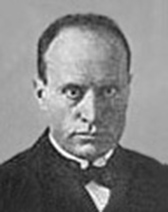
Benito Mussolini
Fascist dictator of Italy and one of the principal architects of 20th-century totalitarianism
Born on July 29, 1883
Died on April 28, 1945
Age at death: 62
Profession: Politician, Dictator, Journalist
Place of Birth: Forlì, Kingdom of Italy
Place of Death: Giulino di Mezzegra, Kingdom of Italy
Benito Amilcare Andrea Mussolini was the fascist dictator of Italy, ruling the country from 1922 until 1943. As Prime Minister during the Second World War, he is regarded—alongside Adolf Hitler—as one of the central implementers of fascism as a political system. Mussolini’s regime was responsible for widespread repression, colonial atrocities, and mass killings, particularly in Ethiopia and the Balkans, where chemical weapons and systematic violence led to the deaths of hundreds of thousands of civilians. His rule left an indelible mark on European history and stands among the most brutal dictatorships of the 20th century.
Early Life and Family Background
Benito Mussolini was born on 29 July 1883 in Forlì, Italy, to Alessandro Mussolini and Rosa Maltoni. His mother was a schoolteacher, while his father was a blacksmith and a committed socialist activist. His name reflected his father’s political inspirations: “Benito” after Mexican reformist Benito Juárez, and “Andrea” and “Amilcare” after Italian socialist figures Andrea Costa and Amilcare Cipriani.
From an early age, Mussolini displayed violent and disruptive behavior. He was expelled from a church school for attacking fellow pupils with stones and later expelled again from boarding school after injuring a classmate and throwing an inkwell at a teacher. Despite this, he was academically capable and graduated in 1901 with qualifications to become a teacher.
Intellectually, the young Mussolini was deeply influenced by socialist and revolutionary thinkers, including Karl Marx, Friedrich Nietzsche, Auguste Blanqui, and Georges Sorel. These influences would later be reconfigured into his unique synthesis of authoritarian nationalism and violence.
Socialism, Exile, and Radicalization
In 1902, Benito Mussolini fled to Switzerland to evade military service. There, he lived precariously, worked sporadically, and was briefly imprisoned for vagrancy before being deported. After returning to Italy and later re-entering Switzerland, he eventually settled in Trento, then under Austro-Hungarian rule.
Mussolini became editor of the socialist newspaper L’Avvenire del Lavoratore and later worked with nationalist-socialist politician Cesare Battisti. During this period, he also wrote a novel, Claudia Particella, the Cardinal’s Mistress, published in 1910, but he was dismissed from his editorial post due to its anti-clerical content.
World War I and the Break with Socialism
At the outbreak of the First World War, Benito Mussolini was initially opposed to Italy’s participation, believing only in class war rather than national war. He worked as an editor for the Socialist Party newspaper L’Avanti!. However, in 1915, he dramatically reversed his position, advocating Italian entry into the war and founding the interventionist group Fasci d’Azione Rivoluzionaria.
This shift led to his expulsion from the Socialist Party. He founded the newspaper Il Popolo d’Italia and began violently opposing socialist and communist movements. Although drafted into the army, he was wounded and returned to journalism, using war nationalism as the foundation for his future ideology.
Birth of Fascism and Seizure of Power
After the war, Italy faced economic collapse, political paralysis, and social unrest. In March 1919, Benito Mussolini founded the fascist movement Fasci di Combattimento, drawing support from landowners, industrialists, and segments of the middle class fearful of socialist revolution.
Fascist paramilitary squads, known as the Blackshirts, used terror, beatings, and assassinations to eliminate political opponents. In 1921, Mussolini established the Partito Nazionale Fascista and entered parliament. Exploiting governmental instability under leaders such as Giovanni Giolitti, Ivanoe Bonomi, and Luigi Facta, Mussolini threatened civil war.
On 29 October 1922, King Victor Emmanuel III appointed Mussolini Prime Minister, making him the youngest in Italian history at the age of 39.
Establishment of a Totalitarian State
Once in power, Benito Mussolini gradually dismantled democratic institutions. Opposition parties were banned, the press censored, trade unions outlawed, and elections rendered meaningless. Italy was transformed into a police state governed by surveillance, propaganda, and repression.
Mussolini concentrated power by personally assuming multiple ministerial roles, including foreign affairs, military command, and colonial administration. His cult of personality portrayed him as Il Duce—the infallible leader, warrior, laborer, and father of the nation.
Church, Propaganda, and Ideology
In 1929, Mussolini signed the Lateran Accords with the Vatican, recognizing Catholicism as Italy’s official religion and granting sovereignty to Vatican City. Although previously anti-clerical and unbaptized, Mussolini accepted baptism to neutralize Catholic opposition.
Fascist ideology was codified in 1932 in La Dottrina del Fascismo, written by philosopher Giovanni Gentile and signed by Mussolini. Drawing from Nietzschean elitism, Vilfredo Pareto’s theories of ruling elites, and Sorelian violence, Mussolini promoted authoritarian nationalism and imperial expansion.
Imperialism and Mass Atrocities
Mussolini’s foreign policy replaced pacifism with aggressive expansion. Early actions included the bombing of Corfu in 1923 and repression in Libya. His most infamous campaign began in 1935 with the invasion of Ethiopia.
During the Ethiopian war, Benito Mussolini authorized the use of chemical weapons, including mustard gas, against both soldiers and civilians. Entire villages were destroyed, guerrillas were gassed in caves, and mass executions followed. Over 300,000 people were killed, marking one of the most horrific colonial genocides of the century.
Simultaneously, Mussolini supported Francisco Franco during the Spanish Civil War, contributing decisively to the fascist victory in Spain.
Alliance with Nazi Germany and World War II
Following international condemnation, Mussolini aligned Italy with Nazi Germany. The Rome–Berlin Axis was formalized, binding Italy’s fate to Hitler’s ambitions. Mussolini endorsed the annexation of Austria and the dismantling of Czechoslovakia.
Italy entered World War II on 10 June 1940. Mussolini’s military campaigns in North Africa and the Balkans were disastrous, relying increasingly on German support. Italy’s defeats eroded both popular support and elite confidence in his leadership.
Fall from Power and Death
On 25 July 1943, the Fascist Grand Council deposed Mussolini, and King Victor Emmanuel III ordered his arrest. He was imprisoned until German commandos led by Otto Skorzeny rescued him in September 1943.
Mussolini was installed as head of the German-controlled Italian Social Republic (Salò Republic), a puppet regime with no real sovereignty. As Allied forces advanced, his position collapsed.
On 27 April 1945, Benito Mussolini and his mistress Clara Petacci were captured by Italian partisans while attempting to flee to Switzerland. On 28 April 1945, they were executed. Their bodies were publicly displayed in Milan, hung upside down as a symbol of fascism’s defeat.
Personal Life
Mussolini married Rachele Guidi after ending his earlier relationship with Ida Dalser. They had four children: Vittorio Mussolini, Romano Mussolini, Bruno Mussolini, and Edda Mussolini. Through marriage, the family later became connected to Italian cinema royalty when Anna Maria Scicolone, sister of Sophia Loren, married Romano Mussolini.
Benito Mussolini remains one of history’s most infamous dictators—a figure whose trajectory from socialism to fascism illustrates how ideological opportunism, violence, and mass propaganda can culminate in catastrophic human cost.
Source: Biyografiler.com
Frequently asked questions about Benito Mussolini
Who is Benito Mussolini?, Benito Mussolini biography, Benito Mussolini life story, Benito Mussolini age, Benito Mussolini facts, Benito Mussolini birthplace, Benito Mussolini photos, Benito Mussolini videos, Benito Mussolini career
Related Biographies

Lamine Yamal
Professional footballer

Kylian Mbappe
Professional footballer

Erling Haaland
Professional footballer

Sam Altman
Entrepreneur, Investor, CEO

Austin Abrams
Actor

Bad Bunny
Rapper, Songwriter


Hongjoong
Singer, Rapper, Songwriter, Composer

Ludacris
Rapper, Actor

Kwon Eunbi
Singer

Sarah Wayne Callies
Actress, Screenwriter, Producer, Director

LaTavia Roberson
Singer, Actress, Entrepreneur

Pedro Sanchez
Politician

Adam Sandler
Actor

Cillian Murphy
Actor
Austin Abrams
Actor
Lamine Yamal
Professional footballer

Brad Pitt
Actor