
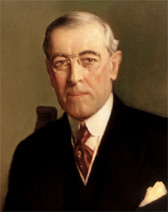
Woodrow Wilson
28th President of the United States & Architect of the Fourteen Points
Born on December 28, 1856
Died on February 3, 1924
Age at death: 68
Profession: Former President, Politician, Academic, Historian
Place of Birth: Staunton, Virginia, United States
Place of Death: Washington, D.C., United States
Thomas Woodrow Wilson served as the 28th President of the United States from 4 March 1913 to 4 March 1921. He is remembered as a progressive reformer at home and an idealist statesman abroad, best known for leading the United States through World War I and for proposing the “Fourteen Points,” a visionary plan for lasting global peace.
Thomas Woodrow Wilson was born on 28 December 1856 in Staunton, Virginia, as the son of a Presbyterian minister. He completed his undergraduate studies in law at Princeton University between 1875 and 1879. In 1880, he began doctoral studies at the University of Virginia, but was forced to abandon them due to illness. After unsuccessfully attempting to run a law office he opened in Atlanta in 1882, Wilson returned to academia in the autumn of 1883 and resumed his doctoral work at Johns Hopkins University in Baltimore. Between 1883 and 1886, he completed his PhD with a dissertation titled Congressional Government.
In 1886, Wilson was appointed assistant professor at Bryn Mawr College in Philadelphia. Two years later, in 1888, he became a full professor at Wesleyan University in Connecticut. During this period, he published one of his most significant works, The State, in 1889, a comparative study of government systems. At the same time, he also became one of the most successful rugby coaches in Wesleyan University’s history.
In 1890, Thomas Woodrow Wilson joined Princeton University, where he taught law and political economy for twelve years. This intellectually productive phase saw the publication of two major works: Division and Reunion, a pioneering study of the American Civil War published in 1893, and History of the American People, completed in 1902.
In 1902, Wilson was elected President of Princeton University, a position he held until 1910. His attempts to introduce democratic reforms into the university’s educational system and his strong support for students provoked resistance from conservative circles, ultimately limiting the scope of his reforms.
Leaving academia in 1910, Thomas Woodrow Wilson entered politics as a member of the Democratic Party. In January 1911, he was elected Governor of New Jersey, serving as the 34th governor from 17 January 1911 to 1 March 1913. His swift and effective reforms drew national attention and paved the way for his presidential candidacy.
Wilson secured the Democratic Party’s presidential nomination in June 1912 and won the November election by capitalizing on the split within the Republican Party between incumbent President William Howard Taft and former President Theodore Roosevelt. He was officially inaugurated on 4 March 1913.
As president, Thomas Woodrow Wilson implemented much of his ambitious reform agenda known as the “New Freedom.” These reforms included lowering tariff rates, introducing progressive income taxation, increasing taxes on luxury goods, establishing the Federal Trade Commission to curb monopolies and promote free competition, improving labor rights, creating government-backed banks to provide easier credit to entrepreneurs, and mandating the direct election of U.S. senators.
Despite his progressive domestic policies, Wilson adopted a firm stance in foreign affairs when U.S. economic and political interests were at stake. His administration oversaw the occupation of Haiti in 1915, military intervention in Santo Domingo (present-day Dominican Republic) in 1916, the refusal to recognize the regime of Victoriano Huerta in Mexico in 1914, and the deployment of the Pershing Expedition against the uprising led by Pancho Villa. Efforts to preserve peace in Europe through arms reduction proposals failed following the assassination of Archduke Franz Ferdinand in Sarajevo on 28 June 1914.
At the outbreak of World War I, Wilson declared U.S. neutrality. However, Germany’s submarine warfare campaign and the sinking of passenger ships such as the Lusitania in May 1915 and the Arabic in August 1915 provoked outrage in the United States. Nevertheless, Wilson maintained his diplomatic stance and secured an agreement with Germany on 4 May 1916 to halt unrestricted submarine warfare.
Reelected on 7 November 1916 largely due to his anti-war position, Thomas Woodrow Wilson continued working toward peace. Germany’s resumption of unrestricted submarine warfare on 31 January 1917 ended these efforts. Diplomatic relations were severed on 3 February 1917, and on 2 April Wilson requested congressional authorization for war. The United States officially entered World War I on 6 April 1917 alongside the Allied Powers.
While sending American troops to Europe, Wilson presented his famous “Fourteen Points” to Congress on 8 January 1918, outlining principles for a just and lasting peace. After the Armistice of 11 November 1918, he attended the Paris Peace Conference beginning on 18 January 1919, warning that failure to adopt his principles could lead the United States to negotiate a separate peace with Germany.
Following the signing of the Treaty of Versailles on 28 June 1919, Wilson returned to the United States, where the treaty faced fierce opposition in Congress, particularly from Republican Senator Henry Cabot Lodge, who objected to U.S. membership in the League of Nations. Wilson embarked on a 21,000-kilometer nationwide speaking tour to rally public support, delivering speeches in forty cities.
The strain severely damaged his health. On 25 September 1919, he suffered a pulmonary collapse, and on 2 October 1919, he was partially paralyzed on his left side. The Senate rejected the Treaty of Versailles on both 19 November 1919 and 19 March 1920, and the United States never joined the League of Nations.
In recognition of his efforts to secure world peace, Thomas Woodrow Wilson was awarded the Nobel Peace Prize in 1919. After leaving office in 1921, he spent his final years in seclusion with his second wife, Edith Bolling Galt.
Marriages:
1st wife: Ellen Axson (m. 1885 – d. 1914). She died on 6 August 1914 due to kidney disease. They had three daughters: Margaret Wilson (born 1886), Jessie Wilson (born 1887), and Eleanor Wilson (born 1889).
2nd wife: Edith Bolling Galt (m. 1915 – 1924).
Thomas Woodrow Wilson died on 3 February 1924 at the age of 68 in Washington, D.C. He was laid to rest in the Bethlehem Chapel of Washington National Cathedral.
Source: Biyografiler.com
Frequently asked questions about Woodrow Wilson
Who is Woodrow Wilson?, Woodrow Wilson biography, Woodrow Wilson life story, Woodrow Wilson age, Woodrow Wilson facts, Woodrow Wilson birthplace, Woodrow Wilson photos, Woodrow Wilson videos, Woodrow Wilson career
Related Biographies

Lamine Yamal
Professional footballer

Erling Haaland
Professional footballer

Austin Abrams
Actor

Keanu Reeves
Actor

Kylian Mbappe
Professional footballer

Bad Bunny
Rapper, Songwriter


Hongjoong
Singer, Rapper, Songwriter, Composer

Ludacris
Rapper, Actor

Kwon Eunbi
Singer

Sarah Wayne Callies
Actress, Screenwriter, Producer, Director

LaTavia Roberson
Singer, Actress, Entrepreneur

Luiz Inacio Lula da Silva
Politician, President

Nicki Minaj
Rapper, Singer, Songwriter, Actress

Ronaldinho
Professional footballer

Jared Kushner
Businessperson, Political Consultant
Kylian Mbappe
Professional footballer

Maria Corina Machado
Politician, Political Activist