
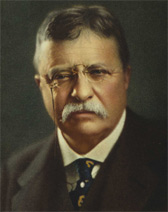
Theodore Roosevelt
26th President of the United States
Born on October 27, 1858
Died on January 6, 1919
Age at death: 61
Profession: Politician, Statesman, Historian, Writer
Place of Birth: Manhattan, New York City, New York, United States
Place of Death: New York City, New York, United States
Theodore Roosevelt was the 26th President of the United States and one of the most dynamic and influential leaders in American history.
Theodore Roosevelt was born on October 27, 1858, in Manhattan, New York City, United States. His father was of Dutch immigrant descent, while his mother was of English origin. He graduated from Harvard University in 1880 and later enrolled at Columbia University Law School, but left the program during his first year.
In 1881, at the age of 23, he entered the New York State Assembly as a Republican member. After serving for a period, he withdrew from politics in 1884 following the tragic deaths of his wife and mother on the same day. He spent two years on his ranch in Dakota Territory, raising cattle and writing history in an effort to overcome his grief. In 1886, he unsuccessfully ran for Governor of New York State.
Returning to public life in 1889, Theodore Roosevelt served as a member of the United States Civil Service Commission until 1895. From 1895 to 1897, he was President of the New York City Board of Police Commissioners. In 1897, he was appointed Assistant Secretary of the Navy by William McKinley.
He supported the Cuban independence movement and resigned from his post in 1898 to fight as a volunteer colonel in the Spanish–American War, where he distinguished himself through acts of bravery. That same year, he was elected Governor of New York. During his governorship, he achieved major reforms in education, taxation, racial integration in schools, and conservation of rural lands.
In 1900, Theodore Roosevelt was elected Vice President under President William McKinley. After McKinley was wounded by an assassin on September 6, 1901, and died on September 14, 1901, Roosevelt assumed the presidency, becoming the 26th President of the United States.
He took office at the age of 42, making him the youngest president in American history up to that time. He was re-elected by a large majority in the 1904 presidential election. His presidency lasted from September 14, 1901, to March 4, 1909.
In foreign policy, Theodore Roosevelt pursued a pragmatic and realistic approach, strengthening the U.S. Navy and supporting the Permanent Court of Arbitration at The Hague. He played a key role in the 1906 Algeciras Conference, enhancing French and Spanish influence in Morocco. After prolonged debates, he initiated the construction of the Panama Canal in 1904 with the permission of the Republic of Panama; the canal was completed and opened in 1914.
Major legislation during his presidency included the Hepburn Act of 1906, which granted the Interstate Commerce Commission authority to regulate railroad rates and prohibited preferential treatment among shipping companies. He also championed laws on meat inspection, pure food and drug regulation, employer liability, inheritance taxation, and labor rights.
He ensured federal control over forests, coal, and mineral resources and argued that racial discrimination was morally wrong. In East Asia, he sought closer relations with a rising Japan and secretly recognized Japanese dominance over Korea.
His mediation in the Russo-Japanese War of 1904–1905 earned him the Nobel Peace Prize, which he received in 1906.
Theodore Roosevelt chose not to run in the 1908 presidential election. On March 4, 1909, he handed over the presidency to William Howard Taft. He then embarked on a ten-month African expedition followed by a European tour, during which he delivered numerous lectures.
Upon returning to the United States, he supported the progressive wing of the Republican Party against Taft. He founded the Progressive Party and ran for president in the 1912 election. This division enabled the Democratic candidate Woodrow Wilson to win the presidency. In 1912, Roosevelt survived an assassination attempt in Milwaukee.
He later led an expedition in Brazil, where a newly discovered river was named the Roosevelt River in his honor. At the beginning of World War I, he actively campaigned for war against Germany. Although he lost the 1916 election, he supported U.S. involvement in the war in 1917 and advocated unconditional German surrender and the establishment of the League of Nations. When his appointment to command a unit in France was rejected by President Woodrow Wilson, he withdrew from active politics.
Suffering from various illnesses, Theodore Roosevelt died at the age of 61 on January 6, 1919, at his home in New York City.
Theodore Roosevelt was the uncle of the 32nd President of the United States, Franklin D. Roosevelt, and of his wife Eleanor Roosevelt.
At the Mount Rushmore National Memorial in the Black Hills of South Dakota, sculptures of George Washington, Thomas Jefferson, Theodore Roosevelt, and Abraham Lincoln are carved into the granite cliffs by sculptor John Gutzon Borglum and his son.
Marriages:
First wife: Alice Hathaway Lee (married in 1880, died in 1884)
Second wife: Edith Kermit Carow (married in 1886)
Children:
Alice Lee Roosevelt
Theodore Roosevelt III
Kermit Roosevelt
Ethel Carow Roosevelt
Archibald Bulloch Roosevelt
Quentin Roosevelt
Source: Biyografiler.com
Frequently asked questions about Theodore Roosevelt
Who is Theodore Roosevelt?, Theodore Roosevelt biography, Theodore Roosevelt life story, Theodore Roosevelt age, Theodore Roosevelt facts, Theodore Roosevelt birthplace, Theodore Roosevelt photos, Theodore Roosevelt videos, Theodore Roosevelt career
Related Biographies

Lamine Yamal
Professional footballer

Kylian Mbappe
Professional footballer

Erling Haaland
Professional footballer

Sam Altman
Entrepreneur, Investor, CEO

Bad Bunny
Rapper, Songwriter

Brad Pitt
Actor


Hongjoong
Singer, Rapper, Songwriter, Composer

Ludacris
Rapper, Actor

Kwon Eunbi
Singer

Sarah Wayne Callies
Actress, Screenwriter, Producer, Director

LaTavia Roberson
Singer, Actress, Entrepreneur
Erling Haaland
Professional footballer

Tim Berners Lee
Computer Scientist, Professor

Amber Heard
Actress, Model
Brad Pitt
Actor
Lamine Yamal
Professional footballer

Tim Roth
Actor, Director