
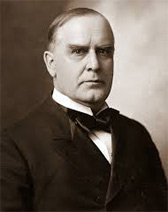
William McKinley
The President of American Expansion | 25th President of the United States
Born on January 29, 1843
Died on September 14, 1901
Age at death: 58
Profession: , Politician, Lawyer, Former President
Place of Birth: Niles, Ohio, United States
Place of Death: Buffalo, New York, United States
William McKinley was born on January 29, 1843, in Niles, Ohio, United States, as the seventh of nine children in his family. His mother was Nancy Allison McKinley, and his father was William McKinley, Sr.
In 1861, McKinley left his education unfinished to join the Union Army during the American Civil War. He served until 1865 as an aide-de-camp to Colonel Rutherford B. Hayes, who later became the 19th President of the United States and played an influential role in McKinley’s political career. After the war, McKinley was discharged with the rank of Major. He then completed his legal education at Albany Law School in New York and was admitted to the Ohio Bar in 1867, beginning his career as a lawyer.
In 1869, McKinley entered public service as the prosecuting attorney of Stark County. In the same year, he formally entered politics as a member of the Republican Party. Between 1877 and 1890, he served multiple terms in the United States Congress. During this period, he became the principal architect of the 1890 tariff legislation that later became known as the McKinley Tariff.
From 1891 to 1896, McKinley served as Governor of Ohio. In 1896, he won the presidential election and became the 25th President of the United States.
During his presidency, McKinley pursued an expansionist foreign policy. In 1898, he initially sought to pressure Spain into granting autonomy to Cuba. When these efforts failed, the United States declared war on Spain. American forces occupied Cuba and Puerto Rico and defeated the Spanish Navy in Manila Bay. Spain was compelled to sign a peace treaty the same year. Under the terms of the agreement, the United States would temporarily remain in Cuba until order was restored, acquire Puerto Rico as war compensation, and take control of the Philippine Islands.
In 1899, McKinley secured Senate approval of the Treaty of Paris. As international competition intensified in China, the United States joined an international military coalition after hundreds of Westerners were killed during the Boxer Rebellion.
Domestically, McKinley’s administration enacted the Dingley Tariff in 1897, imposing high customs duties, and the Gold Standard Act of 1900, both of which generated widespread debate. After winning the 1900 presidential election by a large margin, McKinley planned to focus more extensively on domestic issues during his second term.
William McKinley married Ida Saxton McKinley in 1871. The couple had two children, Katherine McKinley and Ida McKinley.
On September 6, 1901, while attending the Pan-American Exposition in Buffalo, New York, McKinley was shot twice at close range by a Polish anarchist named Leon Czolgosz as he greeted the public in front of the Temple of Music. Gravely wounded, McKinley survived for eight days before succumbing to his injuries.
William McKinley died on September 14, 1901, at the age of 58, in Buffalo, New York, United States, as a result of assassination. He was succeeded by Vice President Theodore Roosevelt.
Source: Biyografiler.com
Frequently asked questions about William McKinley
Who is William McKinley?, William McKinley biography, William McKinley life story, William McKinley age, William McKinley facts, William McKinley birthplace, William McKinley photos, William McKinley videos, William McKinley career
Related Biographies

Lamine Yamal
Professional footballer

Kylian Mbappe
Professional footballer

Erling Haaland
Professional footballer

Sam Altman
Entrepreneur, Investor, CEO

Bad Bunny
Rapper, Songwriter

Brad Pitt
Actor


Hongjoong
Singer, Rapper, Songwriter, Composer

Ludacris
Rapper, Actor

Kwon Eunbi
Singer

Sarah Wayne Callies
Actress, Screenwriter, Producer, Director

LaTavia Roberson
Singer, Actress, Entrepreneur
Erling Haaland
Professional footballer

Tim Berners Lee
Computer Scientist, Professor

Amber Heard
Actress, Model
Brad Pitt
Actor
Lamine Yamal
Professional footballer

John F. Kennedy
Politician, Statesman