
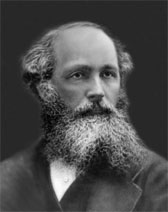
James Clerk Maxwell
Pioneer of Electromagnetic Theory and Classical Physics
Born on June 13, 1831
Died on November 5, 1879
Age at death: 48
Profession: Mathematician, Physicist
Place of Birth: Edinburgh, Scotland
Place of Death: Cambridge, England
James Clerk Maxwell was born on June 13, 1831, in Edinburgh, the capital of Scotland, into a distinguished family. He was the only child of the lawyer John Clerk Maxwell and his wife Frances Maxwell. He grew up in the town of Middlebie. His father was a member of the Edinburgh Royal Society. Maxwell was educated at the Edinburgh Academy, where his extraordinary talent became apparent at an early age.
At just fourteen years old, James Clerk Maxwell developed an advanced mathematical method for drawing perfect ellipses. This discovery was presented to and awarded by the Edinburgh Royal Society. In 1847, he left the academy and enrolled at the University of Edinburgh, where he published two additional scientific papers while still a student.
In 1850, James Clerk Maxwell transferred to University of Cambridge and studied at Trinity College, Cambridge. He graduated with a bachelor’s degree in mathematics, ranking second in his class. During his years at Cambridge, he published groundbreaking papers that laid the axiomatic foundations of elasticity theory and advanced geometric optics, anticipating principles that would later lead to the invention of the fish-eye lens.
In 1855, Maxwell became a fellow of Trinity College. Due to his father’s declining health, he returned to Scotland the following year and accepted a position as professor of natural philosophy—then the Scottish term for physics—at Marischal College in Aberdeen. In 1860, he moved to London to take up the chair of natural philosophy at King’s College London.
James Clerk Maxwell was elected a member of the Royal Society in 1861. In the same year, he produced the first-ever permanent color photograph, using three separate black-and-white images taken through red, green, and blue filters—an achievement that laid the foundation for modern color photography.
Seeking more time for research, Maxwell resigned from King’s College and retreated to his family estate in Scotland. Over the next six years, he developed his monumental work on electromagnetic theory. He unified all known laws of electricity and magnetism into a single coherent mathematical framework, demonstrating that changing electric and magnetic fields are inseparable and that light itself is an electromagnetic wave. In doing so, he unified electricity, magnetism, and optics into a single theoretical system.
His findings were published in 1873 in his seminal work A Treatise on Electricity and Magnetism. From the equations presented in this book—later known as the Maxwell equations—it followed that electromagnetic effects propagate through space at the speed of light. This insight fundamentally changed the understanding of light and radiation.
While some scientists argued that light consisted of particles and others that it behaved as a wave, James Clerk Maxwell described light as a rapidly oscillating electromagnetic field propagating through space. The electromagnetic waves he predicted theoretically were experimentally confirmed eight years after his death by Heinrich Hertz. Hertz’s discovery of radio waves and Wilhelm Röntgen’s later discovery of X-rays both validated Maxwell’s predictions, establishing him as the theoretical founder of radio science.
The mathematical framework Maxwell developed—now known as vector analysis—enabled him to express electromagnetic phenomena through four fundamental equations. These equations describe how electric charges produce electric fields (Gauss’s law), why magnetic monopoles do not exist, how electric currents and changing electric fields generate magnetic fields (Ampère–Maxwell law), and how changing magnetic fields generate electric fields (Faraday’s law of induction). Together, they form the core of modern electromagnetic theory.
James Clerk Maxwell began presenting his mature theory of the electromagnetic field in 1867, culminating in the publication of his greatest work in 1871. His theories remain fully intact today; even Albert Einstein’s theory of relativity did not require any modification of Maxwell’s equations. Later physicists such as Hendrik Antoon Lorentz extended Maxwell’s ideas to the atomic and molecular scale.
Despite the profound impact of his work, James Clerk Maxwell received little public recognition during his lifetime. He suffered from a short illness and died on November 5, 1879. He was buried in the churchyard of Parton village in Scotland.
Maxwell is remembered as one of the greatest scientists in history. His unification of electricity, magnetism, and light stands alongside Newton’s laws and Einstein’s relativity as one of the pillars of modern physics, shaping technology ranging from radio and television to wireless communication and modern electronics.
Source: Biyografiler.com
Frequently asked questions about James Clerk Maxwell
Who is James Clerk Maxwell?, James Clerk Maxwell biography, James Clerk Maxwell life story, James Clerk Maxwell age, James Clerk Maxwell facts, James Clerk Maxwell birthplace, James Clerk Maxwell photos, James Clerk Maxwell videos, James Clerk Maxwell career
Related Biographies

Lamine Yamal
Professional footballer

Kylian Mbappe
Professional footballer

Erling Haaland
Professional footballer

Sam Altman
Entrepreneur, Investor, CEO

Bad Bunny
Rapper, Songwriter

Brad Pitt
Actor


Hongjoong
Singer, Rapper, Songwriter, Composer

Ludacris
Rapper, Actor

Kwon Eunbi
Singer

Sarah Wayne Callies
Actress, Screenwriter, Producer, Director

LaTavia Roberson
Singer, Actress, Entrepreneur
Erling Haaland
Professional footballer

Tim Berners Lee
Computer Scientist, Professor

Amber Heard
Actress, Model
Brad Pitt
Actor

Tim Roth
Actor, Director
Kylian Mbappe
Professional footballer