
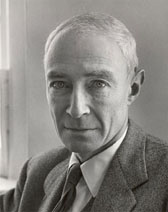
Robert Oppenheimer
Scientific director of the Manhattan Project and key figure in 20th-century nuclear physics
Born on April 22, 1904
Died on February 18, 1967
Age at death: 63
Profession: Theoretical Physicist, Scientist
Place of Birth: New York City, United States
Place of Death: Princeton, New Jersey, United States
Julius Robert Oppenheimer was an American theoretical physicist best known as the scientific director of the Manhattan Project, the World War II program that led to the development of the first nuclear weapons. Often referred to as the “father of the atomic bomb,” Oppenheimer played a central role in organizing and directing one of the largest scientific efforts in history, bringing together many of the most prominent physicists of the 20th century.
Robert Oppenheimer was born on April 22, 1904, in New York City. His father, Julius S. Oppenheimer, was a wealthy German-Jewish immigrant who had arrived in the United States at the age of 17 and worked in the garment industry. His mother, Ella Friedman, was a painter from Baltimore. He had one younger brother, Frank Oppenheimer. The family was non-religious, culturally Jewish, and deeply interested in art and music.
The Oppenheimers lived in a luxurious apartment on Riverside Drive in Manhattan, decorated with post-impressionist paintings, and owned a Long Island property with a private dock and yacht. This affluent and intellectually stimulating environment played a significant role in shaping Oppenheimer’s early development.
Early Education and Intellectual Formation
In 1911, Robert Oppenheimer began his education at the School of Ethical Culture in New York. From the age of five, he developed a strong interest in mineralogy, collecting specimens—some inherited from his grandfather in Germany. By the age of eleven, his knowledge and collection were advanced enough for him to be admitted to the New York Mineralogical Club.
He graduated from high school in 1921 and embarked on a trip to Europe, which was cut short when he contracted colitis. Upon returning to the United States, he enrolled at Harvard University. There, he studied chemistry but also pursued physics, Latin, and Greek, completing a four-year curriculum in just three years. He graduated in 1925 with highest honors (summa cum laude). Between 1945 and 1955, he later served as a member of Harvard’s Board of Overseers.
European Training and Scientific Network
After Harvard, Robert Oppenheimer turned toward experimental and theoretical physics. He moved to the University of Cambridge to work under Ernest Rutherford. During this period, he also met Niels Bohr in Sweden. In 1926, he went to the University of Göttingen, where he completed his doctorate in 1927 under Max Born.
While in Göttingen, Oppenheimer formed close professional relationships with many physicists who would later become central figures in modern physics, including Werner Heisenberg, Pascual Jordan, Wolfgang Pauli, Paul Dirac, Enrico Fermi, and Edward Teller. He published numerous papers on quantum theory and became part of the first generation of physicists working directly with the new quantum mechanics.
Academic Career in the United States
In September 1927, Robert Oppenheimer returned to the United States as a specialist in theoretical physics. He held positions at Harvard University and the California Institute of Technology under Robert Millikan. In 1928, he began teaching physics at the University of California, Berkeley.
From 1929 onward, Oppenheimer simultaneously held assistant professorships at both Caltech and the University of California, Berkeley, dividing his time between Pasadena and Berkeley for over a decade. In 1936, he was promoted to full professor at both institutions. During these years, many of the most prominent American theoretical physicists received training under his supervision.
Although his lectures were known to be demanding, students were deeply influenced by his teaching style, intellectual intensity, and ability to identify fundamental problems. His primary research interests included quantum field theory, cosmic rays, and nuclear physics.
Political Engagement and Personal Life
In the mid-1930s, Robert Oppenheimer became increasingly engaged with left-leaning political circles. In 1936, he formed a relationship with Jean Tatlock, a member of the American Communist Party. Though he never formally joined the party himself, he maintained close contact with many of its members and financially supported leftist causes. Following his father’s death in 1937, he donated part of his inheritance—approximately $300,000—to progressive organizations.
Reflecting later on this period, Oppenheimer described his political awakening as follows:
“I learned that politics was part of life. I began to move far to the left, joined the Teachers Union, and made many Communist friends. I am not ashamed of this; I am ashamed only that I learned it so late.”In 1939, Robert Oppenheimer met Katherine Puening Harrison, the former wife of American Communist Party member Joe Dallet, who had been killed during the Spanish Civil War. He later married her in November 1940. The couple had two children: Peter Oppenheimer (born 1941) and Katherine Oppenheimer (born 1944).
Manhattan Project and World War II
After the United States entered World War II in 1942, Robert Oppenheimer was appointed head of the Los Alamos Laboratory, where the theoretical and practical work of atomic bomb development was centralized. In 1943, he became the scientific director of the Manhattan Project.
Under his leadership, a team including Edward Teller, Enrico Fermi, Niels Bohr, James Franck, Felix Bloch, Rudolf Peierls, James Chadwick, Otto Frisch, Eugene Wigner, Leo Szilard, and Klaus Fuchs developed the first nuclear weapons. The project culminated in the atomic bombings of Hiroshima and Nagasaki in August 1945.
Following the war, Oppenheimer was awarded the Medal for Merit by President Harry S. Truman in recognition of his leadership, organizational skill, and scientific contribution.
Postwar Influence and Political Downfall
After the war, Robert Oppenheimer became chairman of the Atomic Energy Commission’s General Advisory Committee. He advocated international control of nuclear weapons and warned of the dangers of radioactive fallout. In 1949, he opposed the development of the hydrogen bomb, publicly clashing with Edward Teller, who supported its construction.
During the height of McCarthyism, Oppenheimer’s earlier political associations led to a security hearing in 1954. Although no evidence of espionage was found, President Dwight D. Eisenhower ordered that his security clearance be revoked, effectively removing him from government advisory roles. The decision provoked widespread protest, including a petition signed by 493 scientists involved in the Manhattan Project.
Later Years and Recognition
In 1959, Robert Oppenheimer accepted a teaching position at the University of Colorado. He later contributed to the design of the Exploratorium science museum in San Francisco.
In 1963, President Lyndon B. Johnson awarded him the Enrico Fermi Award, formally acknowledging his scientific contributions and symbolically restoring his reputation. In the same year, the accusations related to his political past were officially set aside.
Death and Final Reflections
Robert Oppenheimer was a heavy smoker and died of throat cancer on February 18, 1967, at the age of 63, in Princeton, New Jersey.
Following the first atomic bomb test in New Mexico, he later recalled a line from the Hindu epic *Bhagavad Gita*, a quotation that became inseparably associated with his legacy:
“Now I am become Death, the destroyer of worlds.”
Source: Biyografiler.com
Frequently asked questions about Robert Oppenheimer
Who is Robert Oppenheimer?, Robert Oppenheimer biography, Robert Oppenheimer life story, Robert Oppenheimer age, Robert Oppenheimer facts, Robert Oppenheimer birthplace, Robert Oppenheimer photos, Robert Oppenheimer videos, Robert Oppenheimer career
Related Biographies

Lamine Yamal
Professional footballer

Sam Altman
Entrepreneur, Investor, CEO

Erling Haaland
Professional footballer

Kylian Mbappe
Professional footballer

Alice Weidel
Politician, Economist

Giorgia Meloni
Politician, Journalist


Hongjoong
Singer, Rapper, Songwriter, Composer

Ludacris
Rapper, Actor

Kwon Eunbi
Singer

Sarah Wayne Callies
Actress, Screenwriter, Producer, Director

LaTavia Roberson
Singer, Actress, Entrepreneur

Sydney Sweeney
Actress

Ma Huateng
Entrepreneur, Inventor

Austin Abrams
Actor

Ursula von der Leyen
Politician, Physician

Kevin Warsh
Economist
Lamine Yamal
Professional footballer