
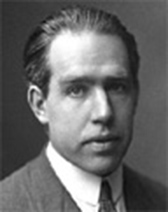
Niels Bohr
Founding Figure of Quantum Theory and the Copenhagen Interpretation
Born on October 7, 1885
Died on November 18, 1962
Age at death: 77
Profession: Physicist
Place of Birth: Copenhagen, Denmark
Place of Death: Copenhagen, Denmark
Niels Bohr, whose full name was Niels Henrik David Bohr, was born on October 7, 1885, in Copenhagen, Denmark. His father was a distinguished professor of medicine at the University of Copenhagen, while his mother was the daughter of a wealthy banker. Niels Bohr and his younger brother Harald Bohr, who later became a renowned mathematician, both graduated from the University of Copenhagen with exceptional academic success. Remarkably, both brothers were also members of the Danish national football team.
In 1910, Niels Bohr earned his doctorate with a dissertation on the electron theory of metals. With a scholarship provided by the Carlsberg Foundation, he traveled to the University of Cambridge to work in the laboratory of J. J. Thomson. After several months, he moved to the University of Manchester, where he worked under Ernest Rutherford, whose discoveries deeply influenced Bohr’s scientific development.
After returning to Denmark in 1912, Niels Bohr constructed the atomic model that now bears his name, marking a decisive breakthrough in quantum physics. He sought to clarify the relationship between classical physics and the emerging quantum theory, an effort that would define much of his scientific legacy.
In 1916, Niels Bohr was appointed professor of physics at the University of Copenhagen. He developed the first quantum theory of atomic structure through the Bohr model, which successfully explained atomic spectra. For nearly fifty years, he played a pioneering role in the advancement of quantum physics. He also introduced the “liquid drop model” of the atomic nucleus, contributing significantly to nuclear physics.
As director of the Copenhagen Institute for Theoretical Physics, Niels Bohr became a central figure in twentieth-century science. In 1922, he was awarded the Nobel Prize in Physics for his investigations into the structure of atoms and the radiation emitted by them. Around this time, his interpretation of quantum mechanics—later known as the Copenhagen interpretation—took shape and became one of the most influential philosophical frameworks in modern physics.
Niels Bohr remained at the head of his institute until Denmark was occupied by Nazi Germany during World War II. In 1943, shortly before the situation became critical, he escaped to Sweden and later traveled to the United States. There, he joined the Manhattan Project at Los Alamos, New Mexico, contributing to the development of the atomic bomb. However, immediately after the war, he returned to Denmark and devoted himself to preventing the use and proliferation of nuclear weapons.
In the postwar period, Niels Bohr publicly advocated for the peaceful use of atomic energy through numerous humanitarian and scientific platforms. In recognition of these efforts, he received the Atoms for Peace Award in 1957. His son, Aage Bohr, also became a distinguished physicist and was awarded the Nobel Prize in Physics in 1975.
One of Niels Bohr’s final major scientific contributions was made in 1939, when he explained why nuclear fission occurs in certain atomic nuclei but not in others by drawing an analogy between the nucleus and a liquid drop. This work proved fundamental to the understanding of nuclear reactions.
Niels Bohr returned to Copenhagen after the war and spent the remainder of his life there. He died on November 18, 1962, leaving behind a scientific legacy that shaped modern physics and transformed humanity’s understanding of the atomic world.
Source: Biyografiler.com
Frequently asked questions about Niels Bohr
Who is Niels Bohr?, Niels Bohr biography, Niels Bohr life story, Niels Bohr age, Niels Bohr facts, Niels Bohr birthplace, Niels Bohr photos, Niels Bohr videos, Niels Bohr career

Lamine Yamal
Professional footballer

Erling Haaland
Professional footballer

Sam Altman
Entrepreneur, Investor, CEO

Kylian Mbappe
Professional footballer

Giorgia Meloni
Politician, Journalist

Alice Weidel
Politician, Economist


Hongjoong
Singer, Rapper, Songwriter, Composer

Ludacris
Rapper, Actor

Kwon Eunbi
Singer

Sarah Wayne Callies
Actress, Screenwriter, Producer, Director

LaTavia Roberson
Singer, Actress, Entrepreneur
Lamine Yamal
Professional footballer
Alice Weidel
Politician, Economist

Elena Andreyevna Rybakina
Professional Tennis Player

Sydney Sweeney
Actress
Kylian Mbappe
Professional footballer
