
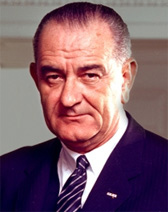
Lyndon B. Johnson
The Architect of the Great Society | 36th President of the United States
Born on August 27, 1908
Died on January 22, 1973
Age at death: 65
Profession: Politician, Former President
Place of Birth: Stonewall, Texas, United States
Place of Death: Stonewall, Texas, United States
Lyndon B. Johnson was born on August 27, 1908, in Stonewall, Texas, United States, as a member of a family with six children. He graduated in 1930 from Texas State Teachers College in San Marcos (formerly Southwest Texas State Teachers College). After graduation, he worked as a teacher in Texas and Houston. In 1931, he entered politics by managing the election campaign of R. M. Kleberg. Following Kleberg’s election to the House of Representatives, Johnson moved to Washington, D.C., serving as his secretary and forming close relationships with many senior officials and politicians.
In 1935, President Franklin D. Roosevelt appointed Johnson as the Texas State Director of the National Youth Administration. In 1937, he won the election for Texas’s 10th congressional district and entered the U.S. House of Representatives. During this period, he strongly supported Roosevelt’s New Deal program. In 1941, he failed to win a Senate seat. Shortly after the attack on Pearl Harbor, Johnson joined the U.S. Navy, becoming the first sitting member of the House to serve on active military duty. He served in Australia and New Zealand and received a medal for his service in New Guinea. For his performance during the Pacific War, he was awarded the “Silver Star” by General Douglas MacArthur. In 1942, he returned to Washington at the president’s request and was appointed chairman of the Naval Affairs Committee.
In 1948, Johnson was elected again as a U.S. Senator from Texas. In 1951, he became the Democratic Party whip in the Senate, and in 1953, he was elected party leader. He was re-elected to the Senate in 1954, and under his leadership, Democrats regained majority control in Congress. In 1955, a severe heart attack caused by overwork forced him to step away from Washington for a period.
During the 1960 presidential elections, Johnson joined the ticket of John F. Kennedy and was nominated as the Democratic Party’s candidate for Vice President. The Kennedy–Johnson ticket narrowly defeated Republican candidate Richard Nixon. As Vice President, Johnson visited numerous countries, including Turkey.
Following the assassination of President John F. Kennedy on November 22, 1963, Lyndon B. Johnson assumed office on the same day as the 36th President of the United States.
Implementing programs envisioned by Kennedy, Johnson secured passage of the Tax Reduction Act, marking one of his earliest major achievements. He won the 1964 presidential election by a large margin. After the Democratic Party achieved overwhelming majorities in Congress in the 1965 elections, Johnson succeeded in passing a wide range of long-delayed social legislation. In 1965, with congressional authorization, he escalated U.S. involvement in the Vietnam War.
Between 1965 and 1968, new laws significantly increased healthcare spending, introduced health insurance for citizens over 65, expanded educational scholarships, promoted social housing, and legalized rental assistance for the poor. During Johnson’s presidency, two major challenges dominated domestic and foreign policy: racial conflict and the Vietnam War. Civil rights protests intensified in response to longstanding racial discrimination. In June 1964, Congress passed the Civil Rights Act, banning racial discrimination in voting, employment, and public institutions. However, continued unrest led to further legislation. After the assassination of civil rights leader Martin Luther King Jr. in April 1968, Congress enacted broader civil rights laws, including bans on racial discrimination in housing.
By 1966, U.S. forces in Vietnam were engaged in prolonged and violent combat against Viet Cong guerrillas supported by China and the Soviet Union. In 1968, with more than 500,000 U.S. troops deployed and growing domestic opposition, Johnson halted the bombing of North Vietnam. Losing congressional support, he chose not to seek re-election in 1969.
During Johnson’s presidency, tensions arose between Turkey and Greece over the Cyprus issue. In 1964, amid escalating tensions, Johnson supported Greece and sent a letter to Turkish Prime Minister İsmet İnönü, later known as the “Johnson Letter,” warning that U.S.-supplied weapons could not be used in a potential intervention in Cyprus. This letter strained Turkish–U.S. relations. İnönü’s visit to Washington on June 13, 1964, marked the beginning of a new phase in bilateral relations.
Lyndon B. Johnson married Lady Bird Taylor in 1934. The couple had two daughters, Lynda and Luci.
Lyndon B. Johnson died on January 22, 1973, at the age of 65, in Stonewall, Texas, United States.
Books:
1971 – The Vantage Point
Source: Biyografiler.com
Frequently asked questions about Lyndon B. Johnson
Who is Lyndon B. Johnson?, Lyndon B. Johnson biography, Lyndon B. Johnson life story, Lyndon B. Johnson age, Lyndon B. Johnson facts, Lyndon B. Johnson birthplace, Lyndon B. Johnson photos, Lyndon B. Johnson videos, Lyndon B. Johnson career
Related Biographies

Lamine Yamal
Professional footballer

Erling Haaland
Professional footballer

Austin Abrams
Actor

Keanu Reeves
Actor

Kylian Mbappe
Professional footballer

Bad Bunny
Rapper, Songwriter


Hongjoong
Singer, Rapper, Songwriter, Composer

Ludacris
Rapper, Actor

Kwon Eunbi
Singer

Sarah Wayne Callies
Actress, Screenwriter, Producer, Director

LaTavia Roberson
Singer, Actress, Entrepreneur
Kylian Mbappe
Professional footballer
Lamine Yamal
Professional footballer

Luiz Inacio Lula da Silva
Politician, President

Maria Corina Machado
Politician, Political Activist

Nicki Minaj
Rapper, Singer, Songwriter, Actress

Zhang Yiming
Entrepreneur, Software Developer