
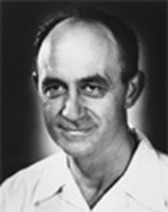
Enrico Fermi
Father of Nuclear Physics and Nuclear Reactor Technology
Born on September 29, 1901
Died on November 27, 1954
Age at death: 53
Profession: Physicist
Place of Birth: Rome, Italy
Place of Death: Chicago, Illinois, United States
Enrico Fermi was born on September 29, 1901, in Rome, Italy. His father, Alberto Fermi, served as the chief inspector of the Roman police. Demonstrating exceptional talent at an early age, Fermi entered the University of Pisa in 1918 and graduated four years later.
In 1923, Enrico Fermi received a scholarship from the Italian government and traveled to Germany to study at the University of Göttingen. In 1924, he was awarded a Rockefeller Fellowship and continued his studies at Leiden University. That same year, he returned to Italy to teach mathematical physics at the University of Florence.
In 1926, Enrico Fermi formulated what is now known as Fermi–Dirac statistics, describing the behavior of particles that obey the Pauli exclusion principle, later called fermions in his honor. In 1927, he was appointed professor of theoretical physics at the University of Rome. He held this position until 1938, when he left Italy shortly after receiving the Nobel Prize, fleeing the fascist regime of Benito Mussolini and its anti-Jewish laws.
Enrico Fermi was awarded the Nobel Prize in Physics in 1938 for his discoveries regarding neutron irradiation and the production of new radioactive elements. His most significant scientific breakthroughs came from his work on electrons and atomic nuclei. In 1934, he developed the theory of beta decay, integrating it with Wolfgang Pauli’s neutrino hypothesis.
Following the discovery of artificial radioactivity by Irène Joliot-Curie and Frédéric Joliot-Curie, Fermi demonstrated that nearly all elements could undergo nuclear transformation when bombarded with neutrons. This research led to the discovery of slow neutrons, nuclear fission, and the creation of previously unknown elements beyond the periodic table.
After emigrating to the United States, Enrico Fermi initially joined Columbia University and later became a professor at the University of Chicago. Following the experimental confirmation of nuclear fission by Otto Hahn and Fritz Strassmann in early 1939, Fermi calculated the conditions necessary for neutron multiplication and self-sustaining chain reactions.
After extensive experimentation, Enrico Fermi achieved the world’s first controlled nuclear chain reaction on December 2, 1942, with the construction of Chicago Pile-1, the first nuclear reactor. Cadmium control rods were used to absorb neutrons and regulate the reaction. Slowly withdrawing these rods allowed a stable, self-sustaining chain reaction to occur. This achievement marked the birth of the nuclear age.
As a leading scientist of the Manhattan Project, Enrico Fermi played a crucial role in overcoming technical challenges related to atomic bomb development. Because his work directly enabled nuclear fission and reactor technology, he is widely regarded as the “father of the atomic bomb”, though his contributions spanned both theoretical and experimental physics.
Enrico Fermi became a United States citizen in 1944. After World War II, he accepted a professorship at the University of Chicago, where he continued nuclear research until his death. In his later years, he focused on the origin of cosmic rays, proposing a theory that identified them as products of extremely high-energy astrophysical processes.
Among his major scientific publications are studies on electron gas statistics and nuclear theory, including Sulla quantizzazione del gas perfetto monoatomico (1935), the Thomas–Fermi atomic model, Quantentheorie und Chemie (1928), and Tentativo di una teoria dei raggi β (1933).
Enrico Fermi married Laura Capon in 1928. The couple had two children, Giulio Fermi and Nella Fermi.
Enrico Fermi died of cancer on November 29, 1954, in Chicago, Illinois, at the age of fifty-three. In his honor, the chemical element with atomic number 100 was named fermium, commemorating one of the most influential physicists of the twentieth century.
Source: Biyografiler.com
Frequently asked questions about Enrico Fermi
Who is Enrico Fermi?, Enrico Fermi biography, Enrico Fermi life story, Enrico Fermi age, Enrico Fermi facts, Enrico Fermi birthplace, Enrico Fermi photos, Enrico Fermi videos, Enrico Fermi career
Related Biographies

Lamine Yamal
Professional footballer

Sam Altman
Entrepreneur, Investor, CEO

Erling Haaland
Professional footballer

Kylian Mbappe
Professional footballer

Alice Weidel
Politician, Economist

Giorgia Meloni
Politician, Journalist


Hongjoong
Singer, Rapper, Songwriter, Composer

Ludacris
Rapper, Actor

Kwon Eunbi
Singer

Sarah Wayne Callies
Actress, Screenwriter, Producer, Director

LaTavia Roberson
Singer, Actress, Entrepreneur

Sydney Sweeney
Actress

Ma Huateng
Entrepreneur, Inventor
Lamine Yamal
Professional footballer

Austin Abrams
Actor

Ursula von der Leyen
Politician, Physician

Kevin Warsh
Economist