
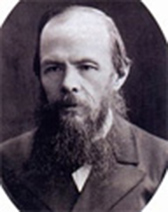
Fyodor Dostoevsky
The psychological architect of the modern novel; the writer who turned the human soul into a battlefield.
Born on October 30, 1821
Died on January 25, 1881
Age at death: 60
Profession: Novelist, Philosopher, Journalist
Place of Birth: Moscow, Russian Empire
Place of Death: Saint Petersburg, Russian Empire
In the second half of the nineteenth century, among the three great masters most widely recognized in the West—Tolstoy, Chekhov and Fyodor Mikhailovich Dostoevsky—the latter stands out as a literary genius who exerted an enormous influence on the development of Western literature, and as the Russian author of timeless classics such as Crime and Punishment and The Brothers Karamazov.
Fyodor Mikhailovich Dostoevsky was born on October 30 1821 in Moscow. His father, Mikhail Andreyevich Dostoevsky, was a military doctor and an extremely harsh man. His greatest passion was alcohol, and he ruled his family with strict discipline. Even when his daughters were fully grown, he did not allow them to go outside on their own. He treated his four sons with the severity of a drill sergeant. He was quick-tempered, and the children constantly searched for ways to escape him. Another defining trait of the man was miserliness. Despite being well-off, he did not even give his children pocket money until they were sixteen or seventeen years old. Dostoevsky’s mother and the children spent their summers in Tula. It was there that Fyodor met the peasants who served his father and formed a bond with them. This experience would have a profound influence on his future life.
In 1837, after losing his mother, Fyodor and his elder brother applied to enter an engineering school.
After his wife’s death, Dostoevsky’s father surrendered himself entirely to alcohol, became unable to work, and withdrew to his estate. There, he treated the peasants and serfs so cruelly that he ultimately provoked them into killing him.
In 1834, Fyodor completed engineering school and joined the army. He plunged into a life that held no meaning for him. He became involved with bohemian circles and remained in constant financial distress despite his salary and an annual income of 5,000 rubles from his share of the family land. He developed a passion for billiards and always lost. Throughout his life, because of his reckless lifestyle, he lived in poverty except for the income he earned from his books in his later years.
Despite his strange and uncontrolled behavior, an event that would completely change his life was approaching. He had begun to take an interest in literature, starting by translating Balzac’s Eugénie Grandet into Russian. He had grown utterly weary of military life. In a letter written to his brother in 1843, he stated: “I hate military service as much as I hate potatoes.” The following year, unable to endure it any longer, he resigned.
While informing his brother of his decision by letter, he wrote: “I have no regrets. I have hope. I am about to finish my novel. It will be an original work.”
Dostoevsky hoped to publish his novel in the prestigious literary journal Otechestvennye Zapiski. However, even after a year had passed, the journal continued to refuse publication unless major changes were made. Instead of complying, he decided to publish the work at his own expense and, hoping to pay off his debts, published Poor Folk in 1846. After reading the book, one of the leading critics of the time, Vissarion Belinsky, sent him a letter stating: “You have reached the deepest layers of the human soul and revealed a great truth in just a few strokes. I urge you to recognize your talent and remain honest to it. In doing so, you may become a great writer.”
Belinsky was not the only one to praise his work. Dostoevsky realized that he had reached the height of fame in a single day. Writing to his brother, he said: “Everything happened almost like a miracle.”
However, after achieving fame, Dostoevsky became increasingly arrogant and treated his admirers harshly. Because of his provincial background, he was ridiculed and humiliated. Following the rapid success of Poor Folk, he entered a stagnant and unsuccessful period. His aggressive behavior left him isolated, and his debts became overwhelming, preventing him from devoting sufficient time to writing. It seemed as though he would never recapture his initial success, and the literary world’s mocking attitude toward him only intensified.
The human soul is a battlefield where God and the devil fight.
With the doors of this literary circle closed to him, Dostoevsky turned elsewhere and joined reformist groups. The government was preparing censorship measures to suppress all forms of free speech and writings advocating the liberation of peasants from serfdom. Dostoevsky was deeply interested in this issue for two reasons: first, as a writer, and second, because of his father’s land in Tula.
On April 23 1849, Dostoevsky was arrested in his bed by Tsarist police and taken with twenty other members of the group to Semyonovsky Square on December 22 to be executed by firing squad. At the very last moment, his death sentence was commuted to imprisonment, and he was sent to Omsk. He later described the suffering he endured over four years in Notes from the House of the Dead, published in 1861.
In an effort to recover, Dostoevsky rejoined the army as a private. During this period, he began writing The House of the Dead. He fell in love with Mariya Isayeva, the wife of an officer, and after the officer’s death, married the widow.
In 1858, his exile ended, and he was permitted to return to St. Petersburg. He completed Notes from the House of the Dead there and published it in the journal Vremya before releasing it as a book.
His wife contracted tuberculosis and returned to the city of Tver in Siberia. Taking advantage of this situation, Dostoevsky traveled abroad for the first time, visiting Paris, London, and Geneva in 1862. In 1863, he went to Rome, followed by travels through Germany and Denmark.
In order to support his wife and child, and hoping to increase his literary income, he began gambling. He played roulette. On one fortunate night, he won 10,000 francs, followed by another 3,000 the next evening. However, the following night, he lost everything except 5,000 francs.
In 1864, he lost his wife, his brother Mikhail, and his friend and colleague Apollon Grigoryev.
Between 1862 and 1863, he traveled across Europe with his companion Pauline Suslova and planned to forget his unhappy first marriage by marrying her. However, Pauline withdrew from her promise. During this time, Dostoevsky was working intensely on Crime and Punishment and traveled to Wiesbaden to avoid distractions. Pauline used this as an excuse to end their relationship.
While in Wiesbaden, Notes from Underground was published. A new genius was emerging, and critics began to take serious interest. At the same time, Dostoevsky assumed responsibility for the debts left behind by his brother Mikhail, plunging him once again into financial hardship.
Crime and Punishment was serialized in 1866. Although it might have freed him from debt, his situation worsened instead. The novel received mixed reactions, as a writer so far ahead of his time was not fully understood. While still publishing it in installments, he abandoned it halfway to begin another novel: The Gambler.
Writing as much as possible became a passion for the great master, and as a result, his eyesight deteriorated. He hired a young stenographer named Anna Snitkina. They first met on October 4, 1866, became engaged on November 8, and married before Easter in 1867. They left for Europe on their honeymoon, intending to stay abroad for only a few months, but did not return to Russia for four years.
At last, Dostoevsky found happiness in marriage. His wife supported him in every possible way, handling creditors and troublesome relatives so that he could focus entirely on his writing.
During his years abroad, Dostoevsky wrote three of the five great novels that secured his lasting fame: The Idiot, The Eternal Husband, and Demons.
Thanks to Anna Dostoevsky’s careful management, their debts were gradually paid off, and they finally achieved a comfortable life. For the first time, the great writer was happy and able to devote time to journalism and his ideas about Russia’s future. However, his worsening health cast a shadow over this happiness. Having suffered epileptic seizures since childhood, his illness intensified with age. Despite this, in 1879 he began working on what would become his greatest masterpiece, The Brothers Karamazov. The novel was serialized in the journal Russkiy Vestnik and continued throughout the following year. He sent the final section to the publisher on November 8, 1880.
On January 25 1881, he fell ill once more. After a seizure during the night, it became clear that he had little time left. On his sickbed, he asked his wife to read passages from The Prodigal Son. A priest prayed at his bedside. He remained conscious until his final breath and died at eight-thirty in the evening.
After his death, his books went through countless reprints. The great writer created works that played a major role not only in Russian literature but also in the development of world literature.
Where had I read it—that a man sentenced to death said or thought just before his execution: if he had to live on a narrow ledge high up on a cliff, with room only for his two feet, surrounded on all sides by abysses, oceans, eternal darkness, eternal loneliness, and an endless storm, and if he had to remain standing on that tiny patch of ground for his entire life, for a thousand years, even for eternity—then living like that would be far better than dying in half an hour. If only he could live, just live! No matter how, but only to live!
— from Crime and Punishment
Source: Biyografiler.com
Frequently asked questions about Fyodor Dostoevsky
Who is Fyodor Dostoevsky?, Fyodor Dostoevsky biography, Fyodor Dostoevsky life story, Fyodor Dostoevsky age, Fyodor Dostoevsky facts, Fyodor Dostoevsky birthplace, Fyodor Dostoevsky photos, Fyodor Dostoevsky videos, Fyodor Dostoevsky career

Lamine Yamal
Professional footballer

Erling Haaland
Professional footballer

Kylian Mbappe
Professional footballer

Austin Abrams
Actor

Bad Bunny
Rapper, Songwriter

Sam Altman
Entrepreneur, Investor, CEO


Hongjoong
Singer, Rapper, Songwriter, Composer

Ludacris
Rapper, Actor

Kwon Eunbi
Singer

Sarah Wayne Callies
Actress, Screenwriter, Producer, Director

LaTavia Roberson
Singer, Actress, Entrepreneur

Amber Heard
Actress, Model
Lamine Yamal
Professional footballer
Bad Bunny
Rapper, Songwriter
Erling Haaland
Professional footballer
Kylian Mbappe
Professional footballer
Austin Abrams
Actor