
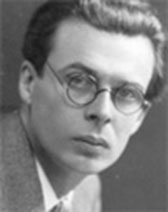
Aldous Huxley
English writer and philosopher known for Brave New World, Ape and Essence, The Doors of Perception, and Island. His writings examined technology, political power, social control, religion, and human consciousness.
Born on July 26, 1894
Died on November 22, 1963
Age at death: 69
Profession: Writer, Novelist
Place of Birth: Godalming, Surrey, England
Place of Death: Los Angeles, California, United States
Aldous Huxley (July 26, 1894 – November 22, 1963), born Aldous Leonard Huxley, was an English novelist, essayist, philosopher, poet, and screenwriter. He belonged to the Huxley family, whose members included scientists, educators, and writers. His best-known novel, Brave New World (1932), depicted a technologically controlled society in which reproduction, social hierarchy, and individual behavior were regulated by the state. His other works included Crome Yellow (1921), Point Counter Point (1928), Eyeless in Gaza (1936), Ape and Essence (1948), The Doors of Perception (1954), and Island (1962). Alongside fiction, he wrote extensively about religion, philosophy, science, literature, and the relationship between individual freedom and modern society. He moved to California in 1937 and spent the remainder of his life in the United States.
Early Life and Family Background
Aldous Huxley was born on July 26, 1894, at Laleham, a house near Godalming in Surrey, England. His father, Leonard Huxley, was a schoolmaster, writer, and editor of The Cornhill Magazine. His mother, Julia Arnold, was an educator who founded Prior's Field School in Surrey.
Huxley grew up in a family associated with British science and literature. His paternal grandfather, Thomas Henry Huxley, was a biologist who publicly defended the evolutionary theories of Charles Darwin. His maternal great-uncle was poet and literary critic Matthew Arnold.
His older brother Julian Huxley became an evolutionary biologist and later served as the first director-general of UNESCO. Another brother, Trevenen, died in 1914. His younger sister was Margaret Huxley. He also had two half-brothers from his father's second marriage, including physiologist Andrew Huxley, who shared the 1963 Nobel Prize in Physiology or Medicine.
Education and Loss of Sight
Aldous Huxley began his education at Prior's Field School and Hillside School, where his mother had been involved in teaching. He subsequently attended Eton College.
In November 1908, his mother died of cancer. Huxley was fourteen years old.
In 1911, while studying at Eton, he developed keratitis punctata, an inflammatory condition affecting the cornea. The illness left him almost completely blind for approximately eighteen months and permanently damaged his eyesight.
During his recovery, he learned Braille and typing. Although his vision gradually improved, he continued experiencing serious visual difficulties throughout his life.
The condition forced him to abandon his original intention of pursuing a scientific career. It also prevented him from entering military service during World War I.
In 1913, Huxley entered Balliol College at the University of Oxford, where he studied English language and literature. He graduated with first-class honors in 1916.
While at Oxford, he developed friendships with writers and intellectuals who later became associated with British literary modernism.
Early Literary Career
Aldous Huxley began his publishing career as a poet. His first collection, The Burning Wheel, appeared in 1916, followed by Jonah (1917) and The Defeat of Youth and Other Poems (1918).
After graduating from Oxford, he worked briefly as a teacher at Eton College, where one of his pupils was Eric Blair, who later wrote under the name George Orwell.
Huxley also worked as a journalist, literary critic, and editor. He contributed reviews and essays to British publications, developing an interest in the relationship between literature, politics, science, and social change.
He became associated with the literary circle surrounding Garsington Manor, the home of Lady Ottoline Morrell. There he encountered writers and artists including D. H. Lawrence, Bertrand Russell, and members of the Bloomsbury Group.
His first published novel, Crome Yellow (1921), was a satirical work portraying intellectual conversations and social relationships among guests at an English country house. The novel drew partly on his experiences of literary society and examined the attitudes of the educated British upper classes after World War I.
Marriage and Years in Europe
In July 1919, Aldous Huxley married Maria Nys, a Belgian woman whom he had met through the Garsington circle.
Their son, Matthew Huxley, was born in April 1920. He later became an anthropologist, author, and educator.
During the 1920s, the family spent considerable time living in Italy and traveling through Europe. These experiences influenced Huxley's writing, particularly his observations of European culture, religion, politics, and intellectual life.
His second novel, Antic Hay (1923), portrayed social and intellectual life in postwar London. It was followed by Those Barren Leaves (1925), which examined cultural and philosophical conflicts among a group of English expatriates in Italy.
In Point Counter Point (1928), Huxley developed a complex narrative involving multiple characters and interconnected relationships. The novel explored competing intellectual positions, scientific ideas, and personal conflicts.
His writing during this period increasingly addressed the limitations of rationalism, the relationship between sexuality and morality, and the social consequences of technological change.
Brave New World and Dystopian Fiction
In 1932, Aldous Huxley published Brave New World, a dystopian novel set in a future society organized around scientific management, genetic selection, psychological conditioning, and mass consumption.
Its fictional World State maintains social stability by controlling reproduction, assigning individuals to predetermined social classes, and encouraging the use of the drug soma to suppress dissatisfaction.
The novel examines the relationship between individual freedom and a society designed to provide comfort, pleasure, and economic stability.
Huxley drew on contemporary discussions of industrial production, behaviorism, eugenics, and the political implications of modern technology.
The book has frequently been compared with We by Yevgeny Zamyatin and Nineteen Eighty-Four by George Orwell. Although the three novels present different forms of authoritarian control, each explores the consequences of subordinating individual life to systems of political or technological power.
In 1958, Huxley returned to several of these subjects in Brave New World Revisited, a nonfiction work examining developments in propaganda, population growth, political persuasion, and social organization.
Later Novels and Philosophical Writing
Following Brave New World, Aldous Huxley continued experimenting with different literary forms and philosophical subjects.
His novel Eyeless in Gaza (1936) explored personal development, political commitment, pacifism, and the search for an ethical way of life.
In After Many a Summer Dies the Swan (1939), he examined scientific ambition, wealth, mortality, and the desire to extend human life.
Time Must Have a Stop (1944) combined a fictional narrative with discussions of spirituality, materialism, and human consciousness.
His 1948 novel Ape and Essence presented a post-apocalyptic world devastated by nuclear warfare. Set after a catastrophic global conflict, it portrayed the breakdown of social institutions and the development of violent religious and political structures.
Huxley's final novel, Island (1962), depicted the fictional island of Pala, whose society combined scientific knowledge, education, contemplative practices, and cooperative social institutions.
Unlike the dystopian world of Brave New World, the society of Island represented an alternative approach to organizing human life. The novel also examined the threats posed by economic interests, military power, and political intervention.
Move to California and Pacifism
In 1937, Aldous Huxley moved to the United States with his wife Maria and their son Matthew. They settled in southern California, where Huxley continued writing novels, essays, and screenplays.
He developed friendships with artists, spiritual teachers, and writers, including Christopher Isherwood, Gerald Heard, and Jiddu Krishnamurti.
Huxley also worked intermittently in Hollywood as a screenwriter. His screenwriting credits included Pride and Prejudice (1940) and Jane Eyre (1943).
During the late 1930s and 1940s, he became increasingly involved in pacifist thought and discussions concerning the ethical responsibilities of individuals during wartime.
Although he lived in the United States for the remainder of his life, he never became an American citizen. His unwillingness to make an unrestricted commitment to military service was among the obstacles affecting his naturalization application.
Vedanta and Eastern Philosophy
After settling in California, Aldous Huxley developed a sustained interest in Vedanta, Hindu philosophy, mysticism, and comparative religion.
He attended meetings and lectures organized by the Vedanta Society of Southern California and became acquainted with Hindu spiritual teacher Swami Prabhavananda.
His friendships with Christopher Isherwood and Gerald Heard also influenced his exploration of spiritual practices and religious traditions.
In 1945, he published The Perennial Philosophy, a collection of texts and commentary examining mystical and ethical teachings found in different religious traditions.
The book presented Huxley's argument that certain fundamental insights concerning spiritual experience appeared across major religious systems.
His later essays continued addressing the relationship between religious experience, consciousness, ethics, and the limitations of ordinary perception.
The Doors of Perception and Experiments with Mescaline
In 1953, Aldous Huxley participated in a supervised experiment involving mescaline, a psychoactive compound naturally found in certain cactus species.
The experience was arranged with psychiatrist Humphry Osmond, who was researching the psychological effects of hallucinogenic substances.
Huxley described changes in his perception of color, form, space, and ordinary objects during the experiment.
His observations became the basis of The Doors of Perception, published in 1954.
The book took its title from a passage in The Marriage of Heaven and Hell by poet and artist William Blake.
Huxley examined the possibility that ordinary human consciousness filters sensory information and that altered states might change the way individuals experience their surroundings.
He continued exploring these subjects in Heaven and Hell (1956), which discussed visionary experiences, art, and the psychology of perception.
His writing later became associated with the counterculture of the 1960s. The American rock band The Doors, whose members included Jim Morrison and Ray Manzarek, took its name from the title of Huxley's book and its reference to Blake.
Huxley also experimented with LSD during the later years of his life. His writings about psychoactive substances primarily concerned their relationship to perception, consciousness, and religious experience rather than recreational drug culture.
Second Marriage and Final Years
In February 1955, Aldous Huxley's wife Maria Nys died of breast cancer.
In March 1956, he married Laura Archera, an Italian-born violinist, writer, and psychotherapist.
Laura later documented aspects of their relationship and Huxley's final years in This Timeless Moment, published in 1968.
In 1960, Huxley was diagnosed with cancer of the larynx. Despite his illness, he continued writing and giving lectures whenever his health permitted.
His final novel, Island, was published in 1962. He also completed Literature and Science, published in 1963, which examined the relationship between scientific knowledge and literary expression.
During his final months, Huxley's health deteriorated, and he remained under medical care at his home in California.
Death
Aldous Huxley died on November 22, 1963, in Los Angeles, California, at the age of 69.
He died on the same day that United States President John F. Kennedy was assassinated in Dallas, Texas, and British writer C. S. Lewis died in Oxford, England.
According to an account later published by Laura Archera Huxley, he requested LSD during his final hours. She administered the substance under the circumstances he had described while he was dying of cancer.
His remains were cremated, and his ashes were later interred in the family grave at Compton Cemetery in Surrey, England.
Works
Novels:
1921 – Crome Yellow
1923 – Antic Hay
1925 – Those Barren Leaves
1928 – Point Counter Point
1932 – Brave New World
1936 – Eyeless in Gaza
1939 – After Many a Summer Dies the Swan
1944 – Time Must Have a Stop
1948 – Ape and Essence
1955 – The Genius and the Goddess
1962 – Island
Short Stories and Collections:
1920 – Limbo
1922 – Mortal Coils
1924 – Little Mexican and Other Stories
1926 – Two or Three Graces
1930 – Brief Candles
1957 – Collected Short Stories
1998 – Jacob's Hands: A Fable (Written with Christopher Isherwood in the 1940s; published posthumously)
Poetry:
1916 – Oxford Poetry (Co-editor)
1916 – The Burning Wheel
1917 – Jonah
1918 – The Defeat of Youth and Other Poems
1920 – Leda
1925 – Selected Poems
1929 – Arabia Infelix and Other Poems
1931 – The Cicadas and Other Poems
1971 – Collected Poems (Posthumous collection)
Selected Essays and Nonfiction:
1923 – On the Margin
1926 – Essays New and Old
1926 – Jesting Pilate
1927 – Proper Studies
1937 – Ends and Means
1942 – The Art of Seeing
1945 – The Perennial Philosophy
1952 – The Devils of Loudun
1954 – The Doors of Perception
1956 – Heaven and Hell
1958 – Brave New World Revisited
1963 – Literature and Science
Source: Biyografiler.com
Frequently asked questions about Aldous Huxley
Who is Aldous Huxley?, Aldous Huxley biography, Aldous Huxley life story, Aldous Huxley age, Aldous Huxley facts, Aldous Huxley birthplace, Aldous Huxley photos, Aldous Huxley videos, Aldous Huxley career
Related Biographies

Lamine Yamal
Professional footballer

Kylian Mbappe
Professional footballer

Keanu Reeves
Actor

Erling Haaland
Professional footballer

Brad Pitt
Actor

Leonardo DiCaprio
Actor

Anton Dvorak
Composer

Antoine Lavoisier
Chemist

Antoine Bourdelle
Sculptor

Anthony van Dyck
Painter

Anthony Stewart Head
Actor, Singer

Antoni Gaudi
Architect

Susie Wiles
Political Consultant

Gadi Eisenkot
Politician, Military Commander

Elizabeth Taylor
Actress

Alberto Ascari
Formula 1 Driver

Michael Jordan
Professional Basketball Player
Antoine Bourdelle
Sculptor