
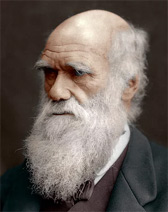
Charles Darwin
The Father of Evolutionary Biology
Born on February 12, 1809
Died on April 19, 1882
Age at death: 73
Profession: Naturalist, Biologist
Place of Birth: Shrewsbury, United Kingdom
Place of Death: London, United Kingdom
Charles Robert Darwin was an English naturalist who lived between 12 February 1809 and 19 April 1882. He was a scientist who left a profound mark on biological science with his theories of natural selection and evolution. Modern evolutionary theory, which forms the foundation of contemporary biology, was developed based on Darwin’s ideas.
Charles Darwin was born on 12 February 1809 in Shrewsbury as the fifth of six children of Robert Darwin and Susannah Darwin. On his father’s side, he was the grandson of Erasmus Darwin, and on his mother’s side, the grandson of Josiah Wedgwood. Both families preferred the Unitarian belief; however, Darwin himself adopted an agnostic worldview.
He lost his mother on 15 June 1817. One year later, he began his education at the Shrewsbury School.
In the summer of 1825, Darwin assisted his father, who was treating poor people in Shropshire. In the autumn of the same year, he began his education at the University of Edinburgh in Scotland. He could not adapt to medical school, as he found surgical operations cruel. At the university, he learned the art of taxidermy from John Edmonstone, a former enslaved man who worked there. Edmonstone told Darwin fascinating stories about the South American rainforests. Darwin later benefited from these experiences in his book The Descent of Man, and Selection in Relation to Sex, where he argued that despite different physical appearances, Black people and Europeans were closely related.
In 1822, together with his brother, Darwin established a chemistry laboratory. Through this laboratory, he learned the principles of scientific experimentation.
In his second year at university, he joined a group interested in natural history. There, he learned about the evolutionary theory of Jean-Baptiste Lamarck and studied marine organisms with his teacher Robert Edmund Grant. During these studies, Darwin discovered “homology,” meaning that completely different species could possess organs with the same basic structure. He also took lessons on plant classification from Robert Jameson and helped organize the plant collection of the Edinburgh Royal Museum, one of the largest museums in Europe.
In 1827, his father withdrew Darwin from medical school and enrolled him at Christ’s College, University of Cambridge, for theological education. Although he was more successful there than in medical school, he preferred horse riding and shooting to his studies. During this period, he began collecting beetles with his cousin William Darwin Fox.
In 1828, he met botany professor John Stevens Henslow, with whom he formed a close friendship. Thanks to the courses he took from Henslow, Darwin successfully graduated in 1831. On 21 February 1829, he met the famous entomologist Frederick Hope, spending long days discussing insects. Hope gave Darwin more than one hundred species for his collection.
Due to residency obligations, Darwin stayed in Cambridge until June. Following the advice and example of his teacher Henslow, he decided not to rush into a religious career.
In 1831, Henslow introduced Darwin to Robert FitzRoy, captain of the British Royal Navy ship HMS Beagle. The ship was to embark on a two-year voyage to South America in December 1831, and Captain FitzRoy wanted a capable naturalist to accompany him. On Henslow’s recommendation, Darwin was accepted onto the ship.
On 6 January 1832, the ship arrived at the port of Santa Cruz on the island of Tenerife. However, due to a cholera outbreak in England, the crew was not allowed to go ashore and was kept under quarantine on the ship for twelve days.
Although the voyage was planned to last two years, it ultimately lasted five years. During this journey, Darwin discovered and collected numerous species, geological formations, and fossils. He periodically sent information and specimens to Cambridge, and although he was not physically present, his reputation spread among naturalists. The letters he wrote to his family about the journey were later published as The Voyage of the Beagle.
The journey was very challenging for Darwin. He struggled with seasickness and febrile illnesses throughout the voyage. In July 1834, while returning from the Andes Mountains to Valparaiso, he fell ill and was confined to bed for nearly a month.
At the beginning of the journey, Captain FitzRoy gave Darwin Charles Lyell’s book Principles of Geology, which argued that geological formations reached their present state through very long and gradual processes. Through his discoveries during the voyage, Darwin confirmed the accuracy of these ideas. His observations in Chile showed that earthquakes and volcanic activity had uplifted land that was once under the sea. On the slopes of the Andes, he found fossils of trees and plants that once grew on sandy beaches.
On 2 October 1836, after a journey lasting four years, nine months, and five days, HMS Beagle returned to England. Darwin arrived home on 4 October 1836. He spent the winter of 1836 organizing the vast collection of specimens he had gathered.
4 January 1837 was a very important day for Darwin. On that date, he delivered his first lecture before the Royal Geological Society in London. The topic was the geological history of South America, and he shared the knowledge he had gained during his voyage. His presentation attracted great interest from all the scientists in attendance.
On 6 March 1837, Darwin moved to London with his brother. Over the following weeks, his brother introduced him to prominent scientists, including Charles Babbage, the inventor of the first calculating machine. Babbage introduced Darwin to the idea that all events in nature were governed by fixed laws, which directed Darwin toward discovering natural laws behind the transformation of species. During this time, ornithologist John Gould examined the birds Darwin had brought from the Galapagos Islands and determined that they were not wrens or blackbirds, as Darwin had thought, but different species of finches.
Among the fossils Darwin discovered were sloth-like mammals, a hippopotamus-like herbivore, and an armadillo-like armored mammal. He realized that these animals anatomically resembled South American animals rather than African ones. During this period, a group of scientists, including his former teacher Robert Edmund Grant and Dr. James Gully, explored the idea that species could transform into one another, despite being accused of heresy and irreligion.
Darwin spent the summer of 1837 contemplating changes in species and trying to understand how certain plants and animals found on continents could also be present on distant oceanic islands. He developed new ideas about the transformation of species together with his brother.
In September 1837, due to stress and excessive work, Darwin began experiencing heart problems. He took a short break and went to Shrewsbury, where he spent much of his time with his cousin Emma Wedgwood.
In February 1838, he published the first volume of the journals he had begun writing aboard HMS Beagle. In the same month, he became vice president of the Entomological Society. On 28 March 1838, he became fascinated by a newly arrived orangutan named Jenny at the London Zoo, spending hours observing her emotional similarities to a young child.
In the summer of 1838, Darwin began considering marriage. Although he feared it would reduce his productivity, the idea of companionship appealed to him. With his father’s approval, he married his cousin Emma on 29 January 1839.
In June 1838, his health problems worsened, particularly affecting his heart and stomach. He traveled to Scotland for rest, where he studied the famous “Parallel Roads.”
On 27 December 1839, his first child, William Erasmus Darwin, was born. Much of 1840 was spent bedridden due to illness. On 2 March 1841, his second child, Anne Elizabeth Darwin, was born.
In May 1842, his research series The Structure and Distribution of Coral Reefs was published. That same year, Darwin wrote essays on species change and natural selection, grounding the formation of natural laws in religion.
On 23 September 1842, Mary Eleanor Darwin was born but died on 18 October. Henrietta Darwin was born on 25 September 1843. That same year, Darwin completed his Beagle voyage series, consisting of five sections: Fossils, Mammals, Birds, Fish, and Reptiles.
In the autumn of 1844, he began writing Geological Observations on South America, completing it in September 1846. His children George Darwin, Elizabeth Darwin, and Francis Darwin were born in 1845, 1847, and 1848 respectively.
On 13 November 1848, his father Robert Darwin died. Due to severe illness, Darwin could not attend the funeral. After recovering, he resumed his research. In January 1850, his eighth child, Leonard Darwin, was born.
Darwin conducted experiments on how species spread over wide geographical areas, discovering that seeds could survive long periods in water and still germinate. His children Horace Darwin and Charles Waring Darwin were born in 1851 and 1856; Charles Waring died in 1858.
In 1853, Darwin was awarded a medal by the Royal Society for his research on barnacles. From that point on, he became known as a biologist rather than a geologist. He observed that barnacles could undergo small changes in response to changing conditions.
On 22 November 1859, On the Origin of Species was published and sold out on its first day. In 1860, biologist Thomas Henry Huxley first used the term “Darwinism.” By 1867, Darwin’s evolutionary theory had spread across Europe.
In March 1871, The Descent of Man was published and received great interest. In July 1875, Insectivorous Plants was released.
Suffering increasing health problems from the beginning of 1880, Charles Robert Darwin died in London on 19 April 1882 following a heart attack.
Throughout his life, Charles Robert Darwin made immense contributions to science. Although most closely associated with the theory of evolution, he played a pioneering role in the development and foundation of many interconnected scientific disciplines. His evolutionary theory continues to be developed today by fields such as paleontology, genetics, and embryology.
Source: Biyografiler.com
Frequently asked questions about Charles Darwin
Who is Charles Darwin?, Charles Darwin biography, Charles Darwin life story, Charles Darwin age, Charles Darwin facts, Charles Darwin birthplace, Charles Darwin photos, Charles Darwin videos, Charles Darwin career

Lamine Yamal
Professional footballer

Erling Haaland
Professional footballer

Austin Abrams
Actor

Keanu Reeves
Actor

Kylian Mbappe
Professional footballer

Bad Bunny
Rapper, Songwriter


Hongjoong
Singer, Rapper, Songwriter, Composer

Ludacris
Rapper, Actor

Kwon Eunbi
Singer

Sarah Wayne Callies
Actress, Screenwriter, Producer, Director

LaTavia Roberson
Singer, Actress, Entrepreneur
Keanu Reeves
Actor

Demi Moore
Actress

Leonardo DiCaprio
Actor

Kim Jong-un
Politician
Bad Bunny
Rapper, Songwriter

Haruki Murakami
Novelist, Writer