
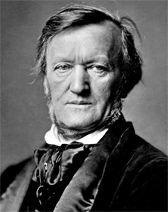
Vilhelm Richard Wagner
“The Composer of the Music of the Future”
Born on May 22, 1813
Died on February 13, 1883
Age at death: 70
Profession: Composer
Place of Birth: Leipzig, Germany
Place of Death: Venice, Italy
Wilhelm Richard Wagner was a famous German composer, born on May 22, 1813, in Leipzig, Germany, shortly after the beginning of the Wars of Liberation against Napoleon Bonaparte and only a few months before the Battle of the Nations.
Richard Wagner’s father, Friedrich Wagner, was a police officer who died shortly before Richard was born. His stepfather, Ludwig Geyer, was an actor, painter, and playwright. Geyer frequently took young Richard to theater rehearsals and, after finishing his own role, performed pantomimes on the wooden stage based on fairy tales he had told Richard the night before. Wagner would later be profoundly influenced by his stepfather in his artistic life.
When Wagner began school, he translated the first twelve books of Homer’s Odyssey entirely on his own. Translating six thousand lines of Homeric Greek was no small task for a thirteen-year-old child. A year earlier, he had started taking piano lessons but did not show exceptional talent. His first major musical inspiration came from hearing a symphony by Ludwig van Beethoven at one of the Gewandhaus concerts. Deeply moved, Wagner told his family that he wanted to become a musician and decided to set one of his own tragedies to music.
Resuming music lessons, Wagner composed an overture that was performed during intermissions at the theater where his stepfather worked. The piece attracted considerable attention from audiences.
In 1830, Wagner entered Leipzig University. He longed to see Vienna, renowned as a city of music, but upon arriving there and finding theaters and concert halls dominated by what he considered shallow and exaggerated works such as Zampa, he quickly left the city. His growing fascination with ancient Scandinavian legends led him toward fantastical subjects. During this period, he also studied ancient Greek tragedies and articulated his artistic theories in his book The Artwork of the Future.
In 1834, Wagner completed his first opera, Die Feen. Filled with magicians, caves, fairies, and mysteries, the work reflected his obsession with fire, which appeared frequently in the opera. The score circulated for some time before being shelved and was not staged until five years after Wagner’s death.
While working as an opera director in Magdeburg, Wagner married actress Wilhelmina Planer, marking his first marriage.
In 1836, Wagner composed another opera, Das Liebesverbot (The Ban on Love). Given only ten days for preparation, the production ended in complete failure, as none of the performers had adequately memorized their roles. The following year, Wagner accepted a position as music director at the Riga Theater in the Baltic state capital. There he began composing the grand and lengthy opera Rienzi. When his contract ended, the work was still unfinished, and mounting debts forced the Wagner family to leave Riga.
Rienzi premiered in Dresden in 1842 and achieved great success. Wagner then began working on his second opera, Der Fliegende Holländer (The Flying Dutchman), and was appointed conductor of the Dresden Court Orchestra.
Tannhäuser was presented in 1845 and Lohengrin in 1848, but neither received the acclaim Wagner had hoped for. A troubled and restless period followed, marked by constant wandering.
Between 1848 and 1849, Wagner became involved in revolutionary political movements in Germany. His participation in the Saxon uprising against the government led to a warrant for his arrest. Wagner fled to Zurich, then traveled to Paris and later to Bordeaux.
During his years in Zurich, Wagner fell in love with a friend’s wife. This forbidden relationship inspired the opera Tristan und Isolde.
In 1859, at the request of the Austrian Emperor, Wagner agreed to stage Tannhäuser at the Paris Opera. Opponents of the Emperor sabotaged the production, and a disillusioned Wagner returned to Vienna.
In 1864, exhausted by debt, Wagner was invited to Munich by King Ludwig II of Bavaria. Welcomed with great enthusiasm, he staged Tristan und Isolde there.
In 1866, Wagner’s wife died, and three years later he remarried. That same year, Wagner and his wife Cosima Wagner had a son named Siegfried Wagner, whose full name was Helferich Siegfried Richard.
In 1876, Wagner’s long-held dream of building a dedicated opera house was realized in the German city of Bayreuth. Supported by admirers from around the world as well as kings and princes, Wagner established the Bayreuth Festival Theatre.
Only one final opera remained to be composed: Parsifal. It was staged in Bayreuth one year before Wagner’s death.
Richard Wagner died on February 13, 1883, at the age of seventy, in Venice, Italy, due to blocked blood vessels in the heart.
Wagner expressed the German spirit through richly colored musical tones and rejected traditional Italian operatic forms. Instead, he created what he called “music drama,” a form in which music followed the words rather than forcing words to fit the music. His fame did not flare briefly and fade; it spread slowly across Germany and eventually beyond its borders. The description of Wagner’s work as “the music of the future” was by no means unfounded.
Source: Biyografiler.com
Frequently asked questions about Vilhelm Richard Wagner
Who is Vilhelm Richard Wagner?, Vilhelm Richard Wagner biography, Vilhelm Richard Wagner life story, Vilhelm Richard Wagner age, Vilhelm Richard Wagner facts, Vilhelm Richard Wagner birthplace, Vilhelm Richard Wagner photos, Vilhelm Richard Wagner videos, Vilhelm Richard Wagner career
Related Biographies

Lamine Yamal
Professional footballer

Erling Haaland
Professional footballer

Sam Altman
Entrepreneur, Investor, CEO

Kylian Mbappe
Professional footballer

Giorgia Meloni
Politician, Journalist

Alice Weidel
Politician, Economist


Hongjoong
Singer, Rapper, Songwriter, Composer

Ludacris
Rapper, Actor

Kwon Eunbi
Singer

Sarah Wayne Callies
Actress, Screenwriter, Producer, Director

LaTavia Roberson
Singer, Actress, Entrepreneur
Lamine Yamal
Professional footballer

Elena Andreyevna Rybakina
Professional Tennis Player
Alice Weidel
Politician, Economist

Sydney Sweeney
Actress

Alex Krizhevsky
Computer Scientist
Sam Altman
Entrepreneur, Investor, CEO