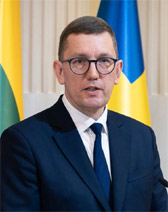
Kristen Michal
Liberal Estonian politician who rose through party management, parliament and three ministerial portfolios to become prime minister
Born on July 12, 1975
Age: 51
Profession: Politician, Lawyer
Place of Birth: Tallinn, Estonia
Kristen Michal was born on July 12, 1975, in Tallinn, Estonia. An Estonian politician and lawyer, Kristen Michal has served as Prime Minister of Estonia since July 23, 2024. A longtime member of the liberal Estonian Reform Party, he previously served as minister of justice, minister of economic affairs and infrastructure, and minister of climate. His premiership has been shaped by Estonia’s economic recovery, fiscal reform, digital government, energy security, rapidly expanding defence expenditure and continued support for Ukraine against Russia.
Early Life and Education
Kristen Michal was born and raised in Tallinn during the period when Estonia was part of the Soviet Union. He reached adulthood as the country restored its independence and began transforming its political institutions, economy and relationship with Europe.
His educational background developed across economics, public administration and law. In 1994, Kristen Michal studied economics at I Studium. Between 1994 and 1999, he studied administrative management at Tallinn University, gaining knowledge of public institutions and organizational administration.
In 2009, Kristen Michal graduated from University Nord with a degree in law. From 2010 to 2014, he pursued law studies at the master’s level at Tallinn University. His legal education later supported his work in parliament and his appointment as minister of justice.
Kristen Michal speaks Estonian as his native language and also speaks English, Finnish, German and Russian. His language skills have been important in European negotiations, regional diplomacy and Estonia’s cooperation with Nordic and Baltic partners.
Entry into the Estonian Reform Party
Kristen Michal joined the Estonian Reform Party in 1996. Founded by former prime minister Siim Kallas, the party promoted economic liberalism, lower taxation, private enterprise, European integration and the modernization of public administration.
His first political position was as an adviser to the Reform Party group in the Tallinn City Council. Between 1996 and 1999, Kristen Michal assisted local representatives with policy preparation, political communication and municipal decision-making.
From 1999 to 2001, he served as an adviser to the Reform Party faction in the Riigikogu, Estonia’s national parliament. This role introduced him to legislative procedures and the internal organization of national politics before he became an elected representative.
Tallinn City Politics
Kristen Michal was elected to the Tallinn City Council in 1999 and remained involved in municipal politics during multiple periods of his career. His local political experience included questions involving urban administration, public services, budgeting and relations between the capital and the national government.
Between 2001 and 2002, he worked as an adviser to the minister responsible for regional affairs and served as head of the minister’s office. This position gave him experience in local-government policy and administrative coordination across Estonia.
In 2002, Kristen Michal became an adviser to Prime Minister Siim Kallas. Later that year, he was appointed elder of Tallinn’s central district, Kesklinn, which includes the historic old town, government institutions and major commercial areas.
As district elder from 2002 to 2003, Kristen Michal gained direct executive experience in local administration. The role included responsibility for municipal services, district development and communication with residents and businesses.
Secretary General of the Reform Party
In 2003, Kristen Michal became secretary general of the Estonian Reform Party. He held the position until 2011 and became one of the party’s most influential organizational figures.
As secretary general, Kristen Michal was responsible for daily party administration, campaign preparation, finances, membership organization and coordination between local branches and national leaders. He played an important role in elections and in maintaining the party’s position as one of Estonia’s leading political organizations.
His tenure coincided with governments led by Juhan Parts, Andrus Ansip and other senior figures of Estonia’s post-independence political system. The Reform Party increasingly established itself as a dominant force in national government, particularly after Andrus Ansip became prime minister in 2005.
The position gave Kristen Michal detailed knowledge of political strategy and party organization. It also connected him closely with the controversies surrounding campaign financing and the relationship between political parties, private donors and electoral expenditure.
First Period in Parliament
Kristen Michal entered the Riigikogu in 2004. As a member of parliament, he worked on legislation involving government administration, law, economic policy and public institutions.
His parliamentary career developed alongside his work as Reform Party secretary general. This combination placed him both inside the legislative process and at the centre of the party organization supporting the government.
Kristen Michal became known as a disciplined political operator with extensive knowledge of parliamentary procedure, coalition negotiations and campaign management. Although he was not initially among the party’s most visible public figures, his organizational influence continued to grow.
Minister of Justice
In April 2011, Prime Minister Andrus Ansip appointed Kristen Michal Minister of Justice. The appointment moved him from party administration into a major cabinet position responsible for the legal system and the development of government legislation.
As minister, Kristen Michal dealt with criminal and civil law, judicial administration, legislative quality and the functioning of state institutions. He supported greater use of digital services and the modernization of procedures within Estonia’s already highly developed electronic government.
His legal background helped him address complex questions involving the courts and government regulation. His ministerial period was nevertheless dominated by a political-financing controversy that became one of the most difficult episodes of his career.
The Reform Party Financing Controversy
In 2012, former Reform Party member Silver Meikar alleged that party officials had used individuals to make donations with money whose true source was concealed. The claims led to a criminal investigation into possible illegal party financing and money laundering.
Kristen Michal, who had served as the party’s secretary general during part of the period under examination, was questioned and formally treated as a suspect. He denied involvement in illegal financing and rejected allegations that he had organized or approved a concealed donation system.
The investigation was closed in October 2012 because prosecutors stated that they lacked sufficient evidence to establish criminal responsibility. No criminal charge was brought against Kristen Michal.
The closure of the case did not end the political controversy. Public confidence in his explanations remained low, and opposition parties continued to demand his departure. In December 2012, Kristen Michal resigned as minister of justice, saying that he wanted to protect the functioning of the government and the Reform Party.
The scandal, widely known in Estonia as Silvergate, remained attached to his public image even after the investigation ended without charges. Supporters emphasized that no wrongdoing had been proven, while critics argued that the episode revealed broader weaknesses in political transparency and party financing.
Return to Parliament
After leaving the Ministry of Justice, Kristen Michal returned to parliamentary work. From 2012 to 2015, he served as a member of the 12th Riigikogu.
His return demonstrated that the financing controversy had damaged but not ended his political career. He continued to hold influence within the Reform Party and gradually rebuilt his position through legislative work.
During this period, Estonia was addressing slow economic growth, regional security concerns and the consequences of Russia’s annexation of Crimea in 2014. The changing security environment strengthened support for closer cooperation with the European Union and NATO.
Minister of Economic Affairs and Infrastructure
In April 2015, Kristen Michal returned to the cabinet as Minister of Economic Affairs and Infrastructure in the government led by Taavi Rõivas.
The portfolio included transport, energy, construction, communications and several areas of economic development. Kristen Michal worked on infrastructure investment, public transportation, energy policy and Estonia’s international economic competitiveness.
He supported the development of digital services and infrastructure capable of connecting Estonia more closely with European markets. Projects involving rail, ports, electricity networks and digital communications were viewed as both economic and strategic priorities.
Energy security became particularly important after the deterioration of relations with Russia. Kristen Michal supported measures intended to reduce Estonia’s dependence on Russian energy systems and strengthen links with other European countries.
He remained in office until November 2016, when the government of Taavi Rõivas lost parliamentary support and was replaced by a coalition led by Jüri Ratas.
Parliamentary Committee Leadership
After leaving the government, Kristen Michal again concentrated on parliamentary work. He served in the 13th and 14th Riigikogu between 2016 and 2021.
He chaired and participated in committees dealing with economic policy, national administration and security. His experience as a former justice and economy minister made him an influential voice in the Reform Party’s legislative strategy.
During the party’s years in opposition, Kristen Michal remained closely involved in internal planning. He supported efforts to restore the Reform Party to government and worked with leading figures including Kaja Kallas, who became party leader in 2018.
Return of the Reform Party to Government
The Reform Party returned to government in January 2021 under Prime Minister Kaja Kallas. Kristen Michal remained an experienced figure within the party and continued to participate in national political planning.
The government faced the COVID-19 pandemic, inflation, energy-market disruption and growing security pressure from Russia. These challenges increasingly connected economic policy, environmental reform and national defence.
Russia’s full-scale invasion of Ukraine in February 2022 fundamentally changed Estonia’s strategic priorities. Estonia became one of Ukraine’s strongest supporters relative to the size of its population and economy, while seeking greater NATO deployments and faster European defence investment.
Minister of Climate
Following the 2023 parliamentary election, Kaja Kallas formed a coalition involving the Estonian Reform Party, Estonia 200 and the Social Democratic Party. Kristen Michal was appointed Minister of Climate in April 2023.
The newly structured ministry combined responsibilities involving climate policy, energy, transport, environmental protection and parts of the green economic transition. Kristen Michal was therefore responsible for a portfolio that connected industrial competitiveness with Estonia’s climate and security objectives.
He argued that environmental policy had to consider the availability and affordability of energy. Estonia was attempting to reduce the use of oil shale while ensuring that industries and households had access to reliable electricity.
Kristen Michal supported renewable energy development, improved electricity connections and investment in transport infrastructure. He also emphasized that the green transition could not succeed without public acceptance and economically realistic implementation.
Selection as Candidate for Prime Minister
In June 2024, European Union leaders nominated Kaja Kallas to become High Representative of the European Union for Foreign Affairs and Security Policy. Her departure created the need for the Reform Party to select a new head of government.
The party leadership chose Kristen Michal as its candidate for prime minister. His long experience in party organization, parliament and three different ministries made him a figure capable of maintaining continuity within the existing coalition.
President Alar Karis formally asked Kristen Michal to form a government in July 2024. The Riigikogu authorized him to establish the new administration, and the cabinet was sworn into office on July 23, 2024.
First Michal Government
The first government led by Kristen Michal continued the coalition of the Estonian Reform Party, Estonia 200 and the Social Democratic Party. It maintained the pro-European, pro-NATO and strongly pro-Ukrainian direction of the previous administration.
The government inherited difficult economic conditions. Estonia had experienced repeated quarters of economic contraction, while exports were affected by weak demand in important trading partners and changes in the energy sector.
Kristen Michal identified economic growth as one of his administration’s central objectives. His government also needed to reduce the budget deficit and finance rapidly increasing defence expenditure.
The coalition considered higher taxation, spending controls and administrative reform. These measures generated criticism from opposition parties and citizens concerned about living costs, purchasing power and the effect of taxes on businesses.
Support for Ukraine
From the beginning of his premiership, Kristen Michal declared that Estonia would continue supporting Ukraine for as long as necessary. He viewed Russia’s invasion not only as an attack on Ukraine but also as a direct threat to the security of Estonia and Europe.
His government continued military, financial and political assistance and supported Ukraine’s eventual membership in the European Union and NATO. Estonia also committed a substantial share of its national income to long-term military support.
Kristen Michal argued that Ukraine needed enough equipment and ammunition to defend itself and negotiate from a position of strength. He rejected peace arrangements that would reward territorial conquest or leave Russia capable of renewing the war later.
His government has also supported the use of frozen Russian state assets for Ukraine’s defence and reconstruction. Kristen Michal maintains that Russia should bear the financial consequences of the destruction caused by its invasion.
Defence Policy and the Russian Threat
Estonia shares a border with Russia and has treated the strengthening of national defence as an urgent priority. Kristen Michal supports large-scale investment in ammunition, air defence, drones, long-range weapons, infrastructure and military personnel.
His government initially committed Estonia to raising defence expenditure to at least five percent of gross domestic product. By 2026, Estonia was spending more than five percent of GDP on core defence and additional resources on wider security and resilience.
Kristen Michal has urged other NATO members to make similar investments. He argues that collective defence commitments must be supported by forces, weapons and industrial production rather than political declarations alone.
His administration has supported the expansion of Estonia’s defence industry and the acquisition of new armoured vehicles, ammunition and air-defence capabilities. It also promotes cooperation among the Baltic and Nordic states.
Kristen Michal views the permanent presence of allied forces in Estonia as essential to deterrence. He supports stronger NATO defence plans for the Baltic region and rapid reinforcement capabilities that would make aggression against Estonia militarily unsuccessful.
Coalition Dispute and the Departure of the Social Democrats
Relations within the original three-party coalition deteriorated over taxation, spending and the pace of economic reform. The Reform Party and Estonia 200 favored a more market-oriented program, while the Social Democratic Party resisted several tax and welfare-policy changes.
In March 2025, Kristen Michal announced that the Social Democrats would leave the government. The decision ended the three-party coalition and left the Reform Party and Estonia 200 with a narrow parliamentary majority.
Kristen Michal argued that the government needed to make urgent decisions on economic growth, taxation, defence and administrative reform without repeatedly reopening previously negotiated policies.
Social Democratic leaders accused the prime minister of shifting the government further to the economic right and weakening protections for workers and lower-income households. The change became an important turning point in the ideological direction of his premiership.
The Reform Party–Estonia 200 Government
A renewed coalition agreement between the Estonian Reform Party and Estonia 200 was signed in March 2025. The restructured government placed security, economic growth and administrative efficiency at the centre of its program.
The coalition committed itself to defence expenditure of at least five percent of GDP, continued support for Ukraine and the strengthening of NATO’s presence in the region.
In economic policy, the government promised a more business-friendly and predictable tax system, fewer reporting obligations and the removal of unnecessary regulation. It also sought to encourage investment in industries producing greater technological and economic value.
Kristen Michal described the new coalition as more capable of taking rapid decisions. Critics argued that its narrow majority made the government vulnerable to internal disagreements and reduced the range of political interests represented in the cabinet.
Leadership of the Reform Party
After Kaja Kallas left national politics for her European Union role, Kristen Michal became leader of the Estonian Reform Party in 2024. The position formally placed him in control of both the government and the country’s largest governing party.
He was reelected as party chairman in June 2025. His leadership has emphasized national security, economic liberalism, technological innovation and administrative reform.
Kristen Michal has also faced the challenge of rebuilding public support for a party that had been in government for much of Estonia’s post-independence history. Tax increases, economic weakness and political fatigue reduced the Reform Party’s popularity during parts of his premiership.
Economic Policy
Kristen Michal supports a market-oriented economic model based on private investment, exports, technological development and limited bureaucracy. His government aims to move Estonia toward industries with higher productivity and greater added value.
The administration has focused on information technology, defence production, energy, engineering and digitally enabled services. It also seeks to improve the conditions faced by start-ups and internationally active Estonian businesses.
Estonia’s small domestic market makes exports essential to economic growth. Kristen Michal has therefore emphasized transport, energy and data links with Finland, Latvia, Sweden and the wider European market.
His government has attempted to balance economic stimulus with the need to finance defence and control the budget deficit. This has produced difficult decisions involving taxation, public-sector expenditure and the timing of social benefits.
Taxation and Public Spending
Tax policy became one of the most controversial areas of the premiership of Kristen Michal. Estonia needed additional revenue for defence, public services and budget stabilization while households were already facing higher prices.
The government supported changes involving consumption, income and business taxation. It also examined spending reductions and the consolidation of administrative functions.
Kristen Michal argued that Estonia could not finance long-term security through temporary measures alone. A sustainable defence system required stable national revenue and clear spending priorities.
Opposition parties accused his government of transferring too much of the financial burden to ordinary consumers. The administration responded that failing to invest in defence would create far greater economic and human risks.
Energy Security and Climate Policy
Kristen Michal views energy policy as both an economic and national-security issue. Estonia has reduced its dependence on Russian energy and synchronized its electricity system more closely with continental Europe.
His government supports renewable electricity, storage, stronger regional connections and the modernization of energy networks. It also recognizes that Estonia must maintain reliable generation during periods when wind and solar production are insufficient.
The future of oil shale remains politically sensitive. The industry has historically provided electricity and employment, particularly in Ida-Viru County, but it also produces substantial greenhouse-gas emissions.
Kristen Michal supports a gradual transition that protects energy security and creates new employment opportunities. Critics from environmental organizations call for faster change, while industrial groups warn that rapid restrictions could raise prices and weaken competitiveness.
Digital Government
Estonia is internationally recognized for digital identification, online public services, electronic taxation and internet voting. Kristen Michal supports the continued expansion of this digital-state model.
His government aims to reduce the amount of information that citizens and companies must repeatedly provide to state institutions. Public databases are expected to exchange information securely so that data is submitted once rather than through multiple administrative procedures.
Kristen Michal argues that digitalization should reduce bureaucracy and allow public officials to concentrate on services requiring human judgment. Cybersecurity and accountability remain central because digital systems also create new vulnerabilities.
Artificial Intelligence and AI Identities
In 2026, the government of Kristen Michal advanced plans to create official digital identities for artificial-intelligence agents. The proposed system would allow AI tools to act on behalf of individuals, companies or institutions under clearly limited and auditable authority.
An AI agent could, for example, be authorized to view selected data, prepare a declaration or create a payment without receiving unrestricted access to all of a user’s information and digital rights.
Kristen Michal has argued that the system could extend the principles of Estonia’s digital identity infrastructure into the age of artificial intelligence. Accountability would remain connected to a clearly identifiable person or organization.
The initiative reflects his wider belief that Estonia must remain an early developer of new digital standards. His government has also promoted testing environments for drones, autonomous systems and dual-use technologies connected to civilian and defence applications.
European Union Policy
Kristen Michal is strongly supportive of Estonia’s membership in the European Union. He views European integration as essential to the country’s economic prosperity, security and international influence.
He supports the development of stronger cross-border transport, energy and data connections. In his view, these links are not only economic infrastructure but also tools that increase Europe’s strategic resilience.
Kristen Michal favors a more competitive European economy with simpler regulation, deeper capital markets and greater investment in technology and defence. He argues that Europe must be able to produce more of the critical equipment and digital capabilities on which its security depends.
His government also supports further European Union enlargement, particularly the accession of Ukraine and other countries that meet democratic and legal requirements.
NATO and Transatlantic Relations
Kristen Michal considers NATO the foundation of Estonia’s national security. The country’s defence strategy depends on its own military readiness combined with credible allied commitments.
He supports close relations with the United States and believes that American military capabilities remain essential to European security. At the same time, Kristen Michal argues that European NATO members must take greater responsibility for financing and producing their own defence.
At the 2026 NATO summit in Ankara, he called for allies to fulfil increased defence-spending commitments and invest in weapons, ammunition, air defence and the defence industry.
Kristen Michal has also emphasized the protection of the Baltic Sea, undersea cables and energy infrastructure. Estonia supports coordinated action against sabotage, cyberattacks and Russia’s so-called shadow fleet of vessels used to transport sanctioned oil.
Political Philosophy
Kristen Michal is generally described as an economically liberal, pro-European and security-focused politician. He supports private enterprise, technological innovation and a relatively simple tax and regulatory system.
His approach reflects the traditional principles of the Estonian Reform Party: personal responsibility, open markets, digital government and close integration with Western institutions.
Russia’s invasion of Ukraine has added a strong defence component to this liberal program. Kristen Michal argues that economic freedom and social prosperity cannot be maintained without credible military security.
Critics on the left accuse him of placing excessive confidence in market-based reforms and insufficient emphasis on inequality. Nationalist opponents question aspects of European integration, while supporters regard his Western orientation as essential to Estonia’s independence.
Leadership Style and Public Image
Kristen Michal is known as an experienced party organizer and pragmatic political negotiator. His career developed gradually through advisory work, local administration, party management, parliament and cabinet office.
Supporters describe him as disciplined, knowledgeable and capable of making difficult decisions during economic and security crises. His familiarity with the internal operation of government allows him to coordinate complicated reforms across ministries.
Critics portray Kristen Michal as a representative of a political establishment that has exercised power for much of Estonia’s post-independence history. The 2012 party-financing controversy continues to influence negative assessments of his political career.
His public style is generally controlled and direct rather than highly emotional. As prime minister, he has increasingly focused his communication on the seriousness of the Russian threat and the economic sacrifices required to strengthen national defence.
Personal Life
Kristen Michal is in a long-term common-law partnership with Evelin Oras. They have three sons.
He generally keeps his family life separate from daily political debate, although Evelin Oras occasionally accompanies him during official events involving visiting foreign leaders and their spouses.
Kristen Michal is a reserve officer in the Estonian Defence Forces. His military connection has gained additional public significance as national defence has become the dominant issue of his premiership.
His personal interests include literature, sports and fishing. In addition to Estonian, he speaks English, Finnish, German and Russian.
Position in Contemporary Estonian Politics
The career of Kristen Michal encompasses almost every level of Estonia’s political system. He began as a local party adviser, became a district administrator and party secretary general, entered parliament and later managed three major ministries.
His resignation during the 2012 financing controversy appeared capable of ending his rise to national leadership. Instead, he gradually returned to cabinet office, rebuilt his influence and eventually succeeded Kaja Kallas as prime minister.
As head of government, Kristen Michal has had to manage economic weakness, taxation disputes, energy reform and a rapidly changing security environment. His decision to restructure the coalition in 2025 shifted the government toward a more clearly liberal and center-right economic program.
His political reputation will depend heavily on whether Estonia can combine defence expenditure above five percent of GDP with economic growth, functioning public services and social stability. The success of his digital and artificial-intelligence initiatives may also determine whether Estonia retains its position as one of Europe’s most innovative states.
From party administration and the Ministry of Justice to the leadership of a frontline NATO state, the career of Kristen Michal reflects the political, technological and security transformation of independent Estonia.
Selected Offices and Positions
- 1996–1999 – Adviser to the Estonian Reform Party Group in the Tallinn City Council
- 1999 onward – Member of the Tallinn City Council during multiple terms
- 1999–2001 – Adviser to the Reform Party Group in the Riigikogu
- 2001–2002 – Adviser to the Minister of Regional Affairs and Head of the Minister’s Office
- 2002 – Adviser to the Prime Minister of Estonia
- 2002–2003 – Elder of Tallinn’s Kesklinn District
- 2003–2011 – Secretary General of the Estonian Reform Party
- 2004–2007 – Member of the Riigikogu
- 2011–2012 – Minister of Justice
- 2012–2015 – Member of the Riigikogu
- 2015–2016 – Minister of Economic Affairs and Infrastructure
- 2016–2021 – Member of the Riigikogu
- 2023–2024 – Minister of Climate
- 2024–Present – Prime Minister of Estonia
- 2024–Present – Chairman of the Estonian Reform Party
Source: Biyografiler.com
Frequently asked questions about Kristen Michal
Who is Kristen Michal?, Kristen Michal biography, Kristen Michal life story, Kristen Michal age, Kristen Michal facts, Kristen Michal birthplace, Kristen Michal photos, Kristen Michal videos, Kristen Michal career

Lamine Yamal
Professional footballer

Erling Haaland
Professional footballer

Sam Altman
Entrepreneur, Investor, CEO

Kylian Mbappe
Professional footballer

Giorgia Meloni
Politician, Journalist

Alice Weidel
Politician, Economist


Hongjoong
Singer, Rapper, Songwriter, Composer

Ludacris
Rapper, Actor

Kwon Eunbi
Singer

Sarah Wayne Callies
Actress, Screenwriter, Producer, Director

LaTavia Roberson
Singer, Actress, Entrepreneur

Jeffrey Dean Morgan
Actor, Television Host

Satya Nadella
Business Leader

Brian De Palma
Film Director, Screenwriter

Ronnie Wood
Musician, Gitarist, Songwriter

Yann LeCun
Computer Scientist

Angelina Jolie
Actress, Director, Human Rights Activist