
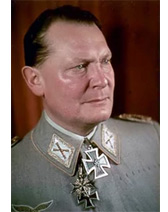
Hermann Göring
“The Reichsmarschall of Nazi Germany”
Born on January 12, 1893
Died on October 15, 1946
Age at death: 53
Profession: Military Officer, Politician, Military Commander
Place of Birth: Rosenheim, Germany
Place of Death: Nuremberg, Germany
Hermann Wilhelm Göring was one of Germany’s most celebrated war heroes of World War I and later became the Commander-in-Chief of Nazi Germany’s Air Force during World War II, ranking among the most powerful figures of the Third Reich.
Hermann Göring was born on January 12, 1893, in Rosenheim, Germany. His father, Heinrich Ernst Göring, was a cavalry officer as well as a jurist and diplomat who served as Governor-General of German South West Africa (present-day Namibia). At the time of Hermann Göring’s birth, his father was serving as consul general in Haiti. His mother lived in Germany at the residence of Hermann Epenstein in Veldenstein; Epenstein, a Jewish-born Christian doctor and businessman, was her lover. The family lived under these circumstances for nearly fifteen years.
At the age of eleven, Göring was sent to a boarding school. By sixteen, he had graduated and was sent to the military academy in Lichterfelde, Berlin. In 1912, he joined the Prussian Army’s Prince Wilhelm Regiment (112th Infantry). The following year, his mother separated from Hermann Epenstein, forcing the family to leave the Veldenstein estate and relocate to Munich. Göring’s father died shortly afterward, on December 7, 1913.
When World War I began in August 1914, Göring served as a lieutenant with his regiment at Mulhouse. He was hospitalized after developing rheumatism due to the damp conditions of trench warfare. After completing pilot training, he was assigned to Jagdstaffel 5, and in February 1917 joined Jagdstaffel 26 under the command of Bruno Loerzer.
On July 7, 1918, following the deaths of Wilhelm Reinhard and the legendary ace Manfred von Richthofen, Göring was appointed commander of the famed Jagdgeschwader 1. During the war, he shot down twenty-two enemy aircraft and was awarded the prestigious Pour le Mérite (Blue Max). Although Germany lost the war, Göring emerged as a national hero. In 1919, he left the army with the rank of captain.
After World War I, Göring remained in aviation. He moved to Sweden and joined the airline Svensk Lufttrafik, where he served as chief pilot, often flying private charter missions and performing demonstration flights across Scandinavia. It was during this period that he met his first wife, Karin von Kantzow, whom he married in Munich in February 1922.
Between 1922 and 1923, Göring studied history and economics at the University of Munich. After attending a speech by Adolf Hitler, he joined the Nazi Party in 1923. That same year, he was appointed Supreme SA Leader (Oberster SA-Führer), assuming command of the Sturmabteilung.
During the failed Beer Hall Putsch of 1923, Göring was wounded. Following the coup’s collapse, political pressure and Hitler’s imprisonment forced him to flee—first to Austria, then Italy, and finally Sweden. During this period of exile, Göring suffered severe psychological distress and developed a serious addiction to narcotics.
Once a celebrated fighter pilot, Göring now lived as a fugitive, a situation that deeply affected him. He turned to alcohol and was on the brink of becoming an alcoholic when news arrived from Germany: Adolf Hitler had been released and restored political order. In 1926, the arrest warrant against Göring was lifted. He rejoined the Nazi Party in 1928. Following the party’s electoral surge, Göring was promoted to SA-Gruppenführer in 1931. Over the next five years, he became one of Hitler’s closest and most influential aides, using his extensive network to rally industrialists, business leaders, and military officials to the Nazi cause.
These efforts culminated in Hitler’s rise to power. After Hitler became Chancellor, Göring was appointed Minister-President of Prussia. From January 30 to May 5, 1933, he served as Reich Minister without Portfolio, and from April 11, 1933 until 1945 as Prime Minister of Prussia. He also served as Prussian Minister of the Interior, Chief of the State Police, and Police General.
In 1933, Göring became Reich Minister of Aviation and founded the Gestapo, Germany’s secret state police, which he directed until 1934. Contrary to popular belief, Göring initially envisioned concentration camps not as extermination sites for Jews but as isolated detention centers for criminals and political opponents. With the onset of war, these camps expanded to include Jews, Roma, communists, and prisoners of war.
In 1934, Göring transferred control of the Gestapo to Heinrich Himmler. He then focused on secretly rebuilding Germany’s air force in violation of the Treaty of Versailles. Once the treaty lost its authority, he openly expanded the Luftwaffe, which became one of the most powerful air forces in the world.
During World War II, Göring served as Commander-in-Chief of the Luftwaffe from 1935 to 1945. He was promoted to Generaloberst in 1936 and to Field Marshal in 1938. His experience as a former combat pilot contributed significantly to the early effectiveness of German air power.
From 1936 to 1945, Göring was Reich Plenipotentiary for Raw Materials and Foreign Exchange and oversaw the Four Year Plan, making him responsible for Germany’s rearmament economy. Between 1937 and 1945, he served as head of the Reichswerke Hermann Göring industrial conglomerate. From 1939 to 1945, he chaired the Council of Ministers for the Defense of the Reich and also held the titles of Reich Forestry Master and Reich Hunt Master.
The war began on September 1, 1939, with the invasion of Poland. Göring’s Luftwaffe played a decisive role in the campaigns against the Netherlands, Belgium, and France in 1940. Following France’s defeat, Göring was awarded the Iron Cross. On July 19, 1940, Adolf Hitler promoted him to the unique rank of Reichsmarschall of the Greater German Reich.
In April 1945, Göring fled to Bavaria. Citing a 1941 decree signed by Hitler naming him as successor should Hitler become incapacitated, Göring proposed assuming leadership. He was accused of attempting a coup and expelled from the Nazi Party on April 29, 1945. Hitler’s private secretary Martin Bormann ordered his arrest. Göring was placed under house arrest but was freed by a Luftwaffe unit on May 5, 1945.
Leaving his wife and child at his Obersalzberg estate, Göring surrendered to the United States Army on May 6, 1945, near Radstadt. He was later transferred to Luxembourg and held at the Palace Hotel in Mondorf-les-Bains, known as Camp Ashcan, where he lost 27 kilograms under strict supervision.
In September 1945, Göring was transferred to Nuremberg to stand trial. During the proceedings, he admitted many of the charges but remained loyal to Hitler until the end. After being sentenced to death, Göring committed suicide in his cell on October 15, 1946, by ingesting a potassium cyanide capsule—hours before his scheduled execution—mirroring the method used by Heinrich Himmler.
Hermann Göring died at the age of fifty-three in Nuremberg, Germany. His body was cremated at Munich’s Ostfriedhof, and his ashes were scattered into the Isar River, leaving behind a legacy inseparably tied to the rise, crimes, and downfall of Nazi Germany.
Source: Biyografiler.com
Frequently asked questions about Hermann Göring
Who is Hermann Göring?, Hermann Göring biography, Hermann Göring life story, Hermann Göring age, Hermann Göring facts, Hermann Göring birthplace, Hermann Göring photos, Hermann Göring videos, Hermann Göring career
Related Biographies

Lamine Yamal
Professional footballer

Erling Haaland
Professional footballer

Austin Abrams
Actor

Keanu Reeves
Actor

Kylian Mbappe
Professional footballer

Bad Bunny
Rapper, Songwriter


Hongjoong
Singer, Rapper, Songwriter, Composer

Ludacris
Rapper, Actor

Kwon Eunbi
Singer

Sarah Wayne Callies
Actress, Screenwriter, Producer, Director

LaTavia Roberson
Singer, Actress, Entrepreneur
Erling Haaland
Professional footballer
Lamine Yamal
Professional footballer

Sadio Mane
Professional footballer
Keanu Reeves
Actor

Ma Huateng
Entrepreneur, Inventor

Giorgia Meloni
Politician, Journalist