
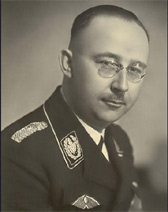
Heinrich Himmler
“The Architect of Nazi Terror”
Born on October 7, 1900
Died on May 23, 1945
Age at death: 45
Profession: Military Commander
Place of Birth: Munich, Germany
Place of Death: Lüneburg, Germany
Heinrich Luitpold Himmler became the most powerful man in Nazi Germany after Adolf Hitler by bringing the SS (Schutzstaffel), the police forces, and toward the final phase of World War II, parts of the German army under his control.
Heinrich Himmler was born on October 7, 1900, in Munich, Germany, as one of three sons of a Bavarian schoolteacher, Gebhard Himmler, and his wife Anna Maria Himmler. He had an older brother, Gebhard Ludwig Himmler, and a younger brother, Ernst Hermann Himmler. Between 1919 and 1922, he studied agricultural science with a specialization in poultry farming at the Munich Technical University. He initially worked as an agricultural consultant and later held various jobs, including poultry farming. In the early 1920s, he joined the Nazi Party and during this period met Margarete Boden, who would later become his wife.
When World War I broke out, Himmler was only fourteen years old. In his diary, he wrote, “If only I could go to war with my brother, I would fight very well for my country.” These diaries also reveal that his hatred of Jews began at an early age, with entries complaining about what he described as Jewish presence in public places.
On November 8, 1923, Himmler participated in the failed Beer Hall Putsch (also known as the Bürgerbräukeller Putsch or Hitler–Ludendorff Putsch), organized by Adolf Hitler to seize control of Bavaria. Deeply aligned with Nazi ideology, Himmler greatly admired Hitler. While Hitler was imprisoned in 1924, Himmler worked as a party secretary and propaganda assistant under Gregor Strasser.
In 1925, following Hitler’s release from prison and the re-establishment of the Nazi Party, Himmler joined the SS (Schutzstaffel). Four years later, in 1929, he was appointed head of the SS. Under his leadership, the SS was transformed from a small personal guard into a powerful and ideologically driven organization.
After Adolf Hitler came to power on January 30, 1933, Hermann Göring established the Gestapo in November 1933 and appointed Rudolf Diels as its head. Shortly afterward, Göring transferred control of the Gestapo to Himmler. On the same day, Hitler appointed Himmler as head of the Munich Police. Himmler placed Reinhard Heydrich in charge of the Gestapo and gradually brought the entire German police apparatus under SS control.
Himmler constructed an extensive security network that eliminated political opponents and directed the extermination of Jews, Roma, and other groups deemed non-Aryan. He established the first Nazi concentration camp at Dachau. In 1934, he played a key role in the purge of the SA leadership, including the killing of its leader Ernst Röhm. On June 7, 1936, Himmler was appointed Chief of the Gestapo and also assumed control of the German Police, working to turn the SS into the most powerful armed force in Germany after the army.
During World War II, Himmler oversaw the mass murder of Jews and regime opponents in concentration and extermination camps across Eastern Europe. In 1943, he was appointed Minister of the Interior. After the failed assassination attempt against Hitler on July 20, 1944, Himmler expanded his authority to include all internal security forces of the Reich.
In the final months of the war, Himmler secretly attempted to negotiate Germany’s surrender to the Western Allies in exchange for a joint front against the Soviet Union. He held meetings with Swedish diplomat Count Folke Bernadotte near Lübeck. When Hitler learned of these actions, he stripped Himmler of all ranks and authority and ordered his arrest one day before committing suicide. At that time, Himmler held the titles of Reichsführer-SS, Chief of German Police, Minister of the Interior, Commander of the Volkssturm, and Supreme Commander of the Home Army.
The negotiations with Bernadotte failed. Unable to return to Berlin, Himmler joined Karl Dönitz near Plön, but Dönitz immediately dismissed him, stating that he had no place in the German government.
As a last resort, Himmler attempted to seek asylum in the United States. He contacted Dwight David Eisenhower’s headquarters, offering to surrender all of Germany if he were not prosecuted as a war criminal. Eisenhower rejected any communication with Himmler. His mental instability was evident when he asked whether he should greet Eisenhower with a Hitler salute or a handshake.
After being repeatedly rejected, Himmler went into hiding near Flensburg, disguising himself under the name Heinrich Hitzinger. He shaved his mustache, wore an eye patch, and dressed in a military uniform. Attempting to return to Bavaria, he forged documents and traveled with eleven SS officers.
On May 21, 1945, Himmler and two aides were stopped at a checkpoint operated by former Soviet prisoners. The forged documents were discovered, and he was detained. After being transferred between several camps, he was brought on May 23 to the British 31st Civilian Interrogation Camp near Lüneburg.
During questioning by Captain Thomas Selvester, Himmler revealed his true identity and was transferred to the Second Army headquarters in Lüneburg, pending transport to the Nuremberg Trials. Although searched and given British military clothing, inspectors failed to detect a potassium cyanide capsule hidden in a hollow tooth.
On May 23, 1945, during a medical examination ordered by officers from Bernard Montgomery’s headquarters, Himmler bit down on the cyanide capsule and died within twelve minutes. His final words were, “Ich bin Heinrich Himmler!” (“I am Heinrich Himmler!”). His body was buried in an unmarked grave near Lüneburg, the location of which remains unknown.
Heinrich Himmler married Margarete Boden in July 1928. Their daughter, Gudrun Himmler Burwitz, was born on August 8, 1929. He also had children from extramarital relationships, including Gerhard von Ahe, Helge Potthast, and Nanette Dorothea Potthast.
Heinrich Himmler died by suicide on May 23, 1945, in Lüneburg, Germany, at the age of forty-five, leaving behind a legacy synonymous with systematic terror, genocide, and the machinery of the Holocaust.
Source: Biyografiler.com
Frequently asked questions about Heinrich Himmler
Who is Heinrich Himmler?, Heinrich Himmler biography, Heinrich Himmler life story, Heinrich Himmler age, Heinrich Himmler facts, Heinrich Himmler birthplace, Heinrich Himmler photos, Heinrich Himmler videos, Heinrich Himmler career
Related Biographies

Lamine Yamal
Professional footballer

Erling Haaland
Professional footballer

Austin Abrams
Actor

Keanu Reeves
Actor

Kylian Mbappe
Professional footballer

Bad Bunny
Rapper, Songwriter


Hongjoong
Singer, Rapper, Songwriter, Composer

Ludacris
Rapper, Actor

Kwon Eunbi
Singer

Sarah Wayne Callies
Actress, Screenwriter, Producer, Director

LaTavia Roberson
Singer, Actress, Entrepreneur
Erling Haaland
Professional footballer
Lamine Yamal
Professional footballer

Sadio Mane
Professional footballer
Keanu Reeves
Actor

Ma Huateng
Entrepreneur, Inventor

Giorgia Meloni
Politician, Journalist