
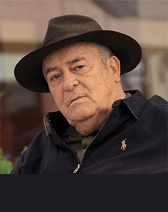
Bernardo Bertolucci
Italian filmmaker known for The Conformist, Last Tango in Paris, 1900 and The Last Emperor, which won nine Academy Awards at the 1988 ceremony.
Born on March 16, 1941
Died on November 26, 2018
Age at death: 77
Profession: Film Director, Screenwriter
Place of Birth: Parma, Italy
Place of Death: Rome, Italy
Bernardo Bertolucci (March 16, 1941 – November 26, 2018) was an Italian film director and screenwriter. He directed Before the Revolution (1964), The Conformist (1970), Last Tango in Paris (1972), 1900 (1976) and The Last Emperor (1987). His films frequently examined political ideology, family relationships, sexuality and personal identity. The Last Emperor won nine Academy Awards in 1988, including Best Picture and Best Director. Bertolucci also received an Academy Award nomination for directing Last Tango in Paris, which became the subject of legal disputes and later controversy over the treatment of actress Maria Schneider during filming.
Early Life and Education
Bernardo Bertolucci was born on March 16, 1941, in Parma, Italy. His father, Attilio Bertolucci, was a poet, literary critic and art historian. His mother, Ninetta Giovanardi, was a teacher. His younger brother, Giuseppe Bertolucci, born in 1947, also became a film director and screenwriter.
He spent much of his childhood in the countryside near Parma, where his paternal grandfather owned a farm. Growing up in a family involved in literature and the arts, he began writing poetry while still young.
In 1954, the family moved to Rome. Bertolucci continued his education there and later enrolled in the modern literature program at Sapienza University of Rome.
In 1956, he made two amateur short films, The Cable and The Death of a Pig, using a borrowed 16 mm camera. These were his first experiments with filmmaking.
His poetry collection In Search of Mystery (In cerca del mistero), published in 1962, received the Viareggio Prize for a first literary work. By that time, however, he had decided to pursue filmmaking rather than complete his university studies.
Pier Paolo Pasolini and Early Directing Career
After moving to Rome, the Bertolucci family lived near writer and filmmaker Pier Paolo Pasolini, who was a friend of Attilio Bertolucci.
In 1961, Bernardo Bertolucci worked as an assistant director on Pasolini's first feature film, Accattone. The experience introduced him to professional film production.
He made his feature directing debut with The Grim Reaper (La commare secca) in 1962, using a story developed by Pasolini. The film follows an investigation into a murder, presenting different accounts of events surrounding the crime.
His second feature, Before the Revolution (Prima della rivoluzione), premiered in 1964. Set in Parma, the film follows a young man whose political convictions conflict with his family circumstances and personal relationships.
Its political concerns and narrative techniques drew from contemporary European filmmaking, particularly the French New Wave and the work of Jean-Luc Godard.
Political Cinema and The Conformist
During the second half of the 1960s, Bernardo Bertolucci continued experimenting with film narratives. He directed the television documentary Oil Route (La via del petrolio) and the feature film Partner (1968), inspired by Fyodor Dostoevsky's novel The Double.
He also collaborated with Sergio Leone and Dario Argento on the story for the Western Once Upon a Time in the West (1968).
In 1970, Bertolucci directed The Spider's Stratagem, based on a story by Jorge Luis Borges, and The Conformist, adapted from the novel by Alberto Moravia.
The Conformist stars Jean-Louis Trintignant as Marcello Clerici, an Italian man who accepts an assignment from the fascist political police. The film explores his personal history and his willingness to conform to the political system.
Its cinematography was created by Vittorio Storaro, who became a frequent collaborator. Bertolucci received an Academy Award nomination for Best Adapted Screenplay for the film.
Last Tango in Paris
In 1972, Bernardo Bertolucci directed Last Tango in Paris, starring Marlon Brando and Maria Schneider. The film follows an American widower and a young French woman who begin a sexual relationship in Paris.
The film's explicit sexual content led to censorship and legal proceedings. In Italy, it was banned, and a court ruling resulted in Bertolucci losing certain civil rights for five years. He was also given a suspended prison sentence.
The film received two Academy Award nominations at the 1974 ceremony: Best Director for Bertolucci and Best Actor for Brando.
Controversy Involving Maria Schneider
Decades after the film's release, Bernardo Bertolucci faced renewed criticism over a scene depicting sexual assault involving Marlon Brando and Maria Schneider.
Schneider stated in interviews that she had not been informed in advance about an element introduced during filming and that the experience left her feeling humiliated and violated. She also criticized the conduct of Brando and Bertolucci.
In a 2013 interview, Bertolucci acknowledged that he and Brando had decided not to tell Schneider about the use of butter in the scene because he wanted to capture an unanticipated emotional reaction.
When the interview attracted widespread attention in 2016, Bertolucci clarified that the simulated sexual assault had been included in the screenplay. According to his statement, the undisclosed detail was the use of butter rather than the existence of the scene itself.
The controversy prompted renewed discussion about informed consent, performers' working conditions and directors' responsibilities during the filming of intimate scenes.
1900 and Later Italian Films
In 1976, Bernardo Bertolucci directed 1900 (Novecento), a historical drama following two men born on the same day into different social classes in rural Italy.
The film stars Robert De Niro and Gérard Depardieu, alongside Burt Lancaster, Dominique Sanda, Donald Sutherland and Stefania Sandrelli.
Running approximately five hours in its original version, the film examines Italian political and social developments during the first half of the twentieth century, including the rise of fascism and conflicts between landowners and agricultural workers.
Bertolucci subsequently directed Luna (1979), starring Jill Clayburgh, and Tragedy of a Ridiculous Man (La tragedia di un uomo ridicolo, 1981), starring Ugo Tognazzi and Anouk Aimée.
The Last Emperor and Academy Awards
In 1987, Bernardo Bertolucci directed The Last Emperor, a historical drama about Puyi, the final emperor of China.
The film was produced by Jeremy Thomas and starred John Lone, Joan Chen and Peter O'Toole. It was filmed in China, including inside the Forbidden City in Beijing, with permission from Chinese authorities.
The screenplay was written by Bertolucci and Mark Peploe, drawing from Puyi's autobiography and other historical materials.
At the 60th Academy Awards, held on April 11, 1988, The Last Emperor won all nine categories for which it had been nominated, including Best Picture, Best Director and Best Adapted Screenplay.
Bertolucci personally received Oscars for directing and co-writing the adapted screenplay. The Best Picture award was presented to producer Jeremy Thomas.
The film also won Academy Awards for cinematography, editing, costume design, art direction, original score and sound.
International Productions
After The Last Emperor, Bernardo Bertolucci directed several films involving stories set outside Italy.
The Sheltering Sky (1990), starring Debra Winger and John Malkovich, was adapted from the novel by Paul Bowles. It follows an American couple travelling through North Africa.
In 1993, Bertolucci directed Little Buddha, starring Keanu Reeves, Bridget Fonda and Chris Isaak. The film combines the story of a Tibetan Buddhist teacher's search for a reincarnated lama with scenes portraying the life of Siddhartha Gautama.
He returned to Italy for Stealing Beauty (1996), starring Liv Tyler, Jeremy Irons and Rachel Weisz.
His next feature, Besieged (1998), starred Thandiwe Newton and David Thewlis and followed the relationship between an African woman and an English pianist living in Rome.
The Dreamers and Final Films
In 2003, Bernardo Bertolucci directed The Dreamers, starring Michael Pitt, Eva Green and Louis Garrel. The film is set in Paris during the political and student demonstrations of 1968 and follows the relationship between an American student and French twins.
The film's references to cinema history and explicit sexual content attracted considerable attention.
Following health problems, Bertolucci returned to feature filmmaking with Me and You (Io e te, 2012), adapted from the novel by Niccolò Ammaniti. The film stars Jacopo Olmo Antinori and Tea Falco as two young people who spend several days together in an apartment basement.
Me and You was the final feature film he directed.
Film Festival Roles and Awards
Bernardo Bertolucci served as president of the international competition jury at the Venice Film Festival in 1983 and 2013. He also chaired the main competition jury at the 1990 Cannes Film Festival.
In 2007, the Venice Film Festival awarded him a special Golden Lion marking the festival's seventy-fifth anniversary.
In 2011, he received the Honorary Palme d'Or at the Cannes Film Festival for his filmmaking career.
His other awards included BAFTA, César and Golden Globe recognition for The Last Emperor and other productions.
Personal Life and Health
Bernardo Bertolucci married Maria Paola Maino in 1967. The marriage ended in divorce in 1972.
On December 22, 1978, he married British filmmaker Clare Peploe, who also worked as a director and screenwriter. They remained married until his death and had no children.
Following complications from spinal surgery in 2003, Bertolucci became a wheelchair user. He continued participating in filmmaking and cultural events despite difficulties with mobility.
He also spoke publicly about accessibility problems in Rome, particularly the uneven stone paving in the historic Trastevere district.
Death
Bernardo Bertolucci died of lung cancer on November 26, 2018, in Rome, Italy, at the age of seventy-seven.
Selected Filmography
Feature Films as Director
2012 – Me and You (Io e te)
2003 – The Dreamers
1998 – Besieged
1996 – Stealing Beauty
1993 – Little Buddha
1990 – The Sheltering Sky
1987 – The Last Emperor
1981 – Tragedy of a Ridiculous Man
1979 – Luna
1976 – 1900 (Novecento)
1972 – Last Tango in Paris
1970 – The Conformist
1970 – The Spider's Stratagem
1968 – Partner
1964 – Before the Revolution
1962 – The Grim Reaper
Short Films, Documentaries and Anthology Contributions
2013 – Venice 70: Future Reloaded (contributor to anthology project)
2002 – Ten Minutes Older: The Cello (director of "Histoire d'eaux" segment)
1989 – 12 Directors for 12 Cities (contributing director)
1984 – Farewell to Enrico Berlinguer (contributing director)
1971 – Health Is Ill (documentary)
1969 – Love and Anger (director of "Agony" segment)
1967 – Oil Route (television documentary)
1966 – The Canal (short documentary)
1956 – The Cable (amateur short film)
1956 – The Death of a Pig (amateur short film)
Other Screenwriting and Production Credits
2001 – The Triumph of Love (co-screenwriter and producer)
1968 – Once Upon a Time in the West (story collaboration with Sergio Leone and Dario Argento)
Source: Biyografiler.com
Frequently asked questions about Bernardo Bertolucci
Who is Bernardo Bertolucci?, Bernardo Bertolucci biography, Bernardo Bertolucci life story, Bernardo Bertolucci age, Bernardo Bertolucci facts, Bernardo Bertolucci birthplace, Bernardo Bertolucci photos, Bernardo Bertolucci videos, Bernardo Bertolucci career
Related Biographies

Lamine Yamal
Professional footballer

Brad Pitt
Actor

Kylian Mbappe
Professional footballer

Erling Haaland
Professional footballer

Leonardo DiCaprio
Actor

Sam Altman
Entrepreneur, Investor, CEO

Billy Zane
Actor

Bernie Sanders
Politician, Activist

Bernardo Bertolucci
Film Director, Screenwriter

Enzo Ferrari
Businessperson, Racing Driver

Melissa McBride
Actress

Melissa Gilbert
Actress

Keira Knightley
Actress

Alexandria Ocasio-Cortez
Politician, Activist

Amber Heard
Actress, Model

Andrea Bocelli
Singer, Musician

Arthur Schopenhauer
Philosopher
Bernardo Bertolucci
Film Director, Screenwriter