
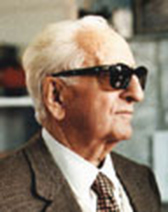
Enzo Ferrari
Italian racing driver and entrepreneur who founded Scuderia Ferrari in 1929 and established the automobile company Ferrari, whose first Ferrari-badged car, the 125 S, debuted in 1947.
Born on February 18, 1898
Died on August 14, 1988
Age at death: 90
Profession: Businessperson, Racing Driver
Place of Birth: Modena, Kingdom of Italy
Place of Death:
Enzo Ferrari (February 18, 1898 – August 14, 1988) was an Italian racing driver, entrepreneur and automobile manufacturer. He founded Scuderia Ferrari in 1929 as a racing team using Alfa Romeo cars and established the company that became Ferrari after leaving Alfa Romeo in 1939. The first automobile to carry the Ferrari name, the Ferrari 125 S, was completed in 1947. Under his leadership, Ferrari produced racing cars, sports cars and grand touring automobiles, while its racing team competed in Formula One and international sports car championships.
Early Life and Family
Enzo Ferrari, whose full name was Enzo Anselmo Giuseppe Maria Ferrari, was born on February 18, 1898, in Modena, Italy. His birth was officially registered on February 20, which explains why some historical records give that date.
His father, Alfredo Ferrari, operated a metalworking workshop in Modena. His mother was Adalgisa Bisbini. Enzo had an older brother, Alfredo Ferrari Jr., who was known as Dino.
His father operated a small manufacturing business that supplied metal components and equipment. The family lived in the same property as the workshop, and Enzo became familiar with machinery during childhood.
In 1908, his father took him and his brother to a motor race near Bologna. The experience increased his interest in automobiles and motorsport.
As a young man, he considered several possible careers, including opera singing, sports journalism and motor racing. He eventually pursued work in the automotive industry.
World War I and Family Losses
In 1916, during World War I, Enzo Ferrari lost both his father and his older brother. Their deaths followed serious illnesses, commonly associated in biographical accounts with influenza and pneumonia.
The deaths interrupted the family's manufacturing business and left Enzo facing financial difficulties.
He was called into the Italian Army in 1917 and served with a mountain artillery unit. His duties included maintaining and shoeing the mules used to transport equipment.
In 1918, he became seriously ill during the influenza pandemic. He received treatment in a military hospital and was subsequently discharged from the army.
After recovering, he returned to civilian life and began looking for employment in the automobile industry.
Early Automotive Career
Following the war, Enzo Ferrari travelled to Turin and applied for a position at Fiat. His application was unsuccessful.
He subsequently found work with businesses involved in converting military vehicles for civilian use. He later became a test driver for Costruzioni Meccaniche Nazionali (CMN), a Milan-based automobile manufacturer.
In 1919, he participated in his first motor race, the Parma–Poggio di Berceto hill climb, driving a CMN automobile.
He also competed in the Targa Florio and other Italian races. Through these events, he developed relationships with racing drivers, engineers and automobile manufacturers.
In 1920, Ferrari joined Alfa Romeo as a racing driver. He subsequently spent nearly two decades working with the company in driving, management and racing operations.
Racing for Alfa Romeo
Enzo Ferrari competed for Alfa Romeo in Italian road races and circuit events throughout the 1920s.
In 1923, he won the Circuito del Savio race near Ravenna. During the event, he met members of the family of Francesco Baracca, an Italian fighter pilot who had been killed during World War I.
Baracca had used the image of a rearing horse on his aircraft. His mother, Countess Paolina Baracca, encouraged Ferrari to use the symbol on his racing cars.
Ferrari later adopted the black prancing horse, known in Italian as the Cavallino Rampante, as the emblem of his racing team and automobile company. The design was placed against a yellow background associated with Modena.
In 1924, he won the Coppa Acerbo race at Pescara, one of his principal victories as a driver.
During this period, he was awarded the title of Cavaliere of the Order of the Crown of Italy. The award was part of the Italian honours system under the monarchy, during the years when Benito Mussolini governed the country.
Retirement from Racing
Ferrari experienced periods of poor health and uncertainty about continuing as a driver during the second half of the 1920s.
Although he continued taking part in races, his interests increasingly included organizing teams, selecting drivers and supervising competition.
His final competitive appearances as a racing driver took place in 1931. He retired from driving before the birth of his son Alfredo, known as Dino, in January 1932.
He subsequently concentrated on the management of racing teams and the development of competition cars.
Founding Scuderia Ferrari
On November 16, 1929, Enzo Ferrari established Scuderia Ferrari in Modena. The organization was created to prepare, maintain and race automobiles, primarily Alfa Romeo models, for private drivers and professional competitors.
The team developed into an organized racing operation with mechanics, engineers and contracted drivers.
Its drivers included Tazio Nuvolari, Achille Varzi, Giuseppe Campari and other competitors active in European motorsport during the 1930s.
Ferrari recruited technical personnel and maintained relationships with manufacturers and suppliers. His work also contributed to the recruitment of engineer Vittorio Jano to Alfa Romeo during the earlier part of his career.
Scuderia Ferrari operated Alfa Romeo racing cars until the manufacturer reorganized its competition activities in the late 1930s.
Leaving Alfa Romeo
In 1938, Alfa Romeo brought its racing operations under direct company control. Enzo Ferrari was appointed to a senior management position within the reorganized department.
However, disagreements over the operation and management of the team led to his departure in 1939.
Under the terms of his separation agreement, he was restricted from using the Ferrari name in connection with racing cars or a racing team for a period of four years.
In September 1939, he founded Auto Avio Costruzioni in Modena. The company initially manufactured automotive components and mechanical equipment.
Auto Avio Costruzioni and World War II
In 1940, Enzo Ferrari's company produced two examples of the Auto Avio Costruzioni 815, a sports racing car built using components from Fiat vehicles.
The cars competed in the 1940 Mille Miglia, but they did not carry the Ferrari name.
Italy's entry into World War II restricted civilian automobile production and motorsport. Auto Avio Costruzioni began manufacturing equipment for wartime industrial requirements, including mechanical components and machine tools.
In 1943, Ferrari moved his industrial operations from Modena to Maranello, approximately eighteen kilometres away.
The factory suffered damage during Allied bombing raids in 1944 and 1945. After the war, Ferrari rebuilt and expanded the facilities to prepare for automobile production.
The First Ferrari Automobile
Following World War II, Enzo Ferrari began manufacturing automobiles under his own name.
The first model was the Ferrari 125 S, completed in 1947. Designed with the involvement of engineer Gioachino Colombo, the car was powered by a 1.5-litre V12 engine.
The Ferrari 125 S made its competition debut on May 11, 1947, at Piacenza, driven by Franco Cortese. Mechanical difficulties prevented it from finishing that race.
On May 25, 1947, Cortese drove the car to Ferrari's first victory at the Rome Grand Prix held at the Terme di Caracalla circuit.
The Ferrari 125 S established the beginning of automobile production under the Ferrari name.
The Ferrari 250 series appeared during the 1950s, followed by several GT variations, including the Ferrari 250 GT. These cars belonged to a later stage of the company's development and were not its first models.
Formula One and International Motorsport
Enzo Ferrari entered Scuderia Ferrari in the newly established Formula One World Championship in 1950. The team made its championship debut at the Monaco Grand Prix.
On July 14, 1951, Argentine driver José Froilán González achieved Ferrari's first Formula One World Championship race victory at the British Grand Prix at Silverstone.
In 1952, Italian driver Alberto Ascari won the Formula One World Drivers' Championship driving for Ferrari. Ascari repeated the achievement in 1953.
The team subsequently won championships with drivers including Juan Manuel Fangio, Mike Hawthorn, Phil Hill, John Surtees, Niki Lauda and Jody Scheckter during Enzo Ferrari's lifetime.
Ferrari also competed in endurance racing, including the 24 Hours of Le Mans, Mille Miglia and Targa Florio. The company's road cars were developed alongside its racing activities.
The Death of Dino Ferrari
Enzo Ferrari married Laura Dominica Garello on April 28, 1923.
The couple's son, Alfredo Dino Ferrari, was born on January 19, 1932. Dino developed an interest in automobile engineering and participated in technical discussions about Ferrari engines.
He suffered from a form of muscular dystrophy that progressively affected his health. He died on June 30, 1956, at the age of twenty-four.
Ferrari subsequently used the Dino name for a series of engines and sports cars. The Dino designation appeared on competition models and later on road cars produced by Ferrari.
Dino's death was followed by a period of personal grief and difficulties within Enzo Ferrari's family life.
The 1957 Mille Miglia Tragedy
On May 12, 1957, a Ferrari driven by Spanish racing driver Alfonso de Portago crashed during the Mille Miglia road race near Guidizzolo, Italy.
The accident killed Portago, his co-driver Edmund Nelson and nine spectators, including children.
Investigations examined the vehicle's condition, tire failure and the circumstances surrounding the crash.
Enzo Ferrari faced legal proceedings concerning responsibility for the accident. He was eventually acquitted.
The disaster contributed to the discontinuation of the Mille Miglia in its traditional competitive road-racing format.
Further fatal accidents involving Ferrari drivers, including Luigi Musso, Peter Collins and Wolfgang von Trips, occurred during the following years.
Ferrari Road Cars and Business Development
During the 1950s and 1960s, Enzo Ferrari expanded the company's production of road-going sports cars and grand touring automobiles.
Models associated with this period included the Ferrari 250 GT, Ferrari 250 Testa Rossa, Ferrari 250 GTO and Ferrari 275 GTB.
The road-car business provided revenue alongside the company's motorsport operations. Ferrari developed a production system involving a limited number of vehicles and an international network of customers.
In 1960, the manufacturing business was reorganized as a joint-stock company and subsequently adopted the name Ferrari S.p.A..
Ferrari continued directing the company's racing strategy and participating in decisions about automobile development.
Fiat Partnership
During the 1960s, automobile manufacturers faced increasing production costs, new technical requirements and the need for greater investment.
Enzo Ferrari explored possible partnerships to support his company's development.
In 1963, discussions about a potential sale to the American automobile manufacturer Ford ended without an agreement. The negotiations involved disagreements about the control of Ferrari's racing activities.
In 1969, the Italian automobile group Fiat acquired a 50 percent ownership stake in Ferrari.
Ferrari retained substantial involvement in the racing division and continued to influence the company's operations.
Fiat's ownership did not rise to 90 percent in 1969. That increase occurred after Enzo Ferrari's death in 1988, when his son Piero Ferrari retained the remaining 10 percent.
Later Years and Final Cars
Enzo Ferrari gradually reduced his participation in daily management as he grew older but remained involved in major racing and product decisions.
During the 1970s, Ferrari achieved Formula One championships with Austrian driver Niki Lauda in 1975 and 1977.
In 1979, South African driver Jody Scheckter won the World Drivers' Championship for Ferrari. The team also won the Constructors' Championship that year.
Ferrari continued introducing new sports cars in the following decade, including the Ferrari 288 GTO and Ferrari Testarossa.
In 1987, the company introduced the Ferrari F40, designed to commemorate Ferrari's fortieth anniversary as an automobile manufacturer.
The F40 was the final Ferrari road-car model developed and introduced during Enzo Ferrari's lifetime.
Personal Life
Enzo Ferrari remained married to Laura Dominica Garello until her death in 1978. Although the couple experienced periods of estrangement, they did not divorce.
He also had a long relationship with Lina Lardi. Their son, Piero Ferrari, was born on May 22, 1945, under the name Piero Lardi.
Piero's connection to Enzo Ferrari was kept largely outside public attention for many years. Following Laura Ferrari's death, Piero was formally recognized and began using the Ferrari surname alongside Lardi.
Piero subsequently held senior positions within Ferrari, including vice-chairman.
Enzo Ferrari generally remained based in Modena and Maranello, preferring to manage racing operations through his staff rather than regularly travelling to international competitions.
Death
Enzo Ferrari died on August 14, 1988, in Modena, Italy, at the age of ninety.
His death was publicly announced on August 16, following a private funeral.
At the time of his death, the Ferrari company manufactured road cars in Maranello and continued competing in Formula One.
Source: Biyografiler.com
Frequently asked questions about Enzo Ferrari
Who is Enzo Ferrari?, Enzo Ferrari biography, Enzo Ferrari life story, Enzo Ferrari age, Enzo Ferrari facts, Enzo Ferrari birthplace, Enzo Ferrari photos, Enzo Ferrari videos, Enzo Ferrari career
Related Biographies

Lamine Yamal
Professional footballer

Brad Pitt
Actor

Kylian Mbappe
Professional footballer

Erling Haaland
Professional footballer

Leonardo DiCaprio
Actor

Sam Altman
Entrepreneur, Investor, CEO

Billy Zane
Actor

Bernie Sanders
Politician, Activist

Bernardo Bertolucci
Film Director, Screenwriter

Enzo Ferrari
Businessperson, Racing Driver

Melissa McBride
Actress

Melissa Gilbert
Actress

Keira Knightley
Actress

Alexandria Ocasio-Cortez
Politician, Activist

Amber Heard
Actress, Model

Andrea Bocelli
Singer, Musician

Arthur Schopenhauer
Philosopher
Bernardo Bertolucci
Film Director, Screenwriter