
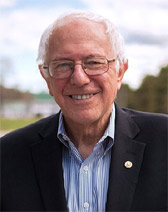
Bernie Sanders
American independent politician and self-described democratic socialist who has represented Vermont in the U.S. Senate since 2007, previously served as mayor of Burlington and a member of the House of Representatives, and sought the Democratic presidential nomination in 2016 and 2020.
Born on September 8, 1941
Age: 85
Profession: Politician, Activist
Place of Birth: Brooklyn, New York City, United States
Bernie Sanders, whose full name is Bernard Sanders, is an American politician, author and political activist who has represented Vermont in the United States Senate since January 2007. An independent politician who describes himself as a democratic socialist, he previously served as mayor of Burlington, Vermont, from 1981 to 1989 and as a member of the United States House of Representatives from 1991 to 2007. He competed for the Democratic Party's presidential nomination in 2016 and 2020. His political proposals have included universal healthcare, stronger labor protections, tuition-free public higher education, higher taxes on wealthy individuals and corporations, and measures to reduce economic inequality.
Early Life and Family Background
Bernie Sanders was born on September 8, 1941, in Brooklyn, New York City, United States. His father, Elias Ben Yehuda Sanders, commonly known as Eli Sanders, was a Jewish immigrant from Poland who worked as a paint salesman. His mother, Dorothy Glassberg Sanders, was born in New York to a Jewish family with roots in Eastern Europe.
Sanders grew up in the Midwood neighborhood of Brooklyn with his older brother, Larry Sanders. The family lived in a rent-controlled apartment and experienced financial difficulties. His father supported the household through his work as a salesman, while his mother managed the family home.
Several members of his father's family remained in Europe and were murdered during the Holocaust. Sanders later discussed his family's history when explaining his opposition to antisemitism, authoritarianism and political persecution.
His parents died when he was young. His mother died in 1959, shortly after he graduated from high school, and his father died in 1962.
Education and University Years
Bernie Sanders attended James Madison High School in Brooklyn, graduating in 1959. During his school years, he participated in athletics, including track and basketball.
He enrolled at Brooklyn College in 1959 and studied there for approximately one year before transferring to the University of Chicago in 1960.
At Chicago, he studied political science and became involved in student organizing, civil rights campaigns and debates about economic inequality and racial segregation.
In 1964, he graduated from the University of Chicago with a Bachelor of Arts degree in political science.
Civil Rights Activism and Opposition to the Vietnam War
During his university years, Bernie Sanders participated in the American Civil Rights Movement. He joined the Congress of Racial Equality (CORE) and became involved with the university's chapter of the Student Nonviolent Coordinating Committee (SNCC).
In January 1962, Sanders helped organize a protest against racially segregated university-owned housing in Chicago. Students occupied an administrative building and demanded changes to the university's housing policies.
He participated in demonstrations against segregation in Chicago's public schools and was arrested during a protest in August 1963.
That same month, Sanders travelled to Washington, D.C., to attend the March on Washington for Jobs and Freedom, where civil rights leader Martin Luther King Jr. delivered his "I Have a Dream" speech.
He also opposed United States military involvement in Vietnam and participated in antiwar activities during the 1960s.
After graduating, Sanders spent time in Israel, where he lived and worked on a kibbutz. He subsequently returned to the United States.
Moving to Vermont
In the late 1960s, Bernie Sanders moved to Vermont, where he became involved in the back-to-the-land movement, which attracted people interested in rural living, communal projects and alternatives to conventional urban life.
He worked at different times as a carpenter, freelance journalist, writer and filmmaker. He also taught in educational programs and produced documentary material about American history and political subjects.
During the 1970s, Sanders joined the Liberty Union Party, a Vermont political organization advocating socialist policies, opposition to the Vietnam War and changes to the American economic system.
He unsuccessfully ran for the United States Senate in 1972 and 1974 and for governor of Vermont in 1972 and 1976. He later ran for governor again in 1986.
Although these campaigns did not result in election victories, they established his participation in Vermont politics before he began running successfully as an independent.
Mayor of Burlington
In March 1981, Bernie Sanders was elected mayor of Burlington, Vermont, defeating incumbent Democrat Gordon Paquette by ten votes after a recount.
He took office in April 1981 and was reelected in 1983, 1985 and 1987, serving four two-year terms until 1989.
As mayor, Sanders worked on municipal budgets, affordable housing, neighborhood participation and public services. His administration supported community organizations and expanded opportunities for residents to participate in local government.
One of the major planning disputes during his administration concerned the Burlington waterfront along Lake Champlain. Sanders opposed proposals that would have substantially privatized waterfront development and advocated preserving public access to the area.
His administration also pursued initiatives involving local arts, youth programs and relationships between Burlington and communities outside the United States.
1988 Visit to the Soviet Union
In May 1988, shortly before the end of his mayoral career, Bernie Sanders married Jane O'Meara Driscoll.
The couple subsequently travelled to the Soviet Union as part of an official Burlington delegation. The visit took place from May 31 to June 10, 1988, and included Moscow, Leningrad and Yaroslavl.
The delegation sought to establish a sister-city relationship between Burlington and Yaroslavl, with the stated aim of encouraging cultural exchange and direct contact between American and Soviet citizens.
The journey later attracted attention during Sanders's presidential campaigns. He described it as a municipal diplomatic initiative rather than an expression of support for the Soviet political system.
United States House of Representatives
Bernie Sanders unsuccessfully ran for the United States House of Representatives in 1988. Two years later, in November 1990, he defeated Republican incumbent Peter Smith and was elected to represent Vermont's at-large congressional district.
He entered the House on January 3, 1991, as an independent and remained there until January 3, 2007. He won eight consecutive House elections, including his first victory in 1990.
During his sixteen years in the House, Sanders supported legislation involving labor rights, social welfare programs, healthcare, veterans' benefits and consumer protection.
He founded the Congressional Progressive Caucus in 1991 with other members of Congress and served as its first chairman.
Sanders opposed aspects of economic deregulation, international trade agreements that he argued weakened American manufacturing employment, and tax policies that benefited higher-income households.
He voted against the congressional authorization for the Iraq War in October 2002 and criticized the foreign policy of President George W. Bush. He also opposed the Bush administration's tax reductions and proposed cuts to social programs.
Election to the United States Senate
In 2006, Bernie Sanders ran for the United States Senate seat being vacated by Republican Senator Jim Jeffords.
He won the November election against Republican businessman Richard Tarrant and began serving as a United States senator on January 3, 2007.
Sanders was reelected in 2012, 2018 and 2024. His 2024 victory gave him a fourth six-year Senate term, running from January 3, 2025, through January 3, 2031.
Although he is formally an independent, Sanders caucuses with Senate Democrats, allowing him to participate in committee assignments and leadership arrangements with the Democratic caucus.
His lengthy service in both chambers has made him the longest-serving independent member in the history of the United States Congress.
Senate Committees and Legislative Work
During his Senate career, Bernie Sanders has served on committees dealing with healthcare, education, labor, veterans' affairs, government spending, energy and environmental policy.
From 2013 to 2015, he chaired the Senate Veterans' Affairs Committee. During this period, he worked on legislation addressing access to medical services and other benefits for military veterans.
In 2014, Sanders negotiated with Republican Senator John McCain on legislation that became the Veterans Access, Choice, and Accountability Act, which expanded certain healthcare options and provided additional resources for the Department of Veterans Affairs.
From 2021 to 2023, Sanders chaired the Senate Budget Committee. He participated in negotiations over federal spending proposals, including measures affecting social programs, taxation and climate policy.
Between 2023 and January 2025, he chaired the Senate Health, Education, Labor, and Pensions Committee, commonly known as the HELP Committee.
After Republicans gained control of the Senate in January 2025, he became the committee's ranking minority member. As of November 2026, he continues in that position.
Political Views and Democratic Socialism
Bernie Sanders describes his political philosophy as democratic socialism. He has argued that democratic institutions should provide greater economic security and that essential services should not depend entirely on individuals' financial resources.
His proposals include universal healthcare, tuition-free education at public colleges and universities, increases to the federal minimum wage, stronger collective bargaining rights and expanded Social Security benefits.
He has called for higher taxes on very wealthy individuals, large corporations and financial activities that he argues contribute to inequality.
Sanders has also supported stronger regulation of pharmaceutical companies and financial institutions, as well as measures intended to reduce the influence of large political donations.
His political positions have generated disagreements with both Republicans and moderate Democrats, particularly over the costs, taxation requirements and administrative arrangements of his proposed programs.
Medicare for All
One of Bernie Sanders's principal healthcare proposals is Medicare for All, a system intended to provide universal health coverage through public financing.
Sanders has introduced legislation proposing to replace much of the existing private insurance structure with a national program that would cover medically necessary care.
He has argued that such a system would reduce administrative costs, make healthcare available regardless of employment and limit financial barriers to medical treatment.
Opponents have questioned the cost of the program, its impact on private insurance and the consequences of moving to a predominantly government-financed system.
The proposal became a recurring issue in Sanders's presidential campaigns and debates over the future of the American healthcare system.
2016 Presidential Campaign
On April 30, 2015, Bernie Sanders announced that he would seek the Democratic Party's nomination for the 2016 United States presidential election.
His principal opponent in the Democratic primaries was former Secretary of State Hillary Clinton.
Sanders campaigned on reducing economic inequality, raising the federal minimum wage, providing tuition-free public college education, expanding healthcare access and limiting corporate influence in politics.
His campaign relied heavily on small individual donations and attracted volunteers and supporters throughout the United States.
He won Democratic primaries and caucuses in twenty-three states but finished behind Clinton in the number of delegates required for the nomination.
After Clinton secured the nomination, Sanders endorsed her in July 2016 and campaigned for her against Republican nominee Donald Trump.
Some supporters criticized the Democratic National Committee's handling of the primary process, while party officials defended the nomination procedures. Internal party communications published during the campaign contributed to disputes about whether the primary contest had been administered fairly.
2020 Presidential Campaign
Bernie Sanders announced his second campaign for the Democratic presidential nomination on February 19, 2019.
His campaign again focused on universal healthcare, economic inequality, climate change, labor rights and reducing the cost of higher education.
He won the 2020 New Hampshire primary and the Nevada caucuses, establishing himself as an early contender for the nomination.
Former Vice President Joe Biden subsequently gained support from several former Democratic candidates and won a series of primaries, including contests held on Super Tuesday and afterward.
On April 8, 2020, Sanders suspended his campaign after Biden established a substantial delegate lead. Sanders subsequently endorsed Biden and supported his campaign against President Donald Trump.
Foreign Policy
Bernie Sanders has generally advocated diplomatic approaches to international conflicts and criticized military interventions that he considers unnecessary or inadequately authorized by Congress.
He opposed the 2003 invasion of Iraq and later criticized prolonged American military involvement in Afghanistan.
He has supported Ukraine's right to defend itself following Russia's full-scale invasion in February 2022, while also emphasizing diplomatic efforts to end the war.
Sanders has criticized the Israeli government's military operations in Gaza and called for humanitarian protections for Palestinian civilians. He has also condemned the October 7, 2023, attacks by Hamas against Israel.
In 2024 and 2026, he pursued Senate resolutions to restrict certain American weapons sales to Israel. In April 2026, the Senate rejected resolutions he introduced, although numerous Democratic senators supported restrictions on particular arms transfers.
Fighting Oligarchy Campaign and 2025–2026 Activities
In 2025, Bernie Sanders began the Fighting Oligarchy Tour, a series of political rallies opposing what he described as the growing concentration of economic and political power among billionaires and large corporations.
Several events were held jointly with Democratic Representative Alexandria Ocasio-Cortez. The rallies addressed income inequality, federal spending decisions, labor protections and policies pursued by the second administration of President Donald Trump.
During 2025 and 2026, Sanders continued speaking about prescription drug prices, healthcare access, tax policy and the economic position of American workers.
He also examined the effects of artificial intelligence and automation on employment, arguing for stronger protections for workers and public consideration of how productivity gains are distributed.
In 2026, he participated in political organizing related to the congressional midterm elections while continuing his work as Vermont's senior United States senator.
Personal Life and Marriages
Bernie Sanders married Deborah Shiling Messing in 1964. They divorced in 1966 and had no children together.
His only biological child, Levi Sanders, was born in 1969 from his relationship with Susan Campbell Mott. Levi later worked in social services and participated in political activities.
Sanders met Jane O'Meara Driscoll during his years as mayor of Burlington. They married on May 28, 1988, in Burlington, Vermont.
Jane had three children from a previous marriage: Heather Titus, Carina Driscoll and David Driscoll. Sanders helped raise them and has described them as his children.
He has seven grandchildren through his son and stepchildren.
The Sanders family has maintained homes in Burlington, Vermont; Washington, D.C.; and North Hero, Vermont, where they have a summer residence near Lake Champlain.
Books
Bernie Sanders has published books discussing his political career, American economic policy and his proposals for political reform.
- 1997 – Outsider in the House (with Huck Gutman)
- 2011 – The Speech: A Historic Filibuster on Corporate Greed and the Decline of Our Middle Class
- 2016 – Our Revolution: A Future to Believe In
- 2017 – Bernie Sanders Guide to Political Revolution
- 2018 – Where We Go from Here: Two Years in the Resistance
- 2023 – It's OK to Be Angry About Capitalism (with John Nichols)
Source: Biyografiler.com
Frequently asked questions about Bernie Sanders
Who is Bernie Sanders?, Bernie Sanders biography, Bernie Sanders life story, Bernie Sanders age, Bernie Sanders facts, Bernie Sanders birthplace, Bernie Sanders photos, Bernie Sanders videos, Bernie Sanders career
Related Biographies

Lamine Yamal
Professional footballer

Brad Pitt
Actor

Kylian Mbappe
Professional footballer

Erling Haaland
Professional footballer

Leonardo DiCaprio
Actor

Sam Altman
Entrepreneur, Investor, CEO

Billy Zane
Actor

Bernie Sanders
Politician, Activist

Bernardo Bertolucci
Film Director, Screenwriter

Enzo Ferrari
Businessperson, Racing Driver

Melissa McBride
Actress

Melissa Gilbert
Actress

Keira Knightley
Actress

Alexandria Ocasio-Cortez
Politician, Activist

Amber Heard
Actress, Model

Andrea Bocelli
Singer, Musician

Arthur Schopenhauer
Philosopher
Bernardo Bertolucci
Film Director, Screenwriter