
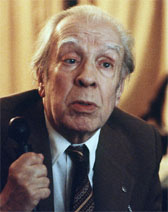
Jorge Luis Borges
A founding figure of Magical Realism and one of the most influential literary minds of the 20th century
Born on August 24, 1899
Died on June 14, 1986
Age at death: 87
Profession: Writer, Essayist, Poet
Place of Birth: Buenos Aires, Argentina
Place of Death: Geneva, Switzerland
Jorge Luis Borges was an Argentine short story writer, essayist, poet, and translator, regarded as one of the most original literary figures of the twentieth century. A master of metaphysical fiction, Borges played a crucial role in shaping the foundations of Magical Realism. Despite his global reputation and profound influence on modern literature, he never received the Nobel Prize. In the final decades of his life, Borges gradually lost his eyesight and continued to write and dictate his works while completely blind.
Jorge Luis Borges was born on 24 August 1899 in Buenos Aires. His father, Jorge Guillermo Borges, was a lawyer and psychology teacher, while his family background exposed him to multiple languages at an early age. Because his paternal grandmother was English, Borges grew up speaking both Spanish and English fluently. His father encouraged him to read extensively and introduced him to chess and philosophy. Borges spent much of his childhood in the family library and garden, environments that profoundly shaped his intellectual imagination.
In 1914, shortly before the outbreak of World War I, Borges and his family moved to Geneva for medical treatment after his father began losing his eyesight due to a hereditary condition. Borges continued his education at the Collège Calvin, where he learned French, Latin, and German. He remained in Geneva until 1919, after which the family lived in Barcelona, Seville, and Madrid before returning to Argentina in 1921. During his European years, Borges encountered numerous writers and literary movements, and his commitment to writing solidified. Influenced by Walt Whitman, he wrote his early poem Hymn to the Sea.
After deciding to pursue a literary career, Borges joined several avant-garde literary circles and became closely associated with figures such as Rafael Cansinos-Asséns and Ramón Gómez de la Serna. Under Cansinos-Asséns’s influence, Borges briefly aligned himself with the Ultraist Movement, although he later distanced himself from it. During this period, he wrote two politically oriented books inspired by the Russian Revolution, but ultimately chose not to publish them.
Two years after returning to Argentina, Borges published his first poetry collection, Fervor of Buenos Aires, followed by Moon Across the Way. He engaged in long philosophical conversations with Macedonio Fernández, a close family friend, through which Borges absorbed the ideas of Arthur Schopenhauer, David Hume, and George Berkeley. These influences contributed to the skeptical, paradoxical, and metaphysical tone that would define his mature style.
In 1929, Borges published Cuaderno San Martín. Beginning in 1934, he released a series of stories in the journal Crítica under the title A Universal History of Infamy. Although these stories reflected earlier narrative experiments, Borges’s distinctive literary voice fully emerged with the 1935 story The Approach to Al-Mu'tasim, widely considered one of the earliest examples of Magical Realism. In 1936, he published his essay collection The History of Eternity.
Facing financial difficulties, Borges began working in 1937 as an assistant at the Buenos Aires Municipal Library. During this time, he translated works by Virginia Woolf and William Faulkner into Spanish. In 1938, the sudden death of his father deeply affected him. After suffering a severe head injury and a life-threatening case of septicemia, Borges temporarily ceased writing. Upon recovery, he produced some of his most celebrated stories, including Pierre Menard, Author of the Quixote and Tlön, Uqbar, Orbis Tertius, both published in the literary journal Sur.
These stories later formed the core of The Garden of Forking Paths, published in 1941. Expanded and revised, the collection reappeared as Fictions in 1944, securing Borges’s place as a central figure in world literature. In 1942, Borges collaborated with Adolfo Bioy Casares under the pseudonym Bustos Domecq to write detective stories, including Six Problems for Don Isidro Parodi.
After Juan Peron came to power in 1946, Borges was dismissed from his library position, and his family suffered persecution under the authoritarian regime. During this period, Borges traveled extensively and published the short story collection The Aleph. Following Perón’s overthrow in 1955, Borges was appointed Director of the Argentine National Library, a role he regarded as deeply symbolic, as he was surrounded by books while gradually losing his sight.
In 1956, Borges became Professor of English and American Literature at the University of Buenos Aires, a position he held for twelve years. In 1961, he received the Formentor International Prize jointly with Samuel Beckett, bringing him long-overdue international recognition. He lectured widely across Europe and the United States.
When Perón returned to power in 1973, Borges resigned from the National Library and relocated to Geneva. During his later years, he published The Book of Sand and collaborated with María Kodama, who assisted him as his eyesight completely failed. Their travels were later documented in Atlas, published in 1984.
Jorge Luis Borges died on 14 June 1986 in Geneva at the age of 86 from liver cancer. His literary legacy—marked by labyrinths, mirrors, infinity, time, and metaphysical doubt—continues to influence writers, philosophers, and thinkers worldwide.
Source: Biyografiler.com
Frequently asked questions about Jorge Luis Borges
Who is Jorge Luis Borges?, Jorge Luis Borges biography, Jorge Luis Borges life story, Jorge Luis Borges age, Jorge Luis Borges facts, Jorge Luis Borges birthplace, Jorge Luis Borges photos, Jorge Luis Borges videos, Jorge Luis Borges career
Related Biographies

Lamine Yamal
Professional footballer

Sam Altman
Entrepreneur, Investor, CEO

Erling Haaland
Professional footballer

Kylian Mbappe
Professional footballer

Giorgia Meloni
Politician, Journalist

Alice Weidel
Politician, Economist


Hongjoong
Singer, Rapper, Songwriter, Composer

Ludacris
Rapper, Actor

Kwon Eunbi
Singer

Sarah Wayne Callies
Actress, Screenwriter, Producer, Director

LaTavia Roberson
Singer, Actress, Entrepreneur

Sydney Sweeney
Actress
Lamine Yamal
Professional footballer

Ma Huateng
Entrepreneur, Inventor

Sergey Lavrov
Diplomat, Politician
Sam Altman
Entrepreneur, Investor, CEO

Abbie Cornish
Actress