
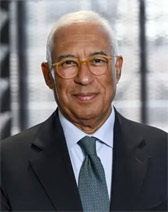
Antonio Costa
Portuguese politician and lawyer who has served as President of the European Council since December 1, 2024. He previously served as Prime Minister of Portugal from 2015 to 2024, Mayor of Lisbon from 2007 to 2015, and Secretary-General of the Socialist Party from 2014 to 2024.
Born on July 17, 1961
Age: 65
Profession: Politician, Lawyer, Former Prime Minister
Place of Birth: Lisbon, Portugal
António Costa, whose full name is António Luís Santos da Costa, was born on July 17, 1961, in Lisbon, Portugal. He is a Portuguese politician and lawyer who has served as President of the European Council since December 1, 2024. A member of the Socialist Party (Portugal), he previously served as Prime Minister of Portugal from November 26, 2015, to April 2, 2024. He was Mayor of Lisbon from 2007 to 2015 and Secretary-General of the Socialist Party from November 22, 2014, to January 7, 2024. His earlier government positions included Minister of Justice, Minister for Parliamentary Affairs, and Minister of Internal Administration. On June 27, 2024, European Union leaders elected him President of the European Council, succeeding Charles Michel. His first term runs until May 31, 2027.
Early Life and Family Background
António Costa was born on July 17, 1961, in the São Sebastião da Pedreira area of Lisbon, Portugal. His father was Orlando da Costa, a writer of Goan Indian descent, and his mother was Maria Antónia Palla, a Portuguese journalist and women's rights advocate.
His father was born in Mozambique to a family with roots in Goa, which had been under Portuguese colonial administration. Orlando da Costa wrote poetry, novels, and plays and was involved in political opposition to the authoritarian Estado Novo regime.
His mother worked in journalism and participated in public discussions concerning women's rights and social issues in Portugal.
Costa grew up during the final years of the Estado Novo dictatorship, which ended with the Carnation Revolution on April 25, 1974.
Education and Legal Career
António Costa studied law at the Faculty of Law of the University of Lisbon, graduating with a degree in legal and political sciences.
He subsequently completed postgraduate studies in European Studies at the Catholic University of Portugal in Lisbon.
He also obtained a postgraduate qualification in contractual litigation, mediation, and arbitration from the same university.
Following his legal education, Costa practiced law in Lisbon. His professional career as a lawyer included periods from 1985 to 1995 and from 2002 to 2004.
During his university years, he participated in student politics and served on the governing body of the University of Lisbon Law Students' Association between 1982 and 1984.
Beginning of His Political Career
António Costa became active in the Socialist Party (Portugal) at a young age.
In 1982, he was elected to the Lisbon Municipal Assembly, serving until 1993.
Between 1990 and 1992, he held a coordinating position in the Socialist Party's Lisbon metropolitan organization.
In 1991, he was elected to the Assembly of the Republic, Portugal's national parliament.
From 1993 to 1995, he served as a municipal councillor in Loures, a municipality in the Lisbon metropolitan area.
These positions preceded his appointment to national government under Socialist Prime Minister António Guterres.
Government Service Under António Guterres
Following the Socialist Party's victory in the 1995 Portuguese legislative election, António Costa joined the government led by Prime Minister António Guterres.
From 1995 to 1997, he served as Secretary of State for Parliamentary Affairs.
In November 1997, he was appointed Minister for Parliamentary Affairs, serving until October 1999.
His responsibilities during this period included government coordination related to Expo '98, the world exposition held in Lisbon in 1998.
On October 25, 1999, Costa became Minister of Justice. He held the position until April 6, 2002.
As Justice Minister, his responsibilities included the administration of the Portuguese justice system and government proposals concerning legal and judicial policy.
Parliamentary Leadership and European Parliament
After leaving the government in 2002, António Costa became president of the Socialist Party's parliamentary group in the Assembly of the Republic.
He held this position from April 2002 until March 2004.
In June 2004, he was elected to the European Parliament. During his term, he also served as one of the Parliament's vice-presidents.
His European Parliament service ended in March 2005 when he returned to the Portuguese government.
Minister of Internal Administration
In March 2005, António Costa joined the government of Prime Minister José Sócrates as Minister of State and Minister of Internal Administration.
His responsibilities included domestic security, police administration, civil protection, and other matters within the ministry's jurisdiction.
He served until May 2007, when he resigned to contest the election for Mayor of Lisbon.
Mayor of Lisbon (2007–2015)
António Costa won the 2007 municipal election in Lisbon and took office as mayor on August 1, 2007.
In that election, the Socialist Party won six of the 17 seats on the Lisbon City Council, leaving Costa without an absolute majority.
He was re-elected in 2009, when the Socialist Party secured nine council seats and an absolute majority.
In the 2013 municipal election, his party increased its representation to 11 seats.
During his eight years as mayor, Costa's administration worked on urban rehabilitation, public transportation, municipal services, and redevelopment projects in Lisbon.
He also served on the European Committee of the Regions from 2010 to 2015.
On November 4, 2013, he became president of the Lisbon Metropolitan Council, a position he held until April 6, 2015.
Costa resigned as mayor on April 6, 2015, to concentrate on national politics and the forthcoming parliamentary election.
Leadership of the Socialist Party
In 2014, António Costa challenged the leadership of the Portuguese Socialist Party following disagreements over its political direction and electoral performance.
He defeated António José Seguro in a party leadership contest and became Secretary-General on November 22, 2014.
His leadership coincided with a period in which Portugal was recovering from the sovereign debt crisis and the economic adjustment programme implemented after the country's 2011 international financial assistance agreement.
Costa led the Socialist Party into the 2015 parliamentary election and subsequently became Prime Minister.
He remained Secretary-General until January 7, 2024, when Pedro Nuno Santos succeeded him.
Prime Minister of Portugal (2015–2024)
António Costa became Prime Minister of Portugal on November 26, 2015, succeeding Pedro Passos Coelho.
Although the centre-right coalition received more votes in the October 2015 parliamentary election, Costa negotiated parliamentary support from parties on the left.
His Socialist minority government was supported through parliamentary agreements with the Left Bloc, the Portuguese Communist Party, and the Ecologist Party "The Greens".
The arrangement became widely known in Portuguese politics as the "geringonça."
His first government adopted measures concerning public-sector salaries, pensions, household incomes, and economic policy following the years of financial austerity.
Portugal also experienced economic growth and a decline in unemployment during parts of his first term.
2019 Election and Second Government
In the October 2019 legislative election, António Costa led the Socialist Party to the largest share of parliamentary seats, although the party did not obtain an absolute majority.
He formed a second minority government and began his second term on October 26, 2019.
During this period, Portugal faced the economic and public health consequences of the COVID-19 pandemic.
His government introduced public health restrictions, economic assistance measures, and vaccination programmes.
Portugal also held the rotating presidency of the Council of the European Union during the first half of 2021.
In October 2021, parliament rejected the government's proposed 2022 state budget, leading to an early parliamentary election.
2022 Election and Third Government
In the January 30, 2022, legislative election, António Costa led the Socialist Party to an absolute parliamentary majority.
He began his third government on March 30, 2022.
His administration faced rising inflation, energy costs, housing shortages, and pressure on public services.
The government also pursued investment programmes involving European Union recovery funding and projects in transport, energy, and digital infrastructure.
Housing affordability became a major political issue during this period, particularly in Lisbon and Porto.
2023 Investigation and Resignation
On November 7, 2023, António Costa announced his resignation as Prime Minister following the opening of a judicial investigation involving alleged irregularities in the approval of major investment projects.
The investigation, known as Operation Influencer, concerned lithium mining concessions and proposed green hydrogen and data centre projects in Portugal.
Investigators examined allegations involving government officials and business representatives. Searches and arrests were carried out as part of the investigation.
Costa denied wrongdoing. He stated that the responsibilities of the prime minister's office were incompatible with the suspicion arising from the investigation.
The investigation and resignation were widely reported, but the allegations against other individuals did not establish personal guilt on Costa's part.
As of the publicly reported developments in 2024, Costa had not been formally charged. Portuguese judicial authorities subsequently clarified that he had not been the direct target of telephone surveillance during the proceedings.
President Marcelo Rebelo de Sousa called an early parliamentary election, which took place on March 10, 2024.
Costa remained in office in a caretaker capacity until April 2, 2024, when Luis Montenegro became Prime Minister.
Election as President of the European Council
On June 27, 2024, European Union heads of state and government selected António Costa as the next President of the European Council.
He succeeded Charles Michel, whose term ended on November 30, 2024.
Costa officially took office on December 1, 2024. His first term is scheduled to end on May 31, 2027.
The President of the European Council chairs meetings of EU heads of state and government, facilitates agreement among member states, and represents the European Union internationally in matters concerning the institution's responsibilities.
The position is distinct from the presidency of the European Commission and the rotating presidency of the Council of the European Union.
European Council Presidency (2024–2026)
After taking office, António Costa focused on coordinating the positions of European Union member states on security, economic policy, migration, and enlargement.
On December 1, 2024, his first day in office, he visited Ukraine and met with Ukrainian President Volodymyr Zelenskyy.
He continued discussions on European support for Ukraine following Russia's full-scale invasion, including military assistance, economic measures, and Ukraine's relationship with the European Union.
His meetings also addressed European defence capabilities, economic competitiveness, migration management, and relations with the United States.
At the European Council meeting of June 26, 2025, EU leaders discussed Ukraine, developments in the Middle East, European defence, migration, and economic challenges.
Costa participated in diplomatic coordination concerning Ukraine alongside European leaders and United States President Donald Trump during 2025.
In 2026, he continued promoting discussions on European competitiveness, defence cooperation, and the enlargement of the European Union.
His enlargement agenda included the membership aspirations of Ukraine, Moldova, and countries in the Western Balkans, with accession remaining conditional on the required political, legal, and economic reforms.
Marriage and Personal Life
António Costa married Fernanda Maria Gonçalves Tadeu in 1987.
The couple have two children, a daughter named Catarina Tadeu da Costa and a son named Pedro Miguel Tadeu da Costa.
His family background includes Portuguese and Goan Indian ancestry through his parents.
Political Party
Socialist Party (Portugal) – Member
November 22, 2014 – January 7, 2024 – Secretary-General
Political and Government Positions
1982–1993 – Member, Lisbon Municipal Assembly
1991–2004 – Member, Portuguese Assembly of the Republic
1993–1995 – Municipal Councillor, Loures
1995–1997 – Secretary of State for Parliamentary Affairs
November 1997 – October 1999 – Minister for Parliamentary Affairs
October 25, 1999 – April 6, 2002 – Minister of Justice
April 2002 – March 2004 – President, Socialist Party Parliamentary Group
June 2004 – March 2005 – Member and Vice-President, European Parliament
March 2005 – May 2007 – Minister of State and Minister of Internal Administration
August 1, 2007 – April 6, 2015 – Mayor of Lisbon
2010–2015 – Member, European Committee of the Regions
November 4, 2013 – April 6, 2015 – President, Lisbon Metropolitan Council
November 22, 2014 – January 7, 2024 – Secretary-General, Socialist Party
November 26, 2015 – April 2, 2024 – Prime Minister of Portugal
December 1, 2024 – Present – President of the European Council
Source: Biyografiler.com
Frequently asked questions about Antonio Costa
Who is Antonio Costa?, Antonio Costa biography, Antonio Costa life story, Antonio Costa age, Antonio Costa facts, Antonio Costa birthplace, Antonio Costa photos, Antonio Costa videos, Antonio Costa career
Related Biographies

Lamine Yamal
Professional footballer

Kylian Mbappe
Professional footballer

Erling Haaland
Professional footballer

Keanu Reeves
Actor

Brad Pitt
Actor

Ronaldinho
Professional footballer

Chris Hansen
Journalist, Presenter

Elizabeth Holmes
Entrepreneur, CEO

Antonio Meucci
Inventor, Engineer

Antonio da Correggio
Painter

Antonio Costa
Politician, Lawyer, Former Prime Minister

Antony Blinken
Politician, Diplomat, Lawyer

Susie Wiles
Political Consultant

Stephen Miller
Consultant
Keanu Reeves
Actor

Nayib Bukele
Politician, Business Leader
Lamine Yamal
Professional footballer
Brad Pitt
Actor