
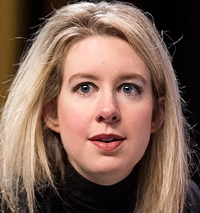
Elizabeth Holmes
American former biotechnology entrepreneur who founded Theranos at the age of 19. The company claimed its technology could perform numerous laboratory tests using a few drops of blood collected from a fingertip and reached a reported valuation of approximately $9 billion. Holmes was convicted of defrauding investors in January 2022. Her original prison sentence of 11 years and three months was reduced to 10 years and three months on March 26, 2026.
Born on February 3, 1984
Age: 42
Profession: Entrepreneur, CEO
Place of Birth: Washington, D.C., United States
Elizabeth Holmes, whose full name is Elizabeth Anne Holmes, was born on February 3, 1984, in Washington, D.C., United States. She is an American former biotechnology entrepreneur and the founder and former chief executive officer of Theranos, a health technology company that claimed it could perform numerous laboratory tests using only a few drops of blood collected from a fingertip. She founded the company in 2003 at the age of 19, after leaving Stanford University. Theranos attracted hundreds of millions of dollars in investment and reached a reported valuation of approximately $9 billion. However, investigations revealed serious problems with the company's testing technology and the accuracy of information provided to investors. On January 3, 2022, Holmes was convicted of conspiracy to commit wire fraud and three counts of wire fraud involving Theranos investors. She received an 11-year-and-three-month prison sentence in November 2022, which was reduced to 10 years and three months in March 2026.
Early Life and Education
Elizabeth Holmes was born on February 3, 1984, in Washington, D.C.. Her mother, Noel Anne Daoust, worked on Capitol Hill as a congressional committee staff member. Her father, Christian Holmes, held positions in government agencies and worked as an executive at the energy company Enron.
Holmes spent much of her childhood in Houston, Texas, where she attended St. John's School. She developed an interest in technology and business while growing up and studied Mandarin Chinese during her school years.
In 2002, she enrolled at Stanford University to study chemical engineering. During a summer internship at the Genome Institute of Singapore, she gained experience in laboratory research and diagnostic testing.
After returning to Stanford, Holmes explored the idea of a wearable patch capable of monitoring a patient's blood chemistry and adjusting medication delivery. She discussed the concept with chemical engineering professor Channing Robertson, who subsequently became involved with Theranos as an adviser and board member.
In 2003, Holmes established a company initially called Real-Time Cures. She left Stanford during her second year to concentrate on the business. The company later adopted the name Theranos, derived from the words "therapy" and "diagnosis."
Founding Theranos and Developing Blood-Testing Technology
At Theranos, Elizabeth Holmes pursued the development of a compact laboratory testing system intended to analyze very small blood samples.
The company promoted devices that it claimed could perform numerous diagnostic tests using blood collected through a finger prick rather than the larger samples typically drawn from a patient's vein.
One of its best-known devices was named Edison. Theranos presented the technology as a way to make laboratory testing more accessible, faster, and less expensive.
Ramesh Balwani, also known as Sunny Balwani, joined Theranos in 2009. He subsequently became the company's president and chief operating officer, taking responsibility for substantial parts of its business and operational activities.
Theranos raised investment from individuals and institutions while keeping much of its technology confidential. By 2014, the company's reported valuation had reached approximately $9 billion, and Holmes was widely featured in business media as its founder and chief executive.
However, the company's technical capabilities did not match many of its public representations. Theranos relied extensively on conventional laboratory equipment manufactured by other companies, while its proprietary devices could perform only a limited portion of the tests it offered.
Walgreens Partnership and the Investigation into Theranos
In 2013, Theranos began offering blood-testing services through a partnership with the American pharmacy chain Walgreens. Collection sites were established in Palo Alto, California, and subsequently at selected Walgreens locations in Arizona.
Customers could visit the collection centers to provide blood samples. Theranos promoted the service as an alternative to conventional laboratory testing, but many analyses were performed using equipment produced by other manufacturers rather than the company's own Edison technology.
In October 2015, The Wall Street Journal published an investigation by journalist John Carreyrou, based on interviews with former employees and company documents. The reporting questioned the reliability of Theranos's testing methods and revealed that its proprietary devices were used for a relatively small proportion of the tests offered to customers.
The investigation was followed by regulatory scrutiny and additional reporting about laboratory quality-control problems and inaccurate test results.
In June 2016, Walgreens terminated its partnership with Theranos and closed approximately 40 Theranos testing centers in Arizona.
John Carreyrou later documented the company's development, internal operations, and collapse in his 2018 book Bad Blood: Secrets and Lies in a Silicon Valley Startup.
SEC Fraud Case and the Closure of Theranos
On March 14, 2018, the U.S. Securities and Exchange Commission (SEC) charged Elizabeth Holmes, Theranos, and Ramesh Balwani with misleading investors.
According to the SEC, Theranos had raised more than $700 million while making false or exaggerated representations concerning its blood-testing technology, financial performance, and business operations.
The allegations included misleading statements about the capabilities of its laboratory devices, projected revenues, and the use of Theranos technology by the United States military.
Holmes settled the SEC's civil charges without admitting or denying the allegations. Under the settlement, she agreed to pay a $500,000 penalty, relinquish voting control of Theranos, return company shares, and accept a ten-year prohibition on serving as an officer or director of a publicly traded company.
In June 2018, a federal grand jury indicted Holmes and Balwani on criminal charges involving alleged fraud against investors and patients.
They were tried separately. Theranos discontinued its remaining operations and began liquidation proceedings in September 2018.
Criminal Trial and Conviction
Elizabeth Holmes's federal criminal trial began in 2021 in the United States District Court for the Northern District of California.
Prosecutors presented evidence concerning statements made to Theranos investors about the performance of its testing technology, its commercial partnerships, projected revenues, and its dealings with the United States Department of Defense.
On January 3, 2022, the jury convicted Holmes of one count of conspiracy to commit wire fraud against investors and three counts of wire fraud involving individual investors.
She was acquitted of the patient-related conspiracy charge and three charges involving alleged fraud against individual patients. The jury was unable to reach a unanimous verdict on three additional investor-related counts. Another patient-related count had been dismissed during the trial.
On November 18, 2022, federal judge Edward J. Davila sentenced Holmes to 135 months in prison, equivalent to 11 years and three months, followed by three years of supervised release.
In May 2023, the court ruled that Holmes and Balwani were jointly responsible for restitution totaling $452,047,268 to investors and other victims identified in the court's order.
Holmes began serving her prison sentence on May 30, 2023, at a federal prison camp in Bryan, Texas.
Appeal and Reduction of Her Prison Sentence
Elizabeth Holmes appealed her conviction, sentence, and restitution order, arguing that errors during the trial had affected the proceedings.
On February 24, 2025, the United States Court of Appeals for the Ninth Circuit upheld her conviction, prison sentence, and the restitution order. The appeals court also upheld the conviction and related judgments against Ramesh Balwani.
On March 26, 2026, Judge Edward J. Davila granted Holmes's motion for a sentence reduction under a retroactive amendment to the federal sentencing guidelines concerning certain defendants without prior criminal history.
The court reduced her prison sentence from 135 months to 123 months, equivalent to 10 years and three months. The reduction did not overturn her fraud convictions or eliminate the restitution obligation.
The Dropout and Media Portrayals
The history of Theranos and Elizabeth Holmes's leadership of the company became the subject of books, investigative reporting, documentaries, and television productions.
In 2022, the television miniseries The Dropout was released, dramatizing Holmes's years at Stanford, the founding of Theranos, its growth, and the events that led to the company's collapse.
Actress Amanda Seyfried portrayed Holmes in the series, which also featured Naveen Andrews as Ramesh Balwani.
The production was based on the podcast of the same name developed by ABC News. Amanda Seyfried received the Primetime Emmy Award for Outstanding Lead Actress in a Limited or Anthology Series or Movie for her performance.
You Can See Everything (2026) Documentary
Elizabeth Holmes's life and the fraud case involving her former company, Theranos, became the subject of the 2026 documentary film You Can See Everything, released in Turkey under the title Her Şey Ortada. Directed by Nathan Fielder and Lance Oppenheim, the film follows Holmes during the final weeks before she began serving her federal prison sentence and examines her relationship with the documentary filmmakers.
Thirty-four days before entering prison in 2023, Holmes invited the filmmakers to document her daily life. What began as an attempt to present her story from her own perspective developed into a documentary project spanning three years. The film features Holmes, her partner Billy Evans, filmmaker Nathan Fielder, and actress Amanda Seyfried.
Distributed by A24, the documentary was released in United States theaters on October 16, 2026. Running approximately 174 minutes, the film examines Holmes's attempts to explain her actions publicly and the filmmakers' efforts to question and assess her account.
Source: Biyografiler.com
Frequently asked questions about Elizabeth Holmes
Who is Elizabeth Holmes?, Elizabeth Holmes biography, Elizabeth Holmes life story, Elizabeth Holmes age, Elizabeth Holmes facts, Elizabeth Holmes birthplace, Elizabeth Holmes photos, Elizabeth Holmes videos, Elizabeth Holmes career

Lamine Yamal
Professional footballer

Kylian Mbappe
Professional footballer

Erling Haaland
Professional footballer

Keanu Reeves
Actor

Brad Pitt
Actor

Ronaldinho
Professional footballer

Chris Hansen
Journalist, Presenter

Elizabeth Holmes
Entrepreneur, CEO

Antonio Meucci
Inventor, Engineer

Antonio da Correggio
Painter

Antonio Costa
Politician, Lawyer, Former Prime Minister

Antony Blinken
Politician, Diplomat, Lawyer

Susie Wiles
Political Consultant

Stephen Miller
Consultant
Keanu Reeves
Actor

Nayib Bukele
Politician, Business Leader
Lamine Yamal
Professional footballer
Brad Pitt
Actor