
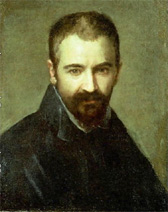
Antonio da Correggio
Italian Renaissance painter whose real name was Antonio Allegri. Associated with the School of Parma, he is known for his illusionistic ceiling frescoes, religious paintings, and mythological works, including Assumption of the Virgin, The Holy Night, and Jupiter and Io.
Born on August 30, 1489
Died on March 5, 1534
Age at death: 45
Profession: Painter
Place of Birth: Correggio, Emilia-Romagna, Italy
Place of Death: Correggio, Emilia-Romagna, Italy
Antonio da Correggio, whose real name was Antonio Allegri, was born around 1489 in Correggio, a town in the Emilia-Romagna region of Italy. He was an Italian Renaissance painter associated with the School of Parma. His work included religious altarpieces, mythological paintings, and large-scale fresco decorations. He is known particularly for the illusionistic ceiling paintings in the Church of San Giovanni Evangelista and Parma Cathedral. His use of light and shadow, foreshortened figures, and compositions designed to create the appearance of open space influenced later developments in Baroque ceiling painting. Among his works are Madonna of St. Francis, The Holy Night, Assumption of the Virgin, and Jupiter and Io. He died on March 5, 1534, in his hometown of Correggio.
Early Life and Family Background
Antonio da Correggio was born around 1489 in Correggio, near Reggio Emilia in northern Italy. His exact birth date is uncertain, although August 30, 1489, has sometimes been given in biographical accounts.
His father, Pellegrino Allegri, was a merchant, and his mother was Bernardina Piazzoli Aromanni. The family lived in a town that maintained cultural and political connections with the courts of northern Italy.
Antonio Allegri became known by the name Correggio, taken from his birthplace.
Little documentary evidence survives concerning his childhood and earliest artistic training. According to traditional accounts, he may have received his first painting lessons from his uncle Lorenzo Allegri, who was also a painter.
Artistic Training in Modena and Mantua
According to accounts of his early career, Antonio da Correggio traveled to Modena around 1503 and may have studied with the painter Francesco Bianchi Ferrari between approximately 1503 and 1505.
During his formative years, he became familiar with the work of artists including Francesco Francia and Lorenzo Costa, whose paintings were associated with the artistic traditions of Bologna and northern Italy.
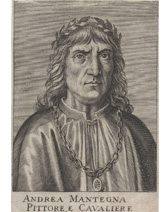
Correggio also spent time in Mantua, where the paintings of Andrea Mantegna influenced his early development.
Mantegna had worked for the Gonzaga court and was known for his experiments with perspective, architectural illusion, and foreshortening. His ceiling decoration in the Camera degli Sposi at the Ducal Palace in Mantua provided an earlier example of the illusionistic approach Correggio later developed in his own frescoes.
Some art historians have suggested that Correggio worked in Mantegna's circle before the painter's death in 1506. His participation in the decoration of the Mantegna family chapel in the Basilica of Sant'Andrea has also been proposed, although the precise extent of his involvement remains disputed.
His presence in Mantua is documented in 1511. He is associated with circular paintings, or tondi, depicting religious subjects for the entrance area of the Basilica of Sant'Andrea. These works include representations of the Holy Family and the Deposition of Christ.
Early Religious Paintings
By 1514, Antonio da Correggio was receiving independent commissions.
That year, he was commissioned to paint Madonna of St. Francis for the Franciscan church in his hometown of Correggio.
The altarpiece presents the Virgin Mary and Christ Child with saints, including Saint Francis of Assisi. The painting is now in the Gemäldegalerie Alte Meister in Dresden, Germany.
The composition combines elements of the northern Italian Renaissance tradition with Correggio's developing approach to figures, expression, and pictorial space.
His early religious works also include representations of the Holy Family, the Adoration of the Christ Child, and scenes from the life of Christ.
Although the influence of Andrea Mantegna is visible in these paintings, Correggio increasingly adopted the soft transitions between light and shadow associated with Leonardo da Vinci.
Leonardo's technique of sfumato, which softens the boundaries between forms and surrounding space, can be recognized in Correggio's treatment of faces, bodies, and atmospheric effects.
His work also shows connections with the paintings of Raphael and the color traditions of northern Italy.
Possible Journey to Rome
Art historians have debated whether Antonio da Correggio visited Rome during his early career.
Some scholars believe that he traveled there around 1517 or 1518 and saw the works of Michelangelo Buonarroti and Raphael in the Vatican.
Michelangelo's ceiling frescoes in the Sistine Chapel and Raphael's wall paintings in the Vatican Rooms offered examples of large-scale figure compositions and architectural perspective.
However, no surviving document conclusively establishes Correggio's visit. His familiarity with Roman painting may also have developed through drawings, prints, and the circulation of artistic ideas between Italian cities.
Camera di San Paolo in Parma
In 1518, Antonio da Correggio received a commission to decorate a room in the Benedictine convent of San Paolo in Parma.
The room belonged to Abbess Giovanna da Piacenza, who commissioned the artist to paint its vaulted ceiling and surrounding decoration.
Completed around 1519, the fresco cycle is known as the Camera di San Paolo or Camera della Badessa.
Correggio painted a simulated arbor formed by interlacing branches and foliage. Within the arrangement, circular openings reveal groups of playful putti, or winged children.
Below these openings, he depicted figures and objects in monochrome, creating the appearance of sculptural reliefs.
Above the fireplace, he painted the Roman goddess Diana.
The decoration combines mythological imagery with an architectural illusion in which the painted ceiling appears to open beyond the actual boundaries of the room.
The Camera di San Paolo is among the earliest surviving examples of Correggio's mature approach to illusionistic ceiling painting.
Frescoes of San Giovanni Evangelista
In 1520, Antonio da Correggio began work on the fresco decoration of the Church of San Giovanni Evangelista in Parma.
The project included the dome, pendentives, and other architectural surfaces of the Benedictine church.
The principal dome composition, commonly known as the Vision of Saint John on Patmos, depicts Christ appearing to Saint John the Evangelist.
Christ is represented above the viewer, surrounded by apostles positioned among clouds. The composition uses foreshortening to make the figures appear to occupy a space extending beyond the dome.
Correggio worked on this decoration between approximately 1520 and 1523.
Instead of dividing the ceiling into separate framed scenes, he organized the painted figures around a continuous illusion of heavenly space.
This approach became a reference point for later painters working on church domes and ceilings.
Parma Cathedral and Assumption of the Virgin
Antonio da Correggio received the commission to decorate the dome of Parma Cathedral in 1522. The frescoes were executed primarily between 1526 and 1530.
The central subject is the Assumption of the Virgin, depicting the Virgin Mary being carried into heaven among angels and saints.
Correggio arranged numerous figures in a circular composition that rises toward the center of the dome.
Viewed from below, the figures appear to move through layers of clouds into an open sky. Their bodies are shown from different angles, including extreme foreshortening.
Architectural boundaries are visually reduced as the painted scene extends into an imagined space above the church.
The treatment of light, movement, and perspective differs from the more clearly divided architectural compositions found in many earlier Renaissance ceiling paintings.
The frescoes were completed around 1530 and remain in Parma Cathedral.
Correggio's work in the cathedral was later studied by artists associated with the development of Baroque ceiling painting, including Giovanni Lanfranco.
Madonna Paintings and Religious Altarpieces
Alongside his fresco commissions, Antonio da Correggio continued producing religious paintings for churches and private patrons.
His treatment of the Virgin Mary and Christ Child frequently emphasizes gestures, physical contact, and the relationship between figures.
One of his paintings, Madonna of St. Jerome, also known as Il Giorno (The Day), was completed around 1528.
The painting depicts the Virgin and Child with Saint Jerome, Mary Magdalene, and other figures. It is now housed in the Galleria Nazionale di Parma.
Another painting, Adoration of the Shepherds, commonly called La Notte (The Holy Night), was commissioned in 1522 for the Pratoneri family chapel in the Church of San Prospero in Reggio Emilia.
The work was completed around 1530 and is now held by the Gemäldegalerie Alte Meister in Dresden.
In La Notte, the infant Christ serves as the principal source of illumination, casting light onto the faces of Mary and the surrounding figures.
The contrast between the illuminated figures and the darkness of the stable creates the painting's nighttime setting.
Other works associated with this period include Madonna della Scodella and Madonna of the Basket.
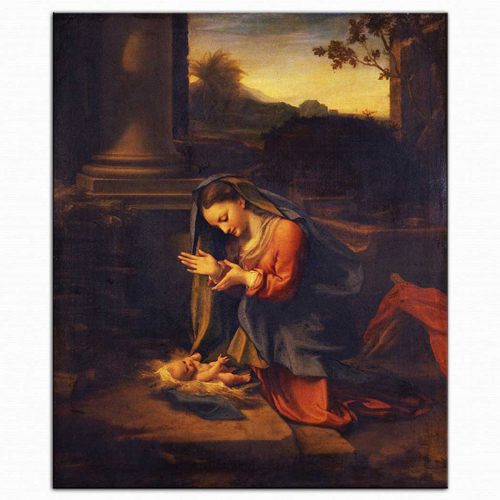
Madonna painting by Antonio da Correggio, dated approximately 1522.
Mythological Paintings
During the later years of his career, Antonio da Correggio painted mythological subjects in addition to religious works.
Several of these paintings were commissioned for Federico II Gonzaga, Duke of Mantua.
Among the works associated with the duke's commissions are Jupiter and Io, Ganymede Abducted by the Eagle, Danaë, and Leda and the Swan.
These paintings depict episodes from classical mythology involving Jupiter and other mythological figures.
In Jupiter and Io, the god Jupiter appears in the form of a cloud embracing Io. Correggio uses the surrounding atmosphere to establish the relationship between the human figure and the supernatural presence.
Danaë depicts the mythological princess visited by Jupiter in the form of a shower of gold.
In Ganymede Abducted by the Eagle, the young Ganymede is carried into the sky by an eagle associated with Jupiter.
The mythological works employ soft modeling, bodily movement, and compositions that place figures within atmospheric settings.
These paintings were completed mainly during the late 1520s and early 1530s.
Painting Technique and Artistic Style
Antonio da Correggio is associated with the High Renaissance tradition of northern Italy, particularly the School of Parma. Elements of his work have also been discussed in relation to Mannerism.
His compositions frequently use diagonal arrangements, overlapping figures, and bodies shown in motion.
He employed chiaroscuro, the contrast between light and shadow, to model figures and direct attention toward particular parts of a painting.
In several works, the edges of figures are softened through gradual tonal transitions rather than defined by strong outlines.
Foreshortening, known in Italian as *scorcio*, became particularly important in his dome paintings.
This technique represents figures or objects from a sharply angled viewpoint, making their proportions appear compressed when seen from below.
Correggio used foreshortening and perspective to create the impression that painted figures were moving through the space above the viewer.
His dome frescoes combined this approach with light, clouds, and circular compositions to give the illusion of an open sky.
These techniques anticipated aspects of seventeenth-century Baroque ceiling painting and were later examined by artists working in the Baroque and Rococo periods.
Influence on Later Painters
The paintings and frescoes of Antonio da Correggio were studied by artists working after his death.
Parmigianino, another painter associated with Parma, was influenced by Correggio's treatment of figures, facial expressions, and compositional movement.
During the late sixteenth and seventeenth centuries, painters including Annibale Carracci and Giovanni Lanfranco examined his ceiling decorations and methods of creating spatial illusion.
Lanfranco's dome paintings in Rome demonstrate the later development of illusionistic compositions that had appeared in Correggio's work at Parma.
Painter and biographer Giorgio Vasari wrote about Correggio in Lives of the Most Excellent Painters, Sculptors, and Architects, first published in 1550 and revised in 1568.
Correggio's paintings were also collected and studied by European artists and patrons in the eighteenth and nineteenth centuries.
Marriage and Children
Antonio da Correggio married Girolama Merlini de' Braghetis, also recorded as Girolama Francesca di Braghetis, in 1520.
The couple had four children. Their son Pomponio Allegri, born on September 3, 1521, later became a painter.
They also had three daughters: Francesca Letizia, born in 1524; Caterina Lucrezia, born in 1526; and Anna Geria, born in 1527.
His wife died in 1529.
Death
Antonio da Correggio died on March 5, 1534, in Correggio, Emilia-Romagna, Italy.
He was approximately 44 or 45 years old, depending on his uncertain birth date.
At the time of his death, his completed works included the dome frescoes of San Giovanni Evangelista and Parma Cathedral, numerous religious altarpieces, and a series of mythological paintings.
Selected Paintings and Frescoes
c. 1512–1514 – Holy Family with the Infant Saint John
1514–1515 – Madonna of St. Francis – Gemäldegalerie Alte Meister, Dresden
c. 1514 – The Deposition of Christ – Basilica of Sant'Andrea, Mantua
c. 1518–1519 – Camera di San Paolo – Convent of San Paolo, Parma
c. 1520–1523 – Vision of Saint John on Patmos – Church of San Giovanni Evangelista, Parma
c. 1522–1525 – Madonna of the Basket
c. 1524–1526 – Noli Me Tangere – Museo del Prado, Madrid
c. 1526–1530 – Assumption of the Virgin – Parma Cathedral
c. 1528 – Madonna of St. Jerome (Il Giorno) – Galleria Nazionale di Parma
c. 1528–1530 – Adoration of the Shepherds (La Notte) – Gemäldegalerie Alte Meister, Dresden
c. 1528–1530 – Madonna della Scodella – Galleria Nazionale di Parma
c. 1530–1532 – Jupiter and Io – Kunsthistorisches Museum, Vienna
c. 1530–1532 – Ganymede Abducted by the Eagle – Kunsthistorisches Museum, Vienna
c. 1531 – Danaë – Galleria Borghese, Rome
c. 1531–1532 – Leda and the Swan – Gemäldegalerie, Berlin
Source: Biyografiler.com
Frequently asked questions about Antonio da Correggio
Who is Antonio da Correggio?, Antonio da Correggio biography, Antonio da Correggio life story, Antonio da Correggio age, Antonio da Correggio facts, Antonio da Correggio birthplace, Antonio da Correggio photos, Antonio da Correggio videos, Antonio da Correggio career
Related Biographies

Lamine Yamal
Professional footballer

Kylian Mbappe
Professional footballer

Erling Haaland
Professional footballer

Keanu Reeves
Actor

Brad Pitt
Actor

Ronaldinho
Professional footballer

Chris Hansen
Journalist, Presenter

Elizabeth Holmes
Entrepreneur, CEO

Antonio Meucci
Inventor, Engineer

Antonio da Correggio
Painter

Antonio Costa
Politician, Lawyer, Former Prime Minister

Antony Blinken
Politician, Diplomat, Lawyer

Susie Wiles
Political Consultant

Stephen Miller
Consultant
Keanu Reeves
Actor

Nayib Bukele
Politician, Business Leader
Lamine Yamal
Professional footballer
Brad Pitt
Actor