
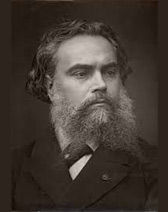
Alexandre Cabanel
French academic painter known for historical, mythological, religious, and portrait paintings. His works include The Fallen Angel (1847), The Birth of Venus (1863), and Phaedra (1880). He was elected to the Académie des Beaux-Arts in 1863 and taught at the École des Beaux-Arts in Paris.
Born on September 28, 1823
Died on January 23, 1889
Age at death: 66
Profession: Painter
Place of Birth: Montpellier, France
Place of Death: Paris, France
Alexandre Cabanel (September 28, 1823 – January 23, 1889) was a French painter associated with nineteenth-century Academic Art. He produced historical, mythological, and religious paintings, portraits, and decorative works for public buildings and private residences. His painting The Birth of Venus (1863), purchased by Emperor Napoleon III, became one of the best-known examples of French academic painting during the Second Empire. Earlier in his career, he painted The Fallen Angel (1847), depicting the fallen angel Lucifer, a work now held by the Musée Fabre in Montpellier. Cabanel studied under François-Édouard Picot at the École des Beaux-Arts in Paris and continued his education at the French Academy in Rome after receiving the second Grand Prix de Rome in 1845. In 1863, he was elected to the Académie des Beaux-Arts and appointed to teach at the École des Beaux-Arts, where his students included painters from France and other countries. He exhibited regularly at the Paris Salon and received commissions from Emperor Napoleon III and members of the French aristocracy.
Early Life and Family Background
Alexandre Cabanel was born on September 28, 1823, in Montpellier, in southern France. His father, Pierre-Jean Cabanel, worked as a cabinetmaker, and his mother was Marie-Anne Jean Cabanel. He grew up in a large family.
His artistic interests developed during childhood. In 1834, when he was approximately eleven years old, he began attending drawing classes at Montpellier's municipal art school, where he studied under Charles-François Matet.
Matet provided instruction in drawing, figure studies, and the principles of classical composition. Cabanel's early training followed the academic system, which emphasized accurate representation of the human figure and knowledge of traditional artistic techniques.
In 1839, he obtained a scholarship from the city of Montpellier that allowed him to continue his studies in Paris.
Education at the École des Beaux-Arts
In 1840, Alexandre Cabanel entered the École des Beaux-Arts in Paris, where he studied painting under François-Édouard Picot, a French artist associated with Neoclassicism.
His formal education included drawing from plaster casts, studying the human figure, and developing compositions based on historical, literary, and religious subjects.
The academic curriculum emphasized familiarity with Greek and Roman art, Renaissance painting, and the traditions of European history painting.
Cabanel also studied works displayed in Parisian museums and collections, which provided examples of painting techniques, composition, and color.
When his original scholarship came to an end, Picot supported his efforts to obtain additional financial assistance from Montpellier's municipal authorities. Cabanel continued his studies and prepared for competitions organized by the French Academy.
Early Exhibitions and the Prix de Rome
Alexandre Cabanel began participating in the Paris Salon during the 1840s. His early exhibited works included The Agony in the Garden, a religious painting associated with his Salon debut in 1843–1844.
He competed for the Prix de Rome, an academic competition that awarded promising artists the opportunity to study in Italy.
In 1844, he submitted Cincinnatus Receiving the Ambassadors of the Roman Senate, a historical composition based on an episode from ancient Roman history.
In 1845, he received the second Grand Prix de Rome for Jesus in the Praetorium, a painting depicting Christ before the Roman authorities.
The distinction enabled him to study at the French Academy in Rome, located at the Villa Medici.
Studies in Rome
In January 1846, Alexandre Cabanel began his residency at the French Academy in Rome. He remained in Italy until the end of 1850, studying ancient sculpture, Renaissance painting, and Italian artistic traditions.
Rome provided direct access to works from classical antiquity and the Renaissance. Cabanel examined paintings, frescoes, and sculptures while continuing to develop his own compositions.
Like other recipients of the Prix de Rome, he was required to produce paintings that could be submitted to the French Academy for evaluation. These works were known as the *envois de Rome*.
His Roman-period paintings included Orestes (1846), The Fallen Angel (1847), Saint John the Baptist (1849), and The Death of Moses (1850).
During this period, Cabanel developed a painting style characterized by detailed figure drawing, carefully modeled bodies, and compositions based on religious and historical narratives.
Friendship with Alfred Bruyas
While studying in Rome, Alexandre Cabanel developed a friendship with Alfred Bruyas (1821–1876), an art collector from Montpellier.
Bruyas came from a wealthy family and used his financial resources to commission paintings and support artists.
Cabanel painted Portrait of Alfred Bruyas in 1846. The work depicts the collector wearing a formal coat and holding a pair of spectacles.
The portrait became part of Bruyas's collection, which was later incorporated into the holdings of the Musée Fabre in Montpellier.
Bruyas also supported other nineteenth-century French artists, including Gustave Courbet.
The relationship between Cabanel and Bruyas continued after the painter returned to France and included further commissions and acquisitions.
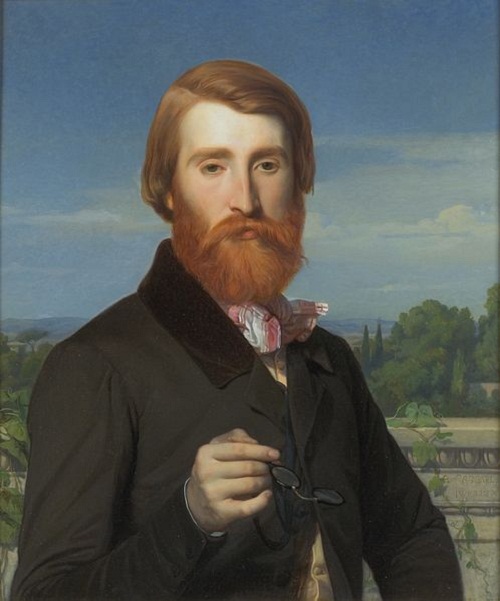
Alexandre Cabanel, Portrait of Alfred Bruyas (1846). Musée Fabre, Montpellier.
The Fallen Angel (1847)
In 1847, while studying at the Villa Medici in Rome, Alexandre Cabanel painted The Fallen Angel (*L'Ange déchu*), an oil painting depicting Lucifer following his expulsion from Heaven.
The painting shows a winged male figure seated on the ground, with his arms raised toward his head. His face is partly concealed, while one eye looks outward from beneath his arm.
His wings extend behind him, and other angels can be seen in the distance.
The subject draws on biblical accounts of the fall of rebellious angels and literary interpretations associated with Paradise Lost by John Milton, first published in 1667.
In the painting, Cabanel represents Lucifer as a physically idealized figure whose facial expression and posture convey anger and distress.
The work was prepared as one of Cabanel's required submissions from Rome to the French Academy in Paris.
Its subject differed from the conventional historical and religious themes often selected by students. Contemporary academic responses criticized aspects of its composition and execution.
The painting remained in Cabanel's possession and later passed to his family. His brother Barthélémy Cabanel donated it to the Musée Fabre in 1889.
The Fallen Angel is preserved in the museum's collection in Montpellier.
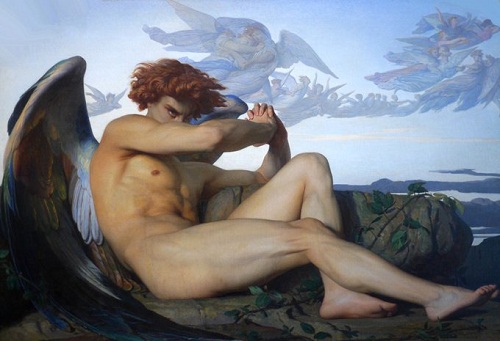
Alexandre Cabanel, The Fallen Angel (1847), oil on canvas. Musée Fabre, Montpellier.
Return to Paris and Early Commissions
After completing his residency in Rome, Alexandre Cabanel returned to France in 1851 and established his professional career in Paris.
In 1852, he received a second-class medal at the Paris Salon.
His work increasingly included portraits and decorative commissions in addition to historical and religious subjects.
Between 1852 and 1853, he contributed paintings representing the months of the year to the decoration of the Hôtel de Ville de Paris. These works were later destroyed during the fires that affected the building in 1871.
He also received commissions for decorative paintings in private Parisian residences, including the Hôtel Chevalier de Montigny.
His decorative projects involved adapting classical and allegorical subjects to architectural spaces, particularly ceilings and large interior wall surfaces.
Self-Portrait of 1852
In 1852, Alexandre Cabanel painted a self-portrait commissioned by his friend and patron Alfred Bruyas.
The painting depicts the artist in dark clothing against a subdued background, with light concentrated on his face and collar.
Cabanel was approximately twenty-nine years old when he completed the portrait.
The painting became part of the Bruyas collection and is now held by the Musée Fabre in Montpellier.
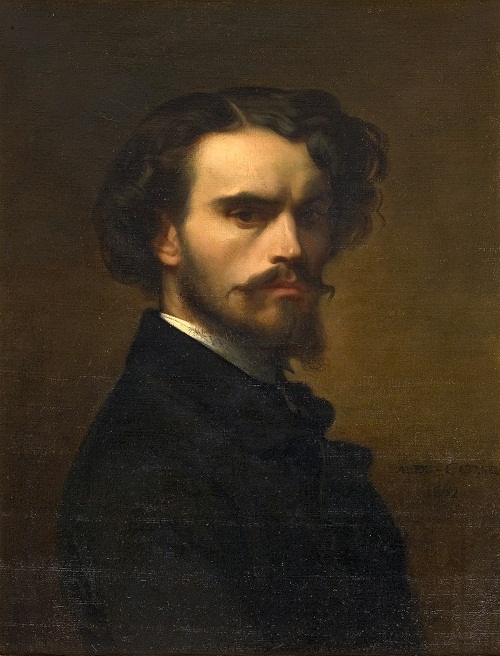
Alexandre Cabanel, Self-Portrait (1852). Musée Fabre, Montpellier.
Recognition Under Napoleon III
During the 1850s, Alexandre Cabanel received a growing number of commissions from wealthy collectors, public institutions, and members of French society.
He exhibited regularly at the Paris Salon, the principal official exhibition of contemporary art in France.
In 1855, he received a first-class medal at the Salon and was appointed a Knight of the Legion of Honour.
Cabanel subsequently worked on decorative commissions for Parisian buildings, including the Hôtel Pereire and Hôtel de Say.
His paintings included mythological figures, biblical subjects, historical characters, and portraits of aristocratic patrons.
He also received commissions from the court of Emperor Napoleon III, whose patronage provided opportunities for further official work.
The Birth of Venus (1863)
In 1863, Alexandre Cabanel exhibited The Birth of Venus (*La Naissance de Vénus*) at the Paris Salon.
The oil painting depicts Venus, the Roman goddess of love and beauty, reclining on the surface of the sea. Small winged figures hover above her, while the sea forms the background.
The composition follows conventions of academic painting, including idealized anatomy, carefully blended colors, and smooth brushwork.
The painting measures approximately 130 by 225 centimeters and was purchased by Emperor Napoleon III for his private collection.
It is now held by the Musée d'Orsay in Paris.
The subject allowed Cabanel to depict the nude human body within the accepted conventions of classical mythology.
The painting received favorable attention at the official Salon, although contemporary critics differed in their assessments of its artistic qualities.
Writer and art critic Émile Zola, for example, criticized the idealized treatment of the female figure.
The work has frequently been discussed in comparison with paintings by Edouard Manet, particularly Olympia and Le Déjeuner sur l'herbe, which challenged established expectations about the representation of the nude.
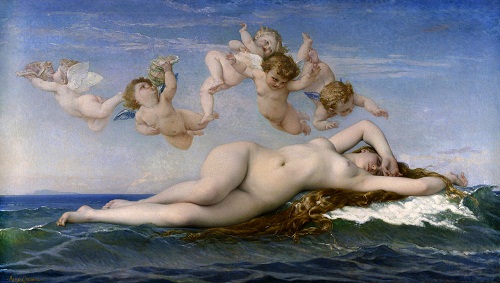
Alexandre Cabanel, The Birth of Venus (1863), oil on canvas. Musée d'Orsay, Paris.
The 1875 Version of The Birth of Venus
In 1875, Alexandre Cabanel produced a smaller version of The Birth of Venus for the American banker and art collector John Wolfe.
This second painting measures approximately 106 by 183 centimeters and follows the composition of the original 1863 work.
It entered the collection of the Metropolitan Museum of Art in New York as a gift from Wolfe in 1893.
The museum holds the work under accession number 94.24.1.
The two versions demonstrate the continued commercial demand for Cabanel's mythological paintings among collectors in France and the United States.
The Paris Salon and the Salon des Refusés
In 1863, the year in which Alexandre Cabanel exhibited The Birth of Venus, the official Paris Salon became the center of a major controversy over the rejection of submitted artworks.
Many artists complained that the Salon jury had excluded works that did not meet prevailing academic expectations.
Among the rejected submissions was Le Déjeuner sur l'herbe by Edouard Manet.
Emperor Napoleon III authorized a separate exhibition known as the Salon des Refusés, allowing the public to view artworks rejected by the official Salon.
The exhibition included works by artists such as James McNeill Whistler, Camille Pissarro, and Edouard Manet.
The two exhibitions demonstrated differences between officially accepted academic art and newer approaches to subject matter, composition, and painting technique.
Cabanel subsequently served on Salon juries and participated in the administration of official artistic institutions.
His professional position placed him among the academic painters whose methods were increasingly questioned by younger artists associated with Realism and Impressionism.
Professor at the École des Beaux-Arts
In 1863, Alexandre Cabanel was elected to the Académie des Beaux-Arts and became a professor at the École des Beaux-Arts in Paris.
He formally directed a painting studio at the institution from 1864 until his death.
His teaching emphasized drawing, figure construction, anatomical study, historical subjects, and the organization of large compositions.
Among his students were Jules Bastien-Lepage, Henri Gervex, Édouard Debat-Ponsan, Henri Regnault, Charles Lucien Léandre, François Guiguet, and Louis Royer.
Other painters associated with his teaching included Charles Fouqueray and Paul Tavernier.
His studio attracted students from France and other countries, including artists who later developed styles different from their teacher's academic approach.
The Ottoman painter Süleyman Seyyid also studied with Cabanel in Paris during the 1860s.
Cabanel continued teaching while producing paintings and participating in the official Salon's artistic administration.
Later Historical and Mythological Paintings
During the 1860s and 1870s, Alexandre Cabanel continued producing paintings based on mythology, literature, and history.
Among these works were Nymph Abducted by a Faun (1860), The Rest of Ruth (1866), and Paradise Lost (1867).
He also painted The Death of Francesca da Rimini and Paolo Malatesta (1870), based on the episode of Francesca and Paolo in The Divine Comedy by Dante Alighieri.
The painting depicts the deaths of the two lovers, whose story appears in the fifth canto of Dante's Inferno.
Cabanel used carefully arranged figures and theatrical gestures to represent the scene.
Other works from this period included Thamar (1875), a painting based on a biblical subject.
His later paintings included Phaedra (1880), drawn from Greek mythology and classical tragedy.
In 1883, he produced Cleopatra Testing Poisons on Condemned Prisoners, depicting the Egyptian queen observing the effects of poison.
Portrait Painting
Alongside his history paintings, Alexandre Cabanel maintained a substantial career as a portrait artist.
His portrait commissions came from French aristocrats, wealthy collectors, political figures, and foreign patrons.
He painted figures including Alfred Bruyas, Catharine Lorillard Wolfe, and members of the European upper classes.
In 1876, he completed a portrait of American art collector Catharine Lorillard Wolfe, now in the collection of the Metropolitan Museum of Art in New York.
His portraits were characterized by precise drawing, detailed treatment of clothing and accessories, and attention to the sitter's posture and facial expression.
Portrait commissions remained a significant part of his professional activity during the final decades of his life.
Decorative Painting and Public Commissions
Alexandre Cabanel received commissions for public buildings and private residences throughout his career.
He contributed to decorative programs in the Louvre Palace, the Hôtel de Ville in Paris, and the Panthéon in Paris.
His paintings for the Panthéon included scenes from the life of Louis IX of France, also known as Saint Louis.
These works formed part of a wider decorative program involving several French painters.
Cabanel's commissions often required large compositions designed to be viewed within architectural interiors.
He continued accepting decorative projects while working on easel paintings and portraits.
Awards and Academic Positions
Alexandre Cabanel received numerous official honors during his lifetime.
He was awarded the Grand Medal of Honour at the Paris Salon in 1865, 1867, and 1878.
In addition to receiving the Legion of Honour in 1855, he was promoted to Officer of the Legion of Honour in 1864.
His election to the Académie des Beaux-Arts in 1863 and his teaching appointment at the École des Beaux-Arts gave him an established role in the administration and education of French academic art.
Death
Alexandre Cabanel died on January 23, 1889, in Paris, France, at the age of 65.
He was buried at Saint-Lazare Cemetery in Montpellier.
Following his death, his works remained in French museum collections and in the collections of institutions including the Musée d'Orsay, Musée Fabre, and Metropolitan Museum of Art.
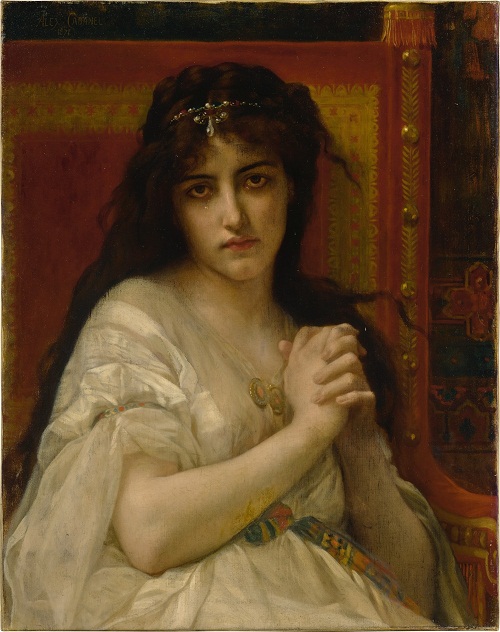
Alexandre Cabanel, Desdemona (1871), signed and dated in the upper-left corner.
Selected Paintings
1844 – Cincinnatus Receiving the Ambassadors of the Roman Senate
1845 – Jesus in the Praetorium
1846 – Orestes
1846 – Portrait of Alfred Bruyas
1847 – The Fallen Angel
1849 – Saint John the Baptist
1850 – The Death of Moses
1852 – Self-Portrait
1852 – Velléda
1860 – Nymph Abducted by a Faun
1863 – The Birth of Venus
1866 – The Rest of Ruth
1867 – Paradise Lost
1870 – The Death of Francesca da Rimini and Paolo Malatesta
1871 – Desdemona
1873 – Portrait of the Countess of Keller
1875 – Thamar
1875 – The Birth of Venus (Second version commissioned by John Wolfe)
1876 – Portrait of Catharine Lorillard Wolfe
1880 – Phaedra
1883 – Cleopatra Testing Poisons on Condemned Prisoners
Source: Biyografiler.com
Frequently asked questions about Alexandre Cabanel
Who is Alexandre Cabanel?, Alexandre Cabanel biography, Alexandre Cabanel life story, Alexandre Cabanel age, Alexandre Cabanel facts, Alexandre Cabanel birthplace, Alexandre Cabanel photos, Alexandre Cabanel videos, Alexandre Cabanel career
Related Biographies

Lamine Yamal
Professional footballer

Kylian Mbappe
Professional footballer

Erling Haaland
Professional footballer

Keanu Reeves
Actor

Brad Pitt
Actor

Bad Bunny
Rapper, Songwriter

Andre Gide
Novelist, Essayist

Andreas Papandreu
Former Prime Minister, Politician, Economist

Andrea Mantegna
Painter

Andrea del Verrocchio
Sculptor, Painter

Andrea del Sarto
Painter

Andrea Bargnani
Former Professional Basketball Player
Brad Pitt
Actor

Susie Wiles
Political Consultant

Sam Altman
Entrepreneur, Investor, CEO

Max Verstappen
Formula 1 Driver

Demi Moore
Actress

Penelope Cruz
Actress