
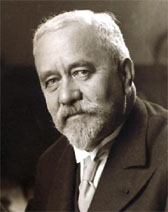
Albert Calmette
French physician and bacteriologist who developed the BCG tuberculosis vaccine with Camille Guérin and conducted research on snake antivenoms, infectious diseases, and tuberculosis diagnosis.
Born on July 12, 1863
Died on October 29, 1933
Age at death: 70
Profession: Doctor, Physician
Place of Birth: Nice, France
Place of Death: Paris, France
Albert Calmette (July 12, 1863 – October 29, 1933), whose full name was Léon Charles Albert Calmette, was a French physician, bacteriologist, and immunologist. A researcher associated with Louis Pasteur and the Institut Pasteur, he collaborated with veterinarian Camille Guérin to develop the BCG vaccine (Bacillus Calmette-Guérin) against tuberculosis. The vaccine was first administered to a human infant in 1921 and subsequently became part of vaccination programs in many countries. Calmette also developed an early snake antivenom, established Pasteur institutes in Saigon and Lille, and introduced a diagnostic method for tuberculosis known as the Calmette reaction.
Early Life and Medical Education
Albert Calmette was born on July 12, 1863, in Nice, France. He grew up in a period when bacteriology was developing into a scientific discipline through the research of physicians and microbiologists including Louis Pasteur and Robert Koch.
In 1881, he entered the Naval Medical School in Brest. During his medical training, he served with the French naval medical corps and traveled to several overseas territories, where he encountered infectious diseases common in tropical regions.
His assignments took him to Hong Kong, Amoy (now Xiamen), Formosa (now Taiwan), and the Gabon-Congo region of Central Africa. He studied diseases including malaria, sleeping sickness, and blackwater fever.
He also worked in Saint-Pierre and Miquelon, near Newfoundland, investigating infectious diseases affecting local communities.
In 1886, Calmette completed his medical doctorate with research on malaria. His experience in colonial and naval medicine gradually directed his professional interests toward microbiology and infectious disease prevention.
Research at the Pasteur Institute and Work in Saigon
In 1890, Albert Calmette joined the Institut Pasteur in Paris, where he studied bacteriology under Émile Roux and became associated with the scientific work of Louis Pasteur.
At Pasteur's request, he traveled to French Indochina in 1891 and established a Pasteur Institute in Saigon, now Ho Chi Minh City, Vietnam.
There, he organized the production of vaccines against rabies and smallpox while investigating infectious diseases affecting the local population.
His research also extended to toxicology, particularly the effects of snake venom and methods of preventing deaths caused by venomous bites.
Calmette returned to France in 1893 after suffering from dysentery. He resumed research at the Pasteur Institute in Paris, concentrating on antivenom serotherapy and infectious diseases.
Development of Snake Antivenom
During the 1890s, Albert Calmette investigated the possibility of producing protective serum against snake venom. His experiments involved immunizing animals with controlled doses of venom and collecting antibodies from their blood.
In 1894, he developed an antivenom serum against cobra venom, contributing to the development of antivenom therapy as a medical treatment.
He also investigated polyvalent antivenoms intended to provide protection against more than one type of snake venom, although the effectiveness of such preparations depended on the species involved.
During laboratory work, Calmette was reportedly bitten on a finger by a venomous snake and treated himself using an antivenom preparation. Accounts of the incident state that he survived but lost the tip of the affected finger.
He also collaborated with Alexandre Yersin on research related to bubonic plague and the development of therapeutic serum.
Founding the Pasteur Institute of Lille
In 1895, Albert Calmette was selected to establish a new branch of the Pasteur Institute in Lille, an industrial city in northern France. He became its founding director, overseeing its development during the following decades. The institute was formally inaugurated in 1899.
His work extended beyond laboratory research to sanitation, public health, and disease prevention. He promoted improvements to urban sewage systems and investigated infectious diseases affecting industrial workers.
He organized research and treatment programs addressing hookworm infection, also known as ankylostomiasis, among miners. He also participated in international public health missions involving outbreaks of bubonic plague in countries including Portugal, Algeria, and Greece.
At Lille, Calmette began the collaboration with veterinarian Camille Guérin that eventually led to the development of the BCG vaccine.
Research on Tuberculosis and the BCG Vaccine
In 1906, Albert Calmette and Camille Guérin began systematic research into tuberculosis, an infectious disease caused by bacteria belonging to the Mycobacterium tuberculosis complex.
Their research initially focused on the bovine tuberculosis bacterium, Mycobacterium bovis, and the possibility of weakening its ability to cause disease while preserving its capacity to stimulate an immune response.
In 1908, the researchers observed that growing the bacteria in a culture medium containing ox bile, glycerin, and potato altered their characteristics.
Through repeated subculturing over approximately thirteen years, they progressively reduced the bacteria's virulence. By 1921, after more than 200 successive transfers, they had obtained an attenuated bacterial strain suitable for experimental vaccination.
This strain became known as Bacillus Calmette-Guérin, or BCG, in recognition of the two researchers.
Their experiments established that the attenuated bacteria could produce an immune response without causing the same disease as the original virulent strain under the conditions studied.
First Human BCG Vaccination in 1921
The first human administration of the BCG vaccine took place in Paris in July 1921.
The recipient was a newborn infant whose mother had died from tuberculosis. Because the child faced a high risk of exposure, physicians administered the experimental vaccine orally.
The infant survived and did not develop tuberculosis during the initial observation period. This outcome encouraged further controlled use of the vaccine among infants at risk of infection.
Over the following years, hundreds and then thousands of children received BCG vaccination. In 1924, the vaccine began to be produced and distributed more extensively under the BCG name.
Calmette and Guérin continued studying its safety, production methods, and ability to prevent severe forms of tuberculosis.
Although BCG was adopted in several European countries, other nations initially approached it with caution. Large-scale international vaccination programs expanded particularly after World War II. The United Kingdom adopted routine BCG programs for selected groups, while the United States generally restricted its use to people at particular risk rather than introducing universal vaccination.
The Calmette Reaction and Tuberculosis Diagnosis
Albert Calmette also investigated methods for diagnosing tuberculosis. In 1907, he described a diagnostic procedure known as the Calmette ophthalmic reaction, or conjunctival tuberculin test.
The method involved applying a diluted tuberculin preparation to the conjunctiva of the eye and observing whether an inflammatory response developed.
Calmette and German physician Alfred Wolff-Eisner independently investigated this form of reaction during the same period.
The test was intended to help identify tuberculosis infection by detecting the body's sensitivity to tuberculin. However, subsequent research showed that the procedure could cause serious eye irritation and other complications.
The ophthalmic test eventually fell out of use as safer skin-based tuberculin tests became established. The Calmette reaction was developed decades before the 1930 Lübeck vaccination incident and was not a remedy devised in response to that event.
World War I and Return to Paris
When World War I began in 1914, Albert Calmette was working at the Pasteur Institute in Lille.
German forces occupied northern France, and Lille remained under occupation for much of the war. Calmette stayed in the city and participated in efforts to control infectious diseases and organize medical assistance.
His wife was reportedly deported to Germany during the occupation. Calmette also worked on controlling outbreaks of typhoid fever affecting military personnel and civilians.
Following the war, he returned to Paris and resumed his research on tuberculosis and vaccination. He became deputy director of the Pasteur Institute and organized a research department devoted to tuberculosis.
He also participated in the development of additional Pasteur Institute branches, including those established in Algiers and Athens.
The Lübeck Vaccination Disaster of 1930
In 1930, a serious medical incident occurred in Lübeck, Germany, during a program intended to vaccinate newborn infants against tuberculosis.
Approximately 251 infants received an orally administered preparation believed to contain the BCG vaccine. Many subsequently developed tuberculosis, and dozens died.
Historical investigations commonly reported 72 deaths attributed to tuberculosis among the vaccinated infants, although a later reassessment of the medical records estimated 67 tuberculosis-related deaths.
The incident generated intense public concern about the safety of BCG vaccination and resulted in investigations into the production and handling of the vaccine.
Researchers determined that the vaccine preparations used in Lübeck had been contaminated with virulent Mycobacterium tuberculosis in the local laboratory where they were prepared for administration.
The investigation found no evidence that the attenuated BCG strain had spontaneously returned to a disease-causing form. The contamination resulted from failures in laboratory procedures rather than from the original BCG strain developed by Calmette and Guérin.
The incident damaged public confidence in vaccination, but the findings cleared the two researchers and their original vaccine of responsibility for the contamination.
It also demonstrated the necessity of strict laboratory controls and careful separation of live pathogenic bacteria from preparations intended for medical use.
Scientific Appointments and Publications
Albert Calmette was elected to the French Academy of Medicine in 1919 and the French Academy of Sciences in 1927.
His publications addressed snake venom, antivenom therapy, tropical infections, tuberculosis, and public health.
In addition to his experimental research, he advocated measures to improve sanitation and prevent infectious diseases in densely populated communities.
Death
Albert Calmette died on October 29, 1933, in Paris, France, at the age of 70.
His research on BCG continued through the work of Camille Guérin and other scientists. The vaccine later became part of tuberculosis prevention programs organized by national health authorities and the World Health Organization.
Selected Publications
1907 – Les venins, les animaux venimeux et la sérothérapie antivenimeuse (Venoms, Venomous Animals and Antivenom Serum Therapy)
1920 – L'infection bacillaire et la tuberculose chez l'homme et chez les animaux (Bacillary Infection and Tuberculosis in Humans and Animals)
Major Dates and Scientific Work
1863 – Born in Nice, France
1881 – Entered the Naval Medical School in Brest
1886 – Completed his medical doctorate
1890 – Began research at the Pasteur Institute in Paris
1891 – Established the Pasteur Institute in Saigon
1894 – Developed an early antivenom serum against cobra venom
1895 – Began establishing the Pasteur Institute of Lille
1899 – Formal inauguration of the Pasteur Institute of Lille
1906 – Began systematic tuberculosis research with Camille Guérin
1907 – Described the Calmette ophthalmic tuberculin reaction
1908 – Developed the bile-containing culture method used in BCG research
1919 – Elected to the French Academy of Medicine
1921 – First human administration of the BCG vaccine
1924 – Wider production and distribution of BCG began
1927 – Elected to the French Academy of Sciences
1930 – Investigations into the Lübeck vaccination disaster
1933 – Died in Paris, France
Source: Biyografiler.com
Frequently asked questions about Albert Calmette
Who is Albert Calmette?, Albert Calmette biography, Albert Calmette life story, Albert Calmette age, Albert Calmette facts, Albert Calmette birthplace, Albert Calmette photos, Albert Calmette videos, Albert Calmette career

Lamine Yamal
Professional footballer

Kylian Mbappe
Professional footballer

Erling Haaland
Professional footballer

Keanu Reeves
Actor

Brad Pitt
Actor

Ronaldinho
Professional footballer

Andre Gide
Novelist, Essayist

Andreas Papandreu
Former Prime Minister, Politician, Economist

Andrea Mantegna
Painter

Andrea del Verrocchio
Sculptor, Painter

Andrea del Sarto
Painter

Andrea Bargnani
Former Professional Basketball Player

Alica Schmidt
Athlete, Model

Susie Wiles
Political Consultant

Abbie Cornish
Actress

Adrien Brody
Actor

Stephen Miller
Consultant

Grace Kelly
Actress, Princess