
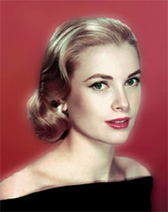
Grace Kelly
Hollywood icon, Princess of Monaco, timeless symbol of elegance
Born on November 12, 1929
Died on September 14, 1982
Age at death: 53
Profession: Actress, Princess
Place of Birth: Philadelphia, Pennsylvania, United States
Place of Death: Monaco
Grace Kelly was an American actress and Princess of Monaco, widely regarded as one of the greatest actresses in the history of cinema. At the height of her Hollywood success, her film career came to an end following her marriage to Prince Rainier III of Monaco. Renowned for her elegance, beauty, and refined screen presence, Kelly became one of the most admired stars of classic Hollywood. Influential figures such as Sharon Stone, Madonna, Annette Bening, and Jennifer Love Hewitt have cited her as a major inspiration, embracing her style and recognizing her as a lasting fashion icon. Among her most significant films are The Country Girl, The Swan, and Mogambo. Following her marriage, Monaco’s international popularity increased dramatically, transforming the principality into a major luxury tourism destination.
Grace Kelly was born on November 12, 1929, in Philadelphia, Pennsylvania, as the third of four children. Her father, John Kelly Sr., was of Irish descent and came from one of Philadelphia’s most respected families. A self-made millionaire, he was also an accomplished athlete who won Olympic medals in rowing. Grace’s uncle, George Kelly, was a Pulitzer Prize–winning playwright. Raised in a comfortable and culturally rich environment, she was surrounded by artistic influences from an early age, which made her natural transition into acting almost inevitable.
Kelly gained her first stage experience at the age of twelve, and during her high school years she stood out for her strong interest in the fine arts. Her school yearbook famously predicted she would become a major star. She studied dance, participated in theater, and later enrolled at the American Academy of Dramatic Arts, an institution known for training legendary performers such as Katharine Hepburn, Spencer Tracy, and Lauren Bacall. Initially opposed by her family in her desire to become an actress, Grace briefly pursued modeling, where her elegance and presence quickly attracted attention.
At just twenty-two years old, Grace Kelly appeared in her first feature film, Fourteen Hours (1951), which introduced her to a wide audience. This was soon followed by High Noon, a career-defining role that elevated her to Hollywood stardom. Starring opposite Gary Cooper, the film sparked tabloid rumors of a romance between the two. Her rise continued with Mogambo, where she starred alongside Clark Gable and Ava Gardner. Her performance earned her an Academy Award nomination for Best Actress in only her third year in cinema, while media speculation about her relationship with Gable dominated headlines. Years later, Kelly would candidly confirm the affair, remarking that being alone with Clark Gable in the African wilderness made it inevitable.
Her steady ascent continued through collaborations with director Alfred Hitchcock, who was famously fascinated by the image of the cool blonde heroine. Kelly starred in Hitchcock’s Dial M for Murder, Rear Window, and To Catch a Thief, performances that solidified her screen persona and critical reputation. In 1955, she won the Academy Award for Best Actress for her role opposite Bing Crosby in The Country Girl, marking the pinnacle of her cinematic achievements.
That same year, she portrayed a princess in The Swan and attended the Cannes Film Festival, an invitation that would alter the course of her life. Among the guests was Prince Rainier III of Monaco, who fell in love with Kelly at first sight. The pair began corresponding, and their relationship intensified when Rainier visited the United States to meet her family. After accepting his marriage proposal, Kelly completed filming her final movie, High Society, and retired from acting. She left Hollywood and America behind to begin a new life in Monaco, preparing for what would be known as the wedding of the century.
Prior to the wedding, the Monaco Palace was extensively renovated. On April 18, 1956, Grace Kelly traveled to Monaco aboard a luxury ocean liner with her family, staff, and beloved dog. Over 20,000 people filled the streets for the ceremony, which was broadcast live around the world. Her iconic wedding gown was designed by MGM’s Academy Award–winning costume designer Helen Rose. Following the wedding, the couple embarked on a seven-week honeymoon aboard Rainier’s yacht.
As Princess of Monaco, Grace Kelly embraced her new role with dignity and devotion. She and Prince Rainier had three children: Princess Caroline (born 1957), Prince Albert II of Monaco (born 1958), and Princess Stéphanie (born 1965). Though she missed acting, she chose to dedicate her life to her family and royal duties. In 1962, director Alfred Hitchcock offered her a role in Marnie, but public pressure ultimately led her to decline, believing her primary responsibility was to Monaco.
Kelly fulfilled her role as princess with remarkable success, contributing significantly to Monaco’s global prestige and cultural visibility. The principality became one of the world’s most exclusive and desirable destinations, a transformation widely attributed to her influence and star power.
Despite a life marked by extraordinary success and transformation, Grace Kelly met a tragic end. In 1982, at the age of 52, she died following a car accident that her daughter Princess Stéphanie survived with minor injuries. According to widespread speculation, the accident occurred while Kelly was attempting to recreate a driving scene reminiscent of her film To Catch a Thief. Her death plunged Monaco and the world into mourning. Prince Rainier never remarried, remaining devoted to her memory until his death in 2005, after which he was laid to rest beside her.
Three Icons of Classic Hollywood
Grace Kelly: Aristocratic Elegance and Royal Stardom
Grace Kelly embodied aristocratic elegance and restraint, transforming cinematic glamour into real-life royalty as Princess of Monaco and redefining sophistication in classic Hollywood.
Audrey Hepburn: Modern Grace and Intellectual Beauty
Audrey Hepburn represented modern femininity through minimalism, emotional depth, and intelligence, becoming a symbol of timeless style and compassionate humanity.
Marilyn Monroe: Sensuality, Fame, and Cultural Myth
Marilyn Monroe defined Hollywood sensuality and mass appeal, creating an enduring image of glamour intertwined with vulnerability and cultural rebellion.
Source: Biyografiler.com
Frequently asked questions about Grace Kelly
Who is Grace Kelly?, Grace Kelly biography, Grace Kelly life story, Grace Kelly age, Grace Kelly facts, Grace Kelly birthplace, Grace Kelly photos, Grace Kelly videos, Grace Kelly career
Related Biographies



Lamine Yamal
Professional footballer

Erling Haaland
Professional footballer

Sam Altman
Entrepreneur, Investor, CEO

Kylian Mbappe
Professional footballer

Giorgia Meloni
Politician, Journalist

Alice Weidel
Politician, Economist


Hongjoong
Singer, Rapper, Songwriter, Composer

Ludacris
Rapper, Actor

Kwon Eunbi
Singer

Sarah Wayne Callies
Actress, Screenwriter, Producer, Director

LaTavia Roberson
Singer, Actress, Entrepreneur

Elena Andreyevna Rybakina
Professional Tennis Player
Alice Weidel
Politician, Economist
Sam Altman
Entrepreneur, Investor, CEO

Lady Gaga
Singer, Musician, Songwriter, Actress, Producer

Vin Diesel
Actor, Producer, Screenwriter
Lamine Yamal
Professional footballer