
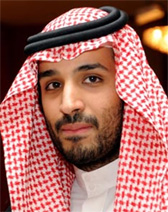
Mohammed bin Salman
“MBS” – Crown Prince and Architect of Saudi Arabia’s Political Transformation
Born on August 31, 1985
Age: 41
Profession: King, Statesman, Politician
Place of Birth: Jeddah, Saudi Arabia
Mohammed bin Salman is the Crown Prince of Saudi Arabia, serving as the kingdom’s de facto ruler and one of the most influential figures in Middle Eastern geopolitics. Holding key positions such as Minister of Defense and Prime Minister, he has overseen sweeping transformations in economic policy, governance, and international relations, positioning himself alongside global leaders like Joe Biden, Vladimir Putin, and Emmanuel Macron in shaping contemporary world affairs.
Early Life and Background
Mohammed bin Salman, August 31, 1985 tarihinde Saudi Arabia’nın Hejaz bölgesindeki Jeddah kentinde doğmuştur. He is the son of Salman bin Abdulaziz Al Saud, the King of Saudi Arabia, and his third wife, Fahda bint Falah bin Sultan Al Hithalayn. Raised within the royal court, he grew up in an environment deeply intertwined with governance, tradition, and political authority.
He pursued higher education at King Saud University in Riyadh, graduating with second-highest honors from the Faculty of Law. Unlike many members of the royal family who studied abroad, Mohammed bin Salman remained in the kingdom, which contributed to his image as a leader closely connected to domestic realities and national priorities.
Career Beginnings
Before entering official royal service, Mohammed bin Salman gained experience in the private sector, working across different business initiatives. His early exposure to economic structures later informed his ambitious reform strategies, often compared in scale to modernization efforts seen under leaders like Mustafa Kemal ATATÜRK and Deng Xiaoping.
On December 15, 2009, he began working as a special adviser to his father, then Governor of Riyadh. This role marked his formal entry into politics, providing him with direct access to administrative decision-making and statecraft.
Rise to Power
The turning point in Mohammed bin Salman’s career came after the death of King Abdullah bin Abdulaziz Al Saud on January 23, 2015. His father ascended the throne as king, immediately elevating his son to prominent roles within the government.
On the same day, Mohammed bin Salman was appointed Minister of Defense and President of the Royal Court, signaling an unprecedented concentration of authority at a relatively young age. Initially, Muqrin bin Abdulaziz was named Crown Prince, followed by Mohammed bin Nayef after a reshuffle in April 2015, while Mohammed bin Salman was designated Deputy Crown Prince.
In June 2017, Salman bin Abdulaziz Al Saud removed Mohammed bin Nayef from his position and appointed Mohammed bin Salman as Crown Prince. This move consolidated his power and established him as the kingdom’s primary decision-maker and heir apparent.
Political Influence and Vision 2030
As Crown Prince, Mohammed bin Salman has become the central figure behind Vision 2030, an ambitious reform program aimed at reducing the kingdom’s dependence on oil and diversifying its economy. The initiative includes large-scale investments in technology, tourism, and infrastructure, aligning Saudi Arabia with global economic trends driven by figures such as Elon Musk and Jeff Bezos.
His leadership has also reshaped the country’s social landscape. Policies allowing women to drive, expanding entertainment sectors, and promoting cultural initiatives reflect a broader attempt to modernize Saudi society while maintaining its political structure.
On the international stage, Mohammed bin Salman has played a decisive role in redefining Saudi Arabia’s foreign policy, strengthening alliances while asserting regional influence. His tenure as Minister of Defense has been marked by active military involvement and strategic repositioning within the Middle East.
Major Collaborations and Global Relations
Mohammed bin Salman has engaged with a wide range of global leaders and business figures, fostering partnerships that extend beyond traditional diplomacy. His interactions with leaders like Donald Trump, Joe Biden, and Xi Jinping reflect Saudi Arabia’s evolving geopolitical strategy.
In the corporate sphere, he has collaborated with international investors and institutions, positioning the kingdom as a hub for global capital. These efforts have drawn comparisons to transformative economic visions seen in other regions, reinforcing his image as a reform-driven leader.
Personal Life
Mohammed bin Salman is married to Sara bint Mashour bin Abdulaziz Al Saud. The couple has four children, including two daughters and two sons. Despite his global prominence, he maintains a relatively private family life, consistent with the traditions of the Saudi royal family.
Known for his assertive leadership style and ambitious vision, Mohammed bin Salman continues to shape the future trajectory of Saudi Arabia, balancing modernization efforts with the preservation of the kingdom’s political and cultural identity.
Source: Biyografiler.com
Frequently asked questions about Mohammed bin Salman
Who is Mohammed bin Salman?, Mohammed bin Salman biography, Mohammed bin Salman life story, Mohammed bin Salman age, Mohammed bin Salman facts, Mohammed bin Salman birthplace, Mohammed bin Salman photos, Mohammed bin Salman videos, Mohammed bin Salman career
Related Biographies


Lamine Yamal
Professional footballer

Erling Haaland
Professional footballer

Kylian Mbappe
Professional footballer

Austin Abrams
Actor

Bad Bunny
Rapper, Songwriter

Sam Altman
Entrepreneur, Investor, CEO


Hongjoong
Singer, Rapper, Songwriter, Composer

Ludacris
Rapper, Actor

Kwon Eunbi
Singer

Sarah Wayne Callies
Actress, Screenwriter, Producer, Director

LaTavia Roberson
Singer, Actress, Entrepreneur
Lamine Yamal
Professional footballer

Amber Heard
Actress, Model
Bad Bunny
Rapper, Songwriter
Erling Haaland
Professional footballer
Kylian Mbappe
Professional footballer
Austin Abrams
Actor