
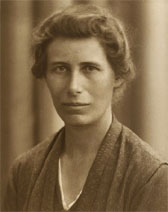
Inge Lehmann
Danish seismologist who discovered Earth's inner core in 1936 through the analysis of seismic waves.
Born on May 13, 1888
Died on February 21, 1993
Age at death: 105
Profession: Mathematician
Place of Birth: Østerbro, Copenhagen, Denmark
Place of Death: Copenhagen, Denmark
Inge Lehmann was born on May 13, 1888, in the Østerbro district of Copenhagen, Denmark. She was a Danish seismologist, geophysicist and mathematician who discovered the existence of Earth's inner core in 1936. By examining the movement of seismic waves generated by earthquakes, she demonstrated that the Earth's core was not a single homogeneous liquid region but contained a distinct inner core. Her findings were published in a scientific paper titled P′ and became part of the modern scientific understanding of the Earth's internal structure. She subsequently conducted research on the upper mantle and identified a seismic discontinuity at a depth of approximately 220 kilometres, now also known as the Lehmann discontinuity.
Early Life and Family Background
Inge Lehmann was born into an educated Danish family. Her father, Alfred Georg Ludvig Lehmann, was a psychologist and professor at the University of Copenhagen. Her mother was Ida Sophie Tørsleff. She had a sister named Harriet.
She attended a progressive school in Copenhagen directed by Hanna Adler, an educator and the aunt of physicist Niels Bohr. The school emphasized scientific education and provided boys and girls with similar opportunities to study mathematics and other academic subjects. This educational environment differed from the gender restrictions common in European universities during the late nineteenth and early twentieth centuries.
Inge Lehmann developed an interest in mathematics while attending school. Her academic interests later led her toward geophysics, a field that uses mathematics and physics to investigate the Earth's structure and physical processes.
University Education and Mathematical Training
In 1907, at the age of 19, Inge Lehmann began studying mathematics at the University of Copenhagen. She later continued her education in England, attending Newnham College, Cambridge, a women's college associated with the University of Cambridge.
During 1910 and 1911, she studied mathematics at Cambridge. However, the demands of her studies affected her health, and she experienced exhaustion that forced her to interrupt her education.
Following her return to Denmark, Inge Lehmann spent several years away from university. During this period, she worked in insurance-related employment, developing her mathematical and computational skills.
She resumed her studies at the University of Copenhagen in 1918 and completed her degree in mathematics in 1920. Her mathematical training later became essential to her analysis of seismic observations, which required extensive calculations of wave velocities, travel times and the distances between earthquake epicentres and recording stations.
Early Professional Career
After completing her university education, Inge Lehmann worked in the insurance industry before returning to academic employment.
In 1923, she became an assistant to mathematician and actuarial scientist Johan Frederik Steffensen at the University of Copenhagen. Her work involved mathematical calculations and statistical methods used in actuarial science.
In 1925, she began working with Niels Erik Nørlund, a Danish mathematician and geodesist who directed the Danish Geodetic Institute. Nørlund was responsible for developing a network of seismological observation stations in Denmark and Greenland.
Through this work, Inge Lehmann became involved in seismology, the scientific study of earthquakes and seismic waves. She began analyzing records collected by seismographs and studying how seismic energy travelled through the Earth's interior.
In 1928, she passed the examination in geodesy and was appointed state geodesist and head of the seismological department at the Danish Geodetic Institute. She was responsible for managing seismographic stations and interpreting seismic observations from Denmark and Greenland.
Seismology and the Study of Earth's Interior
During the early twentieth century, scientists investigated the Earth's interior by studying seismic waves generated by earthquakes. Because direct observation of the deep Earth was impossible, seismologists used differences in the arrival times and movement of seismic waves to identify boundaries between internal layers.
By the 1920s, researchers had established that the Earth contained a crust, mantle and central core. German-American seismologist Beno Gutenberg had estimated the depth of the boundary between the mantle and core at approximately 2,900 kilometres.
However, the physical structure of the core remained uncertain. Many scientists believed that it consisted entirely of liquid material.
Inge Lehmann analyzed observations recorded by seismographic stations at different distances from major earthquakes. She examined travel-time curves, wave amplitudes and the paths followed by seismic energy through the Earth's interior.
Her investigation of a major earthquake near New Zealand in 1929 provided measurements that later became central to her discovery. Certain seismic waves were detected in regions where the existing models of the Earth's core predicted that they should not arrive.
Discovery of Earth's Inner Core in 1936
In 1936, Inge Lehmann published her scientific paper P′, presenting an explanation for unusual seismic observations recorded after large earthquakes.
She found that the behaviour of certain P-waves could not be adequately explained by the prevailing model of a completely liquid core. The observations suggested that some waves travelled along paths influenced by an additional boundary within the Earth's central region.
Her calculations indicated that the Earth contained an inner core with seismic properties different from those of the surrounding outer core. She proposed that the inner region was solid and surrounded by a liquid outer core.
At the time, seismic recordings were analyzed manually. Inge Lehmann compared observations from different recording stations, calculated wave travel times and studied small variations in seismograms.
Her proposed model provided an explanation for P-waves detected within the seismic shadow zone, a region where waves travelling through a uniformly liquid core were not expected to arrive directly.
The paper P′ was published in 1936 in the scientific journal Publications du Bureau Central Séismologique International. The title referred to compressional seismic waves travelling through the Earth's deep interior.
Her interpretation was subsequently examined by other seismologists, including Harold Jeffreys, Beno Gutenberg and Charles Francis Richter. Further theoretical work and improvements in seismic recording supported the existence of a distinct inner core. Later calculations and observations provided additional evidence that the inner core was solid.
P-Waves, S-Waves and Their Scientific Properties
Inge Lehmann's discovery depended on the analysis of seismic waves, particularly primary waves, commonly known as P-waves. Although she did not discover P-waves themselves, she identified previously unexplained aspects of their propagation through the Earth's core.
Earthquakes release elastic energy when accumulated stress causes rocks to fracture or move along faults. This energy propagates through the Earth in several types of seismic waves.
P-waves, or primary waves, are compressional waves in which particles vibrate parallel to the direction of wave propagation. They generally travel faster than other seismic body waves and therefore usually arrive first at recording stations. They can travel through solid materials, liquids and gases.
S-waves, or secondary waves, are shear waves in which particles move perpendicular to the direction of propagation. Unlike P-waves, S-waves cannot travel through liquids because liquids do not support the shear forces required for their propagation.
The difference between the behaviour of P-waves and S-waves helps scientists distinguish solid and liquid regions within the Earth. The absence of direct S-waves passing through the outer core provides evidence that the outer core is liquid.
Wave velocity depends on the elastic properties and density of the material through which the wave travels. In the Earth's crust and mantle, seismic body waves commonly travel at speeds of several kilometres per second, with P-waves generally moving faster than S-waves.
When seismic waves cross boundaries between materials with different physical properties, their paths may change through reflection or refraction. By analyzing these changes, scientists can estimate the depth, composition and physical state of internal geological layers.
Inge Lehmann used these principles to investigate seismic waves that appeared in unexpected locations. Her interpretation demonstrated that some of the recorded signals could be explained by the presence of an additional boundary inside the Earth's core.
Scientific Acceptance and the Lehmann Discontinuity
The boundary between the Earth's solid inner core and liquid outer core became known as the inner-core boundary and is sometimes referred to as the Lehmann discontinuity in recognition of Inge Lehmann's discovery.
The boundary lies approximately 5,150 kilometres beneath the Earth's surface. The inner core extends from this depth to the planet's centre, approximately 6,371 kilometres below the surface.
Lehmann's interpretation was initially based on indirect seismic evidence. Subsequent work by seismologists, advances in recording instruments and mathematical modelling provided additional support for her proposed internal structure.
By the 1960s, improved seismic calculations had strengthened the evidence for a solid inner core. Later observations of seismic waves reflected and refracted by the inner-core boundary further confirmed the model.
The name Lehmann discontinuity is also used for a separate seismic boundary in the upper mantle, associated with another area of her research.
World War II and Research in Denmark
During World War II, Inge Lehmann's research was affected by the German occupation of Denmark, which began on April 9, 1940.
The occupation restricted international correspondence, scientific travel and access to observations from foreign seismographic stations. International cooperation was particularly important to seismology because the analysis of large earthquakes required measurements from geographically separated recording stations.
Lehmann continued working at the Danish Geodetic Institute during the war and maintained her research activities despite these difficulties.
After the war, disagreements with colleagues and administrative difficulties within the institute increasingly affected her professional life. She remained head of the seismological department until her retirement in 1953.
Retirement and Research in the United States
After retiring from the Danish Geodetic Institute in 1953, Inge Lehmann continued her scientific research. She remained based in Denmark but travelled frequently to the United States and collaborated with American research institutions.
She worked with geophysicists Maurice Ewing and Frank Press, including researchers associated with the Lamont Geological Observatory at Columbia University. Their investigations involved seismic waves travelling through the Earth's crust and upper mantle.
The development of more sensitive seismographs and the increasing availability of seismic observations provided opportunities to examine features of the Earth's interior that had previously been difficult to identify.
Lehmann also benefited from seismic recordings generated by underground nuclear tests. During the Cold War, governments and research institutions developed improved methods for detecting underground explosions, producing observations that could also be used in geophysical research.
Her research during this period concentrated increasingly on the upper mantle rather than the Earth's core.
Discovery of the Upper-Mantle Lehmann Discontinuity
During her later investigations, Inge Lehmann identified changes in seismic-wave behaviour at depths of approximately 190 to 250 kilometres beneath the Earth's surface.
Her work indicated that an increase in seismic velocity could occur near a depth of about 220 kilometres. The boundary became known as the upper-mantle Lehmann discontinuity.
This discontinuity is distinct from the boundary between the solid inner core and liquid outer core. Its characteristics vary between geological regions, and its physical interpretation remains a subject of geophysical research.
The observations contributed to the study of seismic velocity changes within the lithosphere and upper mantle. They also provided additional information about variations in the elastic properties of rocks at depth.
Later Scientific Publications
Inge Lehmann continued publishing scientific research after her formal retirement. Her studies included earthquake observations, seismic-wave travel times, regional crustal structures and the interpretation of records from underground explosions.
In 1956, she published Danish Earthquakes, a study that compiled historical information on earthquakes affecting Denmark from as early as 1073.
She maintained scientific correspondence with researchers in Europe and North America and participated in international geophysical organizations.
Her later writing included Seismology in the Days of Old, published in 1987, in which she discussed the history and development of seismic research. She was 99 years old when this work appeared.
Awards and Scientific Honours
Inge Lehmann received numerous scientific honours for her research on the Earth's interior and her contributions to seismology.
In 1960, she received the Harry Oscar Wood Award for her work in seismology. In 1964, the German Geophysical Society awarded her the Emil Wiechert Medal.
That same year, she received an honorary doctorate from Columbia University. In 1965, the Royal Danish Academy of Sciences and Letters awarded her its Gold Medal.
She received the Tagea Brandt Rejselegat in 1967, a Danish award recognizing women's achievements in science, literature and the arts. In 1968, the University of Copenhagen awarded her an honorary doctorate.
In 1969, she was elected a Foreign Member of the Royal Society in London.
In 1971, Inge Lehmann became the first woman to receive the William Bowie Medal, awarded by the American Geophysical Union for contributions to fundamental geophysics and cooperation in scientific research.
She was awarded honorary membership of the European Geophysical Society in 1973 and received the Medal of the Seismological Society of America in 1977.
Death
Inge Lehmann died on February 21, 1993, in Copenhagen, Denmark, at the age of 104. She had remained active in scientific writing and maintained an interest in geophysical research into advanced age.
Scientific Recognition and Namesakes
The asteroid 5632 Ingelehmann, discovered in 1993, was named in honour of Inge Lehmann.
A bridge carrying U.S. Route 1 in Aventura, Florida, was also named after her.
In 1997, the American Geophysical Union established the Inge Lehmann Medal, recognizing scientists whose research advances the understanding of the structure, composition and dynamics of the Earth's mantle and core.
In 2017, a monument dedicated to her was unveiled at the University of Copenhagen. The sculpture was created by Danish artist Elisabeth Toubro and installed near the university's historic buildings in central Copenhagen.
Awards and Honours
1960 – Harry Oscar Wood Award
1964 – Emil Wiechert Medal
1964 – Honorary Doctorate, Columbia University
1965 – Gold Medal of the Royal Danish Academy of Sciences and Letters
1967 – Tagea Brandt Rejselegat
1968 – Honorary Doctorate, University of Copenhagen
1969 – Foreign Member of the Royal Society
1971 – William Bowie Medal, American Geophysical Union (First Female Recipient)
1973 – Honorary Membership, European Geophysical Society
1977 – Medal of the Seismological Society of America
Selected Scientific Publications
1930 – P′ as Read from the Records of the Earthquake of June 16th 1929
1936 – P′ – Research Paper Proposing the Existence of Earth's Inner Core
1956 – Danish Earthquakes
1987 – Seismology in the Days of Old
Source: Biyografiler.com
Frequently asked questions about Inge Lehmann
Who is Inge Lehmann?, Inge Lehmann biography, Inge Lehmann life story, Inge Lehmann age, Inge Lehmann facts, Inge Lehmann birthplace, Inge Lehmann photos, Inge Lehmann videos, Inge Lehmann career
Related Biographies

Lamine Yamal
Professional footballer

Erling Haaland
Professional footballer

Kylian Mbappe
Professional footballer

Keanu Reeves
Actor

Bad Bunny
Rapper, Songwriter

Ronaldinho
Professional footballer

Aleksey Navalni
Lawyer, Politician

Aleksey Nikolayevich Tolstoy
Novelist, Poet, Writer

Alessandra Ambrosio
Model, Actress

Alessandro Safina
Singer

Alessandro Volta
Physicist, Chemist, Inventor

Alexander Albon
Formula 1 Driver

Alan Rickman
Actor, Film Director

Ursula von der Leyen
Politician, Physician

Albert Uderzo
Illustrator, Cartoonist

Alberto Ginastera
Composer

Albert Pike
Poet, Soldier, Lawyer

Albertus Magnus
Philosopher