
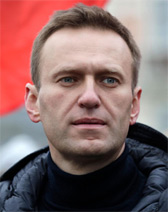
Aleksey Navalni
Russian opposition politician and founder of the Anti-Corruption Foundation who organized protests against government corruption and President Vladimir Putin. He survived a Novichok nerve-agent poisoning in 2020, was imprisoned after returning to Russia in 2021, and died in a Russian penal colony in February 2024. In February 2026, five European governments reported finding the lethal toxin epibatidine in samples from his remains.
Born on July 4, 1976
Died on February 16, 2024
Age at death: 48
Profession: Lawyer, Politician
Place of Birth: Butyn, Moscow Oblast, Russian SFSR, Soviet Union (present-day Russia)
Place of Death: IK-3 Penal Colony, Kharp, Yamalo-Nenets Autonomous Okrug, Russia
Alexei Navalny, whose full name was Alexei Anatolyevich Navalny, was born on June 4, 1976, in Butyn, near Moscow, and died on February 16, 2024, in a Russian penal colony in the Arctic region. He was a Russian lawyer, politician, anti-corruption investigator, and opposition leader who publicly challenged President Vladimir Putin and the governing United Russia party. Beginning in the late 2000s, he published investigations into state-owned companies, government contracts, and the assets of senior Russian officials. He founded the Anti-Corruption Foundation in 2011, organized demonstrations, contested the 2013 Moscow mayoral election, and attempted to register as a candidate for the 2018 Russian presidential election. In August 2020, he was poisoned with a Novichok-type nerve agent and received medical treatment in Germany. He returned to Russia on January 17, 2021, was arrested upon arrival, and subsequently received multiple prison sentences. Navalny died at the age of 47 while serving a sentence at the IK-3 penal colony in Kharp. On February 14, 2026, the governments of the United Kingdom, France, Germany, Sweden, and the Netherlands announced that laboratory examinations had detected epibatidine in samples from his remains and concluded that poisoning was highly likely to have caused his death. Russian authorities rejected the allegation and maintained that he had died of natural causes.
Early Life and Family Background
Alexei Navalny was born on June 4, 1976, in Butyn, a settlement in the Odintsovo district of the Moscow Oblast, then part of the Soviet Union. His father, Anatoly Navalny, served as a military communications officer, while his mother, Lyudmila Navalnaya, worked in the family business.
He had a younger brother, Oleg Navalny, who later became involved in business and was prosecuted alongside him in a prominent Russian criminal case.
Navalny had family connections to Ukraine and spent part of his childhood visiting relatives in the village of Zalissya near the city of Chernobyl. His paternal relatives were affected by the Chernobyl nuclear disaster in April 1986.
The family lived in military settlements around Moscow during his early years. His parents subsequently established a business producing woven household goods.
Navalny identified himself as having Russian and Ukrainian family roots. His political statements later included support for Ukraine's independence and criticism of Russian government policy toward the country.
Education and Legal Training
In 1993, Alexei Navalny graduated from secondary school in Kalininets, a settlement in Moscow Oblast.
He enrolled in the law faculty of the Peoples' Friendship University of Russia in Moscow, graduating in 1998 with a degree in law.
He subsequently studied securities and financial markets at the Financial University under the Government of the Russian Federation, completing his studies in 2001.
During the late 1990s and early 2000s, Navalny worked in legal and business-related positions, including assignments involving property development and commercial organizations.
He gained experience in corporate law, financial documentation, and the operation of Russian companies.
Yale World Fellows Program
In 2010, Alexei Navalny was selected for the Yale World Fellows program at Yale University in New Haven, Connecticut.
The program brought together professionals from different countries for a period of study involving international affairs, public policy, and leadership.
Navalny participated in academic seminars and discussions with other fellows during his time in the United States.
He subsequently returned to Russia and continued his political and anti-corruption activities.
Early Political Activity and Yabloko
Alexei Navalny entered party politics in 2000 when he joined Yabloko, a Russian political party associated with liberal economic policies, constitutional government, and democratic reform.
He became active in the party's Moscow organization and participated in political campaigns.
During the 2000s, he also became involved in nationalist political movements and public demonstrations, including the Russian March.
His statements from this period included nationalist positions on immigration and ethnic relations that subsequently drew criticism from other opposition figures and human rights advocates.
In 2007, Yabloko expelled Navalny, citing his nationalist activities and disagreements with the party leadership.
He continued his political activities outside Yabloko, developing an independent public profile through online commentary, shareholder activism, and organizing campaigns.
Shareholder Activism and Investigations into State Companies
In 2008, Alexei Navalny began purchasing small shareholdings in major Russian corporations to obtain access to corporate information and question management decisions.
His investments included shares in Rosneft, Gazprom, Gazprom Neft, Lukoil, and Surgutneftegas.
He reportedly invested approximately 300,000 rubles in securities as part of this strategy.
Using shareholder rights, Navalny sought company records and examined transactions, procurement procedures, and financial reporting.
He published allegations concerning conflicts of interest, questionable expenditures, and the management of state-controlled businesses.
His investigations increasingly appeared on his personal blog, which attracted readers interested in Russian political and financial affairs.
Navalny distinguished his approach by publishing documentary material, corporate records, and explanations of financial transactions alongside his political criticism.
Anti-Corruption Activism and Online Campaigns
By 2009, Alexei Navalny had become known for publishing allegations of corruption involving Russian public officials and state-owned enterprises.
He used the internet to distribute documents, explain procurement records, and solicit information from readers.
In 2010, he launched RosPil, a project investigating suspected irregularities in government purchasing and public contracts.
Later initiatives included RosYama, which allowed citizens to report problems involving roads and public infrastructure.
His online campaigns combined investigative reporting with legal complaints and public participation.
He subsequently expanded his activities through social media, YouTube videos, and political organizing networks in Russian cities.
United Russia and the 2011 Protests
In 2011, Alexei Navalny publicly described the governing United Russia party as a party of crooks and thieves.
The phrase became associated with his opposition campaigns and was repeated during demonstrations and online political discussions.
Before the December 2011 parliamentary election, he encouraged voters to support parties other than United Russia, arguing that the governing party should face stronger electoral competition.
Following the election, opposition groups alleged that voting irregularities had occurred.
Navalny participated in demonstrations in Moscow and was arrested on December 5, 2011, during a protest against the election results.
He received a fifteen-day administrative detention sentence.
After his release, he addressed further demonstrations, including a large gathering on Sakharov Avenue in Moscow on December 24.
Organizers estimated attendance at more than 100,000 people, although crowd estimates differed among authorities, journalists, and opposition groups.
These protests became part of a broader series of demonstrations against election procedures and the continuation of Putin's political leadership.
The Anti-Corruption Foundation
In 2011, Alexei Navalny founded the Anti-Corruption Foundation (FBK), an organization intended to investigate corruption in Russian government institutions and state-related businesses.
The foundation produced reports and videos examining the assets, business interests, and financial transactions of public officials.
Its investigations included allegations against senior politicians, government officials, and individuals associated with state corporations.
FBK used public records, leaked documentation, aerial photography, and investigative research to support its publications.
Its videos reached audiences through YouTube and other online platforms.
Russian authorities repeatedly challenged the organization and its employees through inspections, criminal investigations, and restrictions on operations.
In 2021, a Russian court designated FBK and related organizations as extremist. The designation was criticized by international human rights organizations and foreign governments, which regarded the proceedings as measures against political opposition.
Prosecution in the Kirovles Case
In 2012, Russian authorities pursued criminal charges against Alexei Navalny concerning transactions involving Kirovles, a timber company in the Kirov region.
The prosecution alleged that Navalny had participated in an arrangement causing financial losses to the company.
Navalny denied wrongdoing and maintained that the transactions were lawful.
In July 2013, a Russian court convicted him of embezzlement and sentenced him to five years in prison.
He was initially taken into custody but was released the following day pending appeal, allowing him to continue campaigning in Moscow's mayoral election.
In October 2013, an appellate court upheld the conviction but suspended his sentence.
In 2016, the European Court of Human Rights concluded that the proceedings had violated fair-trial protections.
Russian authorities subsequently conducted another trial, which again resulted in a conviction in 2017.
Navalny and his supporters maintained that the case was politically motivated, while Russian prosecutors asserted that it concerned ordinary financial crimes.
2013 Moscow Mayoral Election
In 2013, Alexei Navalny entered the election for mayor of Moscow.
He campaigned on government transparency, municipal accountability, public spending, transportation, and urban development.
His campaign relied on volunteer networks, neighborhood meetings, and online fundraising.
The election took place on September 8, 2013.
According to the official results, Navalny received 27.24 percent of the vote, placing second behind incumbent mayor Sergei Sobyanin, who received approximately 51.4 percent.
Navalny disputed aspects of the electoral process and called for greater scrutiny of the results.
The campaign was his most substantial participation in a competitive election for public office.
The Yves Rocher Case
In 2014, Alexei Navalny and his brother Oleg Navalny were prosecuted in a criminal case involving business arrangements connected with the Russian subsidiary of cosmetics company Yves Rocher.
The prosecution alleged that their business activities had resulted in fraud and financial losses.
Both men denied the accusations.
In December 2014, Alexei received a suspended prison sentence of three years and six months, while Oleg received a custodial sentence of the same length.
Navalny remained subject to probation requirements under the suspended sentence.
The case later became central to his imprisonment after his return from Germany in 2021.
In 2017, the European Court of Human Rights ruled that the criminal proceedings had violated the brothers' rights to a fair trial.
The Russian courts subsequently declined to overturn the underlying convictions.
2017 Anti-Corruption Documentary and Protests
In March 2017, Alexei Navalny and the Anti-Corruption Foundation published He Is Not Dimon to You, an investigative documentary concerning then Prime Minister Dmitry Medvedev.
The documentary alleged that Medvedev benefited from properties, foundations, and financial arrangements connected with wealthy business associates.
Medvedev denied the accusations and rejected the documentary's findings.
The video reached millions of viewers and was followed by demonstrations in numerous Russian cities.
On March 26, 2017, Navalny was detained during a protest in Moscow.
He received a fifteen-day administrative detention sentence for disobeying police instructions and a fine for organizing an unauthorized gathering.
Further anti-corruption demonstrations took place later that year.
In April 2017, an attacker threw a green antiseptic chemical at Navalny's face, causing an injury to his right eye.
Attempt to Run in the 2018 Presidential Election
In December 2016, Alexei Navalny announced plans to contest the 2018 Russian presidential election.
He began organizing campaign offices across Russia and recruited volunteers to support his candidacy.
His campaign emphasized investigations into public corruption, political accountability, and changes to government administration.
In December 2017, the Central Election Commission of Russia refused to register his candidacy, citing his criminal conviction in the Kirovles case.
Navalny argued that the prosecution had been unfair and that its use to exclude him from the ballot was unjustified.
Following his exclusion, he called for a boycott of the presidential election and organized further demonstrations.
Vladimir Putin won the election held on March 18, 2018.
Conflict with Viktor Zolotov
In August 2018, Alexei Navalny's Anti-Corruption Foundation published allegations concerning procurement contracts for the National Guard of Russia.
The investigation accused officials associated with the organization of paying inflated prices for food supplies, estimating questionable expenditure at approximately $29 million.
Navalny directed criticism toward Viktor Zolotov, director of the National Guard and a member of Russia's Security Council.
On September 11, 2018, Zolotov published a video responding to Navalny.
He denied the allegations and challenged Navalny to a physical confrontation, threatening to turn him into what he described as a steak.
Navalny was serving a period of administrative detention when the video appeared.
The exchange received extensive coverage in Russian and international media.
Political Views and Public Controversies
Throughout his political career, Alexei Navalny advocated changes to Russia's electoral system, stronger controls on corruption, and greater public accountability for government officials.
His program included proposals concerning judicial independence, public procurement, economic competition, and the transparency of political institutions.
His earlier participation in Russian nationalist movements and his comments about immigration generated criticism, including from other opposition activists.
Navalny also attracted controversy over his initial response to Russia's annexation of Crimea in 2014. Although he criticized the circumstances of the annexation, he initially argued that Crimea's future could not be resolved simply by reversing the Russian government's action.
In February 2023, while imprisoned, he published a political statement explicitly supporting Ukraine's internationally recognized 1991 borders, including Crimea, and calling for Russian forces to withdraw from Ukrainian territory.
His evolving positions on these issues remain part of the documented record of his political career.
Poisoning in August 2020
On August 20, 2020, Alexei Navalny became seriously ill during a flight from Tomsk to Moscow.
The aircraft made an emergency landing in Omsk, Siberia, where he was admitted to hospital and placed in intensive care.
On August 22, he was transported to Berlin, Germany, for treatment at Charité University Hospital.
German doctors diagnosed severe poisoning involving a cholinesterase inhibitor.
On September 2, 2020, the German government announced that a military laboratory had identified a nerve agent belonging to the Novichok group.
Independent examinations conducted in France and Sweden supported the German laboratory findings.
The Organisation for the Prohibition of Chemical Weapons subsequently analyzed samples taken from Navalny and confirmed the presence of biomarkers associated with a cholinesterase inhibitor structurally similar to certain Novichok-type agents.
Navalny remained in treatment until September 2020 and continued recovering in Germany afterward.
He accused Russian state security personnel of involvement in his poisoning. The Russian government denied responsibility.
Investigation into the 2020 Poisoning
In December 2020, journalists from Bellingcat, The Insider, Der Spiegel, and CNN published an investigation into the poisoning.
The investigation identified individuals associated with Russia's Federal Security Service (FSB) who had reportedly traveled to some of the same locations as Navalny.
It drew on telecommunications records, travel information, and other documentary evidence.
Navalny subsequently released a recording of a telephone conversation with a man identified by the investigators as an FSB officer. The conversation appeared to contain details concerning the poisoning operation.
Russian authorities rejected the investigation and denied involvement in the attack.
The allegations led to additional international criticism and sanctions measures against Russian officials.
Return to Russia and Arrest in January 2021
On January 17, 2021, Alexei Navalny returned to Moscow from Germany.
Russian police detained him shortly after his arrival at Sheremetyevo Airport.
Authorities alleged that he had violated the probation requirements associated with his suspended sentence in the 2014 Yves Rocher case.
Navalny maintained that he had been unable to fulfill reporting requirements while receiving medical treatment after the poisoning.
On January 18, a court hearing held at a police station in Khimki ordered him detained for thirty days.
His arrest prompted demonstrations in Moscow, Saint Petersburg, and other Russian cities.
Russian police detained large numbers of protesters during the following weeks.
February 2021 Prison Sentence
On February 2, 2021, a Moscow court ruled that Alexei Navalny had breached the probation conditions attached to his suspended sentence.
The court ordered that the suspended sentence be converted into imprisonment, initially amounting to approximately three and a half years, subject to deductions for time previously spent under house arrest.
Navalny appealed the decision, but the sentence was substantially upheld.
He was transferred into the Russian penal system and later held at a correctional colony in the Vladimir region.
The European Court of Human Rights called for his release through an interim measure issued in February 2021.
Russian authorities refused to comply, arguing that the European court's intervention was incompatible with Russian law.
In March 2021, Navalny began a hunger strike to protest the authorities' refusal to provide medical care from a doctor of his choosing. He ended the strike in April after receiving medical examinations.
Additional Criminal Convictions
While imprisoned, Alexei Navalny faced further criminal proceedings.
In March 2022, a Russian court convicted him of fraud and contempt of court and imposed a nine-year prison sentence.
Navalny rejected the charges and described the prosecution as politically motivated.
In June 2022, he was transferred to a higher-security penal colony.
On August 4, 2023, a Moscow court convicted him of offenses involving extremism and imposed a nineteen-year prison sentence.
The prosecution related to his political organization and the activities of the Anti-Corruption Foundation, which Russian courts had previously designated as extremist.
Navalny and his lawyers denied the charges.
International human rights organizations and several foreign governments condemned the proceedings and called for his release.
Imprisonment in the Arctic Region
In December 2023, after his lawyers had lost contact with him for several weeks, Alexei Navalny was located at the IK-3 penal colony in Kharp, in Russia's Yamalo-Nenets Autonomous Okrug.
The facility, commonly known as the Polar Wolf penal colony, is situated in the Arctic region of northern Russia.
Navalny continued communicating through his legal representatives and publishing political messages while in custody.
He reported repeated placement in punishment cells and restrictions affecting his detention conditions.
His lawyers and supporters expressed concerns about his health and access to medical treatment.
He remained imprisoned at IK-3 until his death in February 2024.
Death on February 16, 2024
Alexei Navalny died on February 16, 2024, at the IK-3 penal colony in Kharp. He was 47 years old.
The regional branch of Russia's Federal Penitentiary Service announced that he had felt unwell after a walk, lost consciousness, and could not be resuscitated.
Russian authorities initially stated that the cause of death was being investigated and subsequently maintained that he had died from natural causes.
His family, political associates, and several foreign governments disputed the official account and demanded an independent investigation.
His widow, Yulia Navalnaya, accused the Russian authorities and President Vladimir Putin of responsibility for his death.
The Kremlin rejected accusations that Russian officials had deliberately caused his death.
Navalny's body was initially withheld from his family while Russian authorities conducted their procedures.
Funeral and Burial
On March 1, 2024, a funeral service for Alexei Navalny was held at the Church of the Icon of the Mother of God, Soothe My Sorrows, in Moscow's Maryino district.
He was buried later that day at Borisovskoye Cemetery in Moscow.
Large crowds gathered near the church and cemetery despite a substantial police presence.
Navalny's mother, Lyudmila Navalnaya, attended the funeral.
His widow and their two children did not attend because they were outside Russia and his associates expressed concerns about possible detention if they returned.
Supporters also organized commemorative gatherings in other cities.
European Court of Human Rights Ruling in 2026
On February 3, 2026, the European Court of Human Rights issued a judgment in the case Navalnyy v. Russia (No. 4).
The case concerned Alexei Navalny's arrest in January 2021, his subsequent detention, and his treatment in prison.
The court found violations of the right to life, the right to liberty and security, and the prohibition of inhuman or degrading treatment under the European Convention on Human Rights.
The judgment addressed the authorities' failure to assess risks to Navalny's health and life, his unlawful detention, and the cumulative effects of restrictions and ill-treatment in prison.
The court also found that Russia had failed to comply with an interim measure directing his release.
The judgment became final on May 3, 2026.
These findings concerned the legality and conditions of his detention; they were separate from the later laboratory findings concerning the cause of his death.
2026 Investigation into the Cause of Death
On February 14, 2026, the governments of the United Kingdom, France, Germany, Sweden, and the Netherlands published a joint statement concerning the death of Alexei Navalny.
The five governments announced that their national laboratories had analyzed samples recovered from Navalny's remains and identified the presence of Epibatidine.
Epibatidine is a highly toxic chemical originally identified in certain South American poison dart frogs. It is not naturally found in Russia.
The governments stated that the laboratory analyses had conclusively established the presence of the substance and that poisoning was highly likely to have caused Navalny's death.
They also argued that Russian authorities had the opportunity to administer the toxin because Navalny was in state custody.
The joint statement attributed responsibility to the Russian state and announced that the findings had been communicated to the Organisation for the Prohibition of Chemical Weapons.
Russia rejected the allegations, describing them as politically motivated propaganda and continuing to maintain that Navalny had died of natural causes.
The publicly released statement did not provide a complete account of how the substance was administered, and responsibility had not been established through a judicial finding as of October 2026.
The 2026 findings concerned epibatidine, a different toxic substance from the Novichok-type nerve agent detected following Navalny's poisoning in August 2020.
Personal Life and Family
In 2000, Alexei Navalny married Yulia Navalnaya, whom he had met while traveling abroad.
The couple had two children: a daughter, Daria Navalnaya, born in 2001, and a son, Zakhar Navalny, born in 2008.
For many years, the family lived in the Maryino district of Moscow.
Yulia participated in public events supporting Navalny during his political campaigns and periods of detention.
Following his death, she announced that she intended to continue his political work and supported international campaigns calling for accountability over the circumstances of his imprisonment and death.
His younger brother, Oleg Navalny, also became involved in legal proceedings in Russia and spent time in prison following the Yves Rocher case.
Political Organizations and Affiliations
2000–2007 – Yabloko, member and Moscow party official
2008–2011 – Independent political and anti-corruption activist
2011–2024 – Founder and leading figure associated with the Anti-Corruption Foundation
2012 – Member of the Russian Opposition Coordination Council
2013–2018 – Associated with the Progress Party
2018–2024 – Associated with Russia of the Future, the successor political organization to the Progress Party
Selected Political Campaigns and Investigations
2008 – Investigations into corporate governance and state-controlled energy companies
2010 – RosPil, investigation of public procurement and government contracts
2011 – Opposition campaign against United Russia and participation in election protests
2013 – Campaign for Mayor of Moscow
2017 – He Is Not Dimon to You, documentary alleging corruption involving Dmitry Medvedev
2017–2018 – Campaign to register as a candidate in the 2018 Russian presidential election
2018 – Investigation of National Guard procurement involving Viktor Zolotov
2021 – Putin's Palace: History of the World's Largest Bribe, documentary investigation concerning a Black Sea property allegedly connected to Vladimir Putin
Selected Awards and Recognition
2021 – Sakharov Prize for Freedom of Thought, awarded by the European Parliament
2021 – Knight of Freedom Award, awarded by the Casimir Pulaski Foundation
2021 – Listed among the annual TIME 100 influential people
2023 – Oscar for Best Documentary Feature awarded to Navalny, directed by Daniel Roher and concerning his poisoning and investigation
Source: Biyografiler.com
Frequently asked questions about Aleksey Navalni
Who is Aleksey Navalni?, Aleksey Navalni biography, Aleksey Navalni life story, Aleksey Navalni age, Aleksey Navalni facts, Aleksey Navalni birthplace, Aleksey Navalni photos, Aleksey Navalni videos, Aleksey Navalni career
Related Biographies

Lamine Yamal
Professional footballer

Erling Haaland
Professional footballer

Kylian Mbappe
Professional footballer

Keanu Reeves
Actor

Bad Bunny
Rapper, Songwriter

Ronaldinho
Professional footballer

Aleksey Navalni
Lawyer, Politician

Aleksey Nikolayevich Tolstoy
Novelist, Poet, Writer

Alessandra Ambrosio
Model, Actress

Alessandro Safina
Singer

Alessandro Volta
Physicist, Chemist, Inventor

Alexander Albon
Formula 1 Driver

Alan Rickman
Actor, Film Director

Albert Pike
Poet, Soldier, Lawyer

Albert Uderzo
Illustrator, Cartoonist

Alberto Ginastera
Composer

Albertus Magnus
Philosopher

Patrick Stewart
Actor