
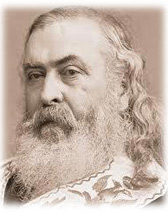
Albert Pike
American lawyer, writer, Confederate brigadier general, and Freemasonic leader, known for his book Morals and Dogma and for an unsubstantiated letter attributed to him that supposedly predicted three world wars.
Born on December 29, 1809
Died on April 2, 1891
Age at death: 82
Profession: Poet, Soldier, Lawyer
Place of Birth: Boston, Massachusetts, United States
Place of Death: Washington, D.C., United States
Albert Pike (December 29, 1809 – April 2, 1891) was an American lawyer, writer, poet, journalist, military officer, and prominent figure in Freemasonry. He served as a brigadier general in the Confederate Army during the American Civil War and became Sovereign Grand Commander of the Supreme Council of the Southern Jurisdiction of the Scottish Rite in 1859. His best-known publication, Morals and Dogma of the Ancient and Accepted Scottish Rite of Freemasonry (1871), discussed Masonic philosophy, symbolism, religion, and history. Pike's name has also been associated with a supposed letter dated August 15, 1871, addressed to Italian revolutionary Giuseppe Mazzini, allegedly predicting the First, Second, and Third World Wars. No authenticated original of this letter has been found, and its historical authenticity is not supported by documentary evidence.
Early Life and Education
Albert Pike was born on December 29, 1809, in Boston, Massachusetts, to Benjamin Pike and Sarah Andrews Pike. He grew up in Newburyport, Massachusetts, and received his early education at schools in Byfield, Newburyport, and Framingham.
He studied classical literature, languages, history, and mathematics. At approximately sixteen years old, he qualified for admission to Harvard College but lacked the financial resources to attend. He therefore pursued much of his advanced education independently.
During the 1820s, Pike worked as a teacher in Massachusetts communities including Gloucester, Fairhaven, and Newburyport. He also developed an interest in poetry and began writing literary compositions.
In 1831, he traveled westward through Missouri and New Mexico, eventually settling in Arkansas. His journeys provided material for travel writing, journalism, and poetry.
Journalism, Law, and Marriage
After settling in Arkansas, Albert Pike began contributing articles and poems to local newspapers. He became associated with the Arkansas Advocate in Little Rock and later served as its editor.
On October 10, 1834, he married Mary Ann Hamilton. Her family's financial support helped him purchase an interest in the newspaper, which he subsequently controlled.
During the 1830s, Pike studied law independently and was admitted to legal practice. By 1837, he had shifted much of his professional attention from journalism to law.
He developed a legal career involving property disputes, commercial matters, and cases concerning Native American nations. He represented members of the Creek, Choctaw, and Chickasaw nations in claims involving land, treaties, and financial obligations.
He also remained active in politics, supporting the Whig Party and later becoming associated with the nativist American Party, commonly known as the Know-Nothing movement.
Military Service in the Mexican-American War
During the Mexican-American War of 1846–1848, Albert Pike served as a captain in an Arkansas volunteer cavalry regiment.
He participated in military operations under the command of Archibald Yell and fought at the Battle of Buena Vista in February 1847.
After the war, he returned to Arkansas and resumed his legal, political, and literary activities.
Freemasonry and the Scottish Rite
Albert Pike joined Freemasonry in Little Rock in 1850, becoming a member of Western Star Lodge.
He subsequently advanced through various Masonic organizations and developed a particular interest in the Ancient and Accepted Scottish Rite, a system of Masonic degrees and associated philosophical teachings.
In 1859, he was elected Sovereign Grand Commander of the Supreme Council, Southern Jurisdiction of the United States. He retained that office until his death in 1891.
Pike revised Scottish Rite rituals, studied comparative religion and symbolism, and produced writings intended for members of the organization.
His principal Masonic publication was Morals and Dogma of the Ancient and Accepted Scottish Rite of Freemasonry, published in 1871. The book addressed the teachings and symbolism associated with the Scottish Rite degrees and drew extensively on religious, philosophical, and historical literature.
His extensive Masonic activities made him a widely recognized figure within the American Scottish Rite during the nineteenth century.
Confederate Service During the American Civil War
When the American Civil War began in April 1861, Albert Pike joined the Confederate cause despite his earlier reservations concerning secession.
He became involved in negotiations with Native American nations in Indian Territory, attempting to secure their support for the Confederacy.
On November 22, 1861, he was appointed a brigadier general in the Confederate Army.
He organized and commanded units composed largely of Native American soldiers, including members of the Creek, Choctaw, Chickasaw, and Cherokee nations.
In March 1862, his forces participated in the Battle of Pea Ridge, also known as the Battle of Elkhorn Tavern, in Arkansas.
Following the battle, Pike faced criticism concerning military discipline, command decisions, and reports of misconduct by soldiers under his command. He subsequently became involved in disputes with other Confederate officers.
He offered his resignation in 1862, and his military command ended later that year. His continuing disagreements with Confederate authorities resulted in a brief period of detention.
After the Confederate defeat in 1865, Pike faced the possibility of prosecution for his wartime activities. President Andrew Johnson granted him a presidential pardon on August 30, 1865.
He subsequently returned to legal and literary work, spending time in Memphis and Washington, D.C.
Literary Works
In addition to legal and political writing, Albert Pike published poetry throughout his life.
His early literary publications included Prose Sketches and Poems Written in the Western Country (1834), which drew partly on his travels through the American Southwest.
His poetry included Hymns to the Gods, first published in the nineteenth century and later collected with other compositions.
His most widely known book remains Morals and Dogma (1871), which circulated among Scottish Rite Freemasons and became a frequently discussed text in literature concerning Masonic beliefs and traditions.
Ku Klux Klan Allegations
Albert Pike has sometimes been described as a member or leader of the Ku Klux Klan, an organization established after the Civil War and associated with white supremacist violence.
Some later accounts attributed senior organizational positions to him. However, the available historical documentation does not conclusively establish that he held such a position. Claims that he was a founder or principal leader of the organization should therefore not be presented as established facts.
His documented Confederate military service, including his efforts to recruit Native American forces for the Confederacy, is separate from the disputed claims concerning Klan membership.
Personal Life and Children
Albert Pike married Mary Ann Hamilton in 1834. They had a large family, although historical accounts differ concerning the total number of children.
Children identified in biographical and genealogical accounts include Luther Hamilton Pike, Isadore Pike, Albert Holden Pike, Lilian Pike, Eustace Pike, Benjamin Desha Pike, Yvon Pike, Walter Lacy Pike, Clarence Pike, and Albert Pike Jr.
Mary Ann Hamilton died on April 14, 1876.
Pike maintained an interest in Christianity, comparative religion, classical literature, and Masonic philosophy throughout his adult life. He had been raised in an Episcopal Christian environment.
The Alleged 1871 Letter to Giuseppe Mazzini
One of the most frequently circulated stories concerning Albert Pike involves a supposed letter dated August 15, 1871, allegedly written in Washington, D.C., to Italian revolutionary and political thinker Giuseppe Mazzini.
According to the story, Pike described a secret plan to provoke three major international wars, using political and religious conflicts to transform world society.
The text is often attributed to Pike through the writings of William Guy Carr, a Canadian former naval officer and conspiracy author. Carr discussed the alleged correspondence in Pawns in the Game and Satan: Prince of This World.
Carr and later writers claimed that the letter had once been preserved in the British Museum Library. However, no authenticated manuscript, archival reference, or contemporary publication has established that Pike wrote the document.
Claims About the First and Second World Wars
The text attributed to Albert Pike describes a supposed plan to provoke the First World War by intensifying tensions between the British and German empires and weakening the Russian monarchy.
It alleges that the resulting conflict would enable communism and atheism to become established in Russia and subsequently spread internationally.
In its discussion of the Second World War, the alleged letter refers to fascism, Nazism, Zionism, and the establishment of Israel in Palestine. It presents the war as part of a secret effort to alter political and religious power throughout the world.
These claims are not supported by authenticated nineteenth-century correspondence. The references to Nazism, twentieth-century international communism, and the world wars are also inconsistent with the historical vocabulary and political circumstances of 1871.
Claims About a Third World War
The final section of the alleged letter attributed to Albert Pike describes a supposed future conflict between political Zionists and leaders of the Islamic world.
According to the circulated text, such a conflict would cause extensive physical, economic, moral, and social destruction. It then describes the emergence of nihilism and atheism, followed by a worldwide religious and philosophical transformation.
The text claims that the collapse of established religious institutions would prepare societies to accept a doctrine associated with Lucifer.
These passages are elements of an unverified document circulated in conspiracy literature. They do not provide evidence that Pike or any organization planned the world wars or that a future world war was predetermined.
Historical Authenticity of the Supposed Letter
The principal problem with the alleged Pike–Mazzini correspondence is the absence of a verifiable original document.
Although William Guy Carr repeated the claim that the letter had been held by the British Museum, he did not provide an archival catalogue number or reproduce an authenticated original manuscript.
In Satan: Prince of This World, Carr acknowledged that the British Museum Library had informed him that the purported letter was not listed in its catalogue.
Research into the story has connected aspects of its development with nineteenth-century anti-Masonic fabrications associated with Léo Taxil and later conspiracy literature.
The document's references to political movements and historical events that emerged long after 1871 provide further grounds for rejecting it as authentic nineteenth-century correspondence.
The alleged letter is therefore best understood as an apocryphal text rather than a genuine prediction or political plan written by Albert Pike.
Death
Albert Pike died on April 2, 1891, in Washington, D.C., at the age of 81.
He was initially buried at Oak Hill Cemetery in Washington. His remains were later moved to the House of the Temple, the headquarters of the Supreme Council of the Scottish Rite's Southern Jurisdiction.
Selected Publications
1834 – Prose Sketches and Poems Written in the Western Country
1839 – Hymns to the Gods (Early publication)
1854 – Nugæ (Poetry collection)
1871 – Morals and Dogma of the Ancient and Accepted Scottish Rite of Freemasonry
1872 – Hymns to the Gods and Other Poems
1900 – General Albert Pike's Poems (Posthumous collection)
1916 – Lyrics and Love Songs (Posthumous collection)
Source: Biyografiler.com
Frequently asked questions about Albert Pike
Who is Albert Pike?, Albert Pike biography, Albert Pike life story, Albert Pike age, Albert Pike facts, Albert Pike birthplace, Albert Pike photos, Albert Pike videos, Albert Pike career

Lamine Yamal
Professional footballer

Erling Haaland
Professional footballer

Kylian Mbappe
Professional footballer

Keanu Reeves
Actor

Bad Bunny
Rapper, Songwriter

Ronaldinho
Professional footballer

Aleksey Navalni
Lawyer, Politician

Aleksey Nikolayevich Tolstoy
Novelist, Poet, Writer

Alessandra Ambrosio
Model, Actress

Alessandro Safina
Singer

Alessandro Volta
Physicist, Chemist, Inventor

Alexander Albon
Formula 1 Driver

Alan Rickman
Actor, Film Director

Albert Pike
Poet, Soldier, Lawyer

Albert Uderzo
Illustrator, Cartoonist

Alberto Ginastera
Composer

Albertus Magnus
Philosopher

Patrick Stewart
Actor