
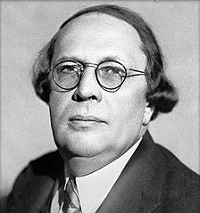
Aleksey Nikolayevich Tolstoy
Russian and Soviet novelist, playwright, and poet who wrote The Road to Calvary trilogy, the historical novel Peter the Great, the science fiction works Aelita and The Hyperboloid of Engineer Garin, and the children's story The Golden Key, or the Adventures of Buratino.
Born on January 10, 1883
Died on February 23, 1945
Age at death: 62
Profession: Novelist, Poet, Writer
Place of Birth: Nikolayevsk, Samara Governorate, Russian Empire (present-day Pugachyov, Saratov Oblast, Russia)
Place of Death: Moscow, Soviet Union
Aleksey Nikolayevich Tolstoy (January 10, 1883 – February 23, 1945) was a Russian and Soviet writer whose work encompassed historical fiction, science fiction, drama, poetry, children's literature, and political journalism. Born into a family associated with the Russian aristocracy, he studied engineering in Saint Petersburg before turning to literature. After opposing the Bolshevik Revolution, he emigrated to France and Germany but returned to Soviet Russia in 1923 and subsequently supported the Soviet government. His principal novels include The Road to Calvary, a trilogy following Russian society through the First World War, the 1917 revolutions, and the Civil War; Peter the Great, an unfinished historical novel; and the science fiction works Aelita and The Hyperboloid of Engineer Garin. He also wrote The Golden Key, or the Adventures of Buratino, an adaptation of the Pinocchio story that became widely published in the Soviet Union. Tolstoy was elected to the Academy of Sciences of the Soviet Union in 1939 and received three Stalin Prizes, the third awarded posthumously. He is not to be confused with the novelist Leo Tolstoy (1828–1910), to whom he was distantly related.
Early Life and Family Background
Aleksey Nikolayevich Tolstoy was born on January 10, 1883, according to the Gregorian calendar, corresponding to December 29, 1882, in the Julian calendar then used in Russia. His birthplace was Nikolayevsk in the Samara Governorate, a town subsequently renamed Pugachyov.
His mother, Alexandra Leontyevna Turgeneva, was a writer who produced stories for children. She belonged to the Turgenev family and was related to the Russian novelist Ivan Turgenev.
His legal father was Count Nikolay Alexandrovich Tolstoy, a member of the aristocratic Tolstoy family and a distant relative of Leo Tolstoy.
Before her son's birth, Alexandra left her husband and began living with Aleksey Apollonovich Bostrom, a landowner in the Samara region. Bostrom raised the child, who was known as Aleksey Bostrom during part of his youth.
The circumstances of Tolstoy's biological parentage have been disputed by biographers. Although he was later legally recognized as Count Nikolay Tolstoy's son and adopted the Tolstoy surname, some contemporary accounts identified Bostrom as his biological father. The available evidence does not establish the matter conclusively.
Tolstoy spent much of his childhood at Bostrom's estate in Sosnovka, near Samara. His early surroundings included rural life, agricultural activity, and the traditions of the provincial Russian gentry.
Childhood Education and Move to Samara
Aleksey Nikolayevich Tolstoy received his earliest education at home, with instruction provided by family members and private teachers.
His mother encouraged his reading and writing. He became familiar with Russian literature, folklore, and historical narratives during childhood.
In 1897, when he was fourteen, the family moved to Samara, where he continued his secondary education.
He attended the Samara Realschule, an institution emphasizing mathematics, science, and modern practical subjects.
He completed his secondary studies in 1901 and moved to Saint Petersburg to pursue university-level education.
Engineering Studies in Saint Petersburg
In 1901, Aleksey Nikolayevich Tolstoy entered the Saint Petersburg Technological Institute, where he studied mechanical engineering.
His education included mathematics, technical drawing, and engineering subjects. He also developed an interest in painting, theater, and literary circles.
During his student years, Tolstoy began writing poetry and participating in discussions about Russian literature.
He read the work of poets including Nikolay Nekrasov and Semyon Nadson, whose styles influenced his earliest verse.
In 1907, shortly before completing his studies, he left the institute without obtaining an engineering diploma and decided to pursue writing professionally.
First Poems and Literary Publications
Aleksey Nikolayevich Tolstoy began publishing poetry in the early twentieth century.
His first collection, Lirika, appeared in 1907 and contained poems influenced by nineteenth-century Russian verse and contemporary literary experimentation.
He subsequently shifted toward prose, writing stories about provincial society, landowning families, and changing relationships within the Russian social hierarchy.
His early fiction included A Week in Turenevo, Mishuka Nalymov, The Marriage Proposal, and The Dreamer.
He also experimented with drama, producing works for theatrical performance while continuing to publish short fiction.
His stories often drew upon the provincial environments he had known as a child, including rural estates, family conflicts, and declining aristocratic households.
Early Prose and Theater
Between 1909 and 1914, Aleksey Nikolayevich Tolstoy developed his reputation as a prose writer and playwright.
His stories examined provincial Russian society, household relationships, and the changing circumstances of the landowning class.
Works from this period included The Little Cockerel, The Actress, Mishuka Nalymov, and The Adventures of Rastegin.
He also wrote fiction drawing on folklore, superstition, and episodes from Russian history.
His early dramatic works reflected his interest in stage dialogue and character relationships, while his prose increasingly incorporated historical settings and social satire.
First World War Correspondent
When the First World War began in 1914, Aleksey Nikolayevich Tolstoy worked as a war correspondent.
He traveled to military areas and reported on events involving the Russian army.
His journalism brought him into contact with soldiers, officers, and civilians affected by the war.
These experiences provided material for his later fiction, particularly the first volume of The Road to Calvary.
During the war years, he continued writing plays, stories, and newspaper articles.
The Russian Revolution and Civil War
The February Revolution of 1917 and the subsequent October Revolution disrupted the political and social institutions of the Russian Empire.
Aleksey Nikolayevich Tolstoy initially opposed the Bolshevik seizure of power and the political changes that followed.
He left Petrograd and traveled south during the Russian Civil War, spending time in territories controlled by anti-Bolshevik forces.
Although his sympathies lay with the anti-Bolshevik movement, describing him as a regular soldier of the White Army would be misleading. He was primarily active as a writer and journalist.
In 1919, he left Russia and settled in France with members of his family.
Exile in Paris
During his first years abroad, Aleksey Nikolayevich Tolstoy lived in Paris, where he joined the Russian émigré community.
He continued writing fiction and worked with Russian-language publications.
The experience of displacement, political division, and uncertainty became a recurring subject in his work.
He developed the novel Nikita's Childhood, which drew on memories of his upbringing in the Samara countryside.
The work was published in 1921 and follows a boy growing up on a rural estate, describing his family, childhood experiences, and surrounding landscape.
Tolstoy also began working on the material that would become The Road to Calvary trilogy.
Berlin and the Changing Relationship with Soviet Russia
In 1921, Aleksey Nikolayevich Tolstoy moved from Paris to Berlin, which had become an important center of Russian émigré publishing.
He became associated with the Russian-language newspaper Nakanune, whose editorial position supported reconciliation with Soviet Russia.
The publication was connected with the broader Smenovekhovstvo movement, which encouraged Russian émigrés to reconsider their opposition to the Soviet government.
During this period, Tolstoy's political views shifted toward acceptance of the new Soviet state.
His literary work in Berlin included the science fiction novel Aelita and shorter prose such as Black Friday and The Manuscript Found Under the Bed.
In May 1923, he returned permanently to Soviet Russia with his family.
Return to the Soviet Union in 1923
After returning to Moscow, Aleksey Nikolayevich Tolstoy resumed publishing in Soviet literary journals and newspapers.
He increasingly supported the Soviet government and became involved in official literary and cultural organizations.
His return distinguished him from émigré writers who continued to oppose Bolshevik rule from abroad.
During the following decades, he produced historical novels, science fiction, plays, and works intended for Soviet readers.
He became known by the nickname "Red Count," referring to his aristocratic background and his public association with the Soviet state.
His position also brought privileges and access to official cultural institutions during Joseph Stalin's rule, a period when many other Soviet writers faced censorship, imprisonment, or persecution.
Aelita: Science Fiction and Mars
In 1923, Aleksey Nikolayevich Tolstoy published Aelita, a science fiction novel involving an expedition from Earth to Mars.
The story follows the engineer Los and the revolutionary soldier Gusev, who travel to Mars in a spacecraft.
On Mars, they encounter a civilization organized around social divisions and political conflict.
Los develops a relationship with Aelita, the daughter of the Martian ruler, while Gusev becomes involved in revolutionary activity.
The novel combines adventure, romantic fiction, and political themes within a speculative technological setting.
In 1924, director Yakov Protazanov released the silent film Aelita: Queen of Mars, based on the novel.
The film featured futuristic sets and costume designs and became an early example of science fiction cinema produced in the Soviet Union.
The Hyperboloid of Engineer Garin
Aleksey Nikolayevich Tolstoy returned to science fiction with The Hyperboloid of Engineer Garin, also known in English as The Garin Death Ray.
The novel appeared in serialized form during 1925–1926 and was published in book form in 1927.
Its principal character, engineer Pyotr Garin, develops a powerful energy weapon capable of destroying objects at great distances.
Garin attempts to use the invention to obtain political and economic control on an international scale.
The story incorporates espionage, international finance, scientific experimentation, and political conflict.
The novel was subsequently revised and appeared in several editions.
It was adapted for cinema in 1965 and again for television in 1973.
The Road to Calvary Trilogy
Aleksey Nikolayevich Tolstoy worked on The Road to Calvary (*Khozhdeniye po mukam*) over approximately two decades, beginning during the First World War and completing the trilogy in 1941.
The three novels follow members of the Russian intelligentsia through the final years of the Russian Empire, the First World War, the revolutions of 1917, and the Russian Civil War.
The central characters include the sisters Darya and Yekaterina Bulavina, the engineer Ivan Telegin, and the officer Vadim Roshchin. Their experiences bring together personal relationships, political disagreements, military events, and the disruption of civilian life.
The first volume, Sisters (*Syostry*), was begun in 1918, serialized during Tolstoy's emigration, and published in book form in 1922. It portrays Russian society before the revolution and follows the characters as political tensions intensify.
The second volume, The Eighteenth Year (*Vosemnadtsaty god*), was written in 1927–1928. It concentrates on events during 1918, including the Civil War and the political divisions that followed the Bolshevik Revolution.
The third volume, Gloomy Morning (*Khmuroye utro*), was completed in 1941. It follows the characters through the later stages of the Civil War and reflects Tolstoy's changed attitude toward the Soviet state.
The trilogy's development reveals a change in the author's political outlook. The early material was written while Tolstoy opposed the Bolsheviks, whereas the completed work presents the revolution and the establishment of Soviet power through a more sympathetic perspective.
In 1943, Tolstoy received the Stalin Prize for the trilogy.
The work has appeared in Turkish under the title Azap Yolları, with its three volumes published as *İki Kız Kardeş*, *Yıl 1918*, and *Kederli Sabah*. The Turkish translation of the first volume by Ali Rıza Yalt was published in 1969.
Peter the Great
In 1929, Aleksey Nikolayevich Tolstoy began writing Peter the Great (*Pyotr Pervy*), a historical novel about the reign of Peter I of Russia.
The novel examines the transformation of Russia during the late seventeenth and early eighteenth centuries, including military reforms, state administration, relations with European powers, and conflicts within Russian society.
Tolstoy researched historical documents and accounts of the period while developing the characters and events.
The first two books were published during the 1930s. He continued working on a third volume but did not complete the novel before his death.
The novel presents Peter's efforts to reorganize the Russian state through an extensive narrative involving political figures, soldiers, officials, merchants, and ordinary people.
Tolstoy received the Stalin Prize in 1941 for the first two volumes.
The novel also provided material for the two-part Soviet historical film Peter the Great (1937–1938), directed by Vladimir Petrov.
The Golden Key and Buratino
In 1936, Aleksey Nikolayevich Tolstoy published The Golden Key, or the Adventures of Buratino (*Zolotoy klyuchik, ili Priklyucheniya Buratino*).
The children's story was adapted from the character and narrative developed by Italian writer Carlo Collodi in The Adventures of Pinocchio.
Tolstoy reworked the story for Russian readers, introducing different characters, episodes, and narrative developments.
Its protagonist, Buratino, is a wooden puppet who becomes involved in adventures involving a mysterious golden key, a puppet theater, and several threatening or deceptive characters.
The supporting characters include Papa Carlo, Malvina, Pierrot, Karabas-Barabas, and the fox Alice.
Unlike Collodi's Pinocchio, Buratino does not undergo a transformation into a human boy at the conclusion of the story.
The book was adapted for film in 1939 and subsequently for animation and television. It became a recurring publication in Soviet children's literature.
Historical Fiction and Other Prose
Alongside his principal novels, Aleksey Nikolayevich Tolstoy wrote historical stories, satirical fiction, and works examining social and political change.
The Adventures of Nevzorov, or Ibicus (1924) follows a character whose experiences take place against the background of revolution, displacement, and the Russian émigré world.
Blue Cities (1925) addresses questions involving Soviet life, social expectations, and attempts to construct a different society.
The Viper (1928) concerns the experiences of a woman whose life has been affected by the Civil War and the difficulties of adapting to civilian society.
Black Gold, subsequently revised and associated with the title The Emigrants, examines Russian émigré circles and political activity abroad.
His historical prose also included Peter's Day, while his shorter fiction ranged from supernatural stories such as Count Cagliostro to accounts of everyday life and family relationships.
Plays and Ivan the Terrible
Aleksey Nikolayevich Tolstoy wrote extensively for the theater throughout his career.
His plays included historical dramas, satirical works, and adaptations of literary and folkloric material.
Among his historical plays was Ivan the Terrible, a dramatic work about Ivan IV of Russia, the sixteenth-century Russian ruler.
The project consisted of two plays, The Eagle and His Mate (1942) and The Difficult Years (1943).
They examine conflicts involving the Russian monarchy, aristocratic factions, foreign threats, and the consolidation of royal authority.
Tolstoy corresponded with Soviet officials regarding the plays, and Joseph Stalin reviewed the manuscripts and suggested changes.
The revised texts were published in 1944. The productions encountered difficulties, and the second play reached the stage after the author's death.
The Ivan the Terrible plays received a Stalin Prize in 1946, awarded posthumously.
Second World War Journalism
Following the German invasion of the Soviet Union in June 1941, Aleksey Nikolayevich Tolstoy devoted increasing attention to wartime journalism.
He published articles and essays concerning the German invasion, Soviet resistance, military operations, and national identity.
His wartime writings included The Motherland, Russian Character, The Enemy Threatens Moscow, and What Are We Defending?.
He also wrote pieces addressing German military strategy, Nazi ideology, and the experiences of Soviet soldiers and civilians.
In November 1942, Tolstoy became a member of the Extraordinary State Commission, established to investigate crimes committed by German occupying forces and their collaborators.
His work for the commission involved documentary investigations and official reports. Soviet archival records include material connected with investigations in the North Caucasus and other occupied territories.
He remained active in literary and public affairs during the war despite declining health.
Political Position and Soviet Recognition
After returning from emigration, Aleksey Nikolayevich Tolstoy became associated with Soviet cultural institutions and publicly supported the government led by Joseph Stalin.
He was elected to the Academy of Sciences of the Soviet Union in 1939 and received several state decorations.
His public position included representing Soviet literature at official events, publishing political commentary, and participating in government-supported organizations.
His status also reflected the Soviet authorities' willingness to recognize a writer from the former aristocracy who had returned from exile and accepted the new political system.
His historical novels, particularly Peter the Great, were interpreted within Soviet literary culture as accounts of state development and national transformation.
Tolstoy's relationship with Stalin and his participation in official cultural institutions remain subjects of literary and historical study, particularly because his public success coincided with state censorship and the persecution of other writers.
Marriages and Children
Aleksey Nikolayevich Tolstoy married several times.
His first wife was Yulia Rozhanskaya, whom he married in 1901. He subsequently married artist Sofya Dymshits.
In 1915, he married poet Natalya Krandievskaya, who accompanied him during his years of emigration.
Their children included Nikita Tolstoy and Dmitry Tolstoy. His family also included daughters Maryana and Elena from his marriages.
In 1935, Tolstoy married Lyudmila Krestinskaya, with whom he spent the final decade of his life.
His descendants included scientists, scholars, and writers, among them Tatyana Tolstaya, a novelist and essayist.
Death
Aleksey Nikolayevich Tolstoy died of lung cancer on February 23, 1945, in Moscow, Soviet Union. He was 62 years old.
He was buried at Novodevichy Cemetery in Moscow.
At the time of his death, his historical novel Peter the Great remained unfinished.
In 1946, he received a posthumous Stalin Prize for his Ivan the Terrible plays, bringing his total to three.
Major Novels
1922 – Sisters (*Syostry*), first volume of The Road to Calvary
1923 – Aelita, science fiction novel
1924 – The Adventures of Nevzorov, or Ibicus
1927 – The Hyperboloid of Engineer Garin, also known as The Garin Death Ray
1928 – The Eighteenth Year, second volume of The Road to Calvary
1929–1945 – Peter the Great, unfinished historical novel
1931 – Black Gold, revised as The Emigrants
1941 – Gloomy Morning, third volume of The Road to Calvary
Short Stories and Novellas
1910 – The Little Cockerel
1910 – A Week in Turenevo
1910 – The Marriage Proposal
1910 – Mishuka Nalymov
1910 – The Actress, also known as Two Friends
1910 – The Dreamer, also known as Aggey Korovin
1910 – The Adventures of Rastegin
1911 – Khariton's Gold
1916 – Love
1916 – A Pleasant Lady
1917 – An Ordinary Man
1918 – Peter's Day
1920 – Four Ages
1921 – In Paris
1921 – Count Cagliostro
1921–1922 – Nikita's Childhood
1922 – A Tale of Troubled Times
1924 – Seven Days in a Plundered World
1925 – Blue Cities
1927 – A Well-Mannered Man
1928 – The Viper
1937 – Bread
1944 – Russian Character
1944 – A Strange Story
Other shorter works attributed to Tolstoy include The Old Road, Black Friday, On Halki Island, The Manuscript Found Under the Bed, In the Snow, Mirage, The Murder of Antoine Rivo, and While Fishing. Publication titles and dates differ among Russian editions and translated collections.
Children's Literature and Fairy Tales
The Mermaid Tales, collection of fairy tales
The Magpie Tales, collection of fairy tales
1936 – The Golden Key, or the Adventures of Buratino
The Gluttonous Henpecked Husband, folk-inspired tale
The Sorcerer's Daughter and the Sorceress Queen, fairy-tale material
Plays
The Death of Danton
The Death of Fyodor Ivanovich
The Beggar
The Village Swallow
The Empress's Spell
1924–1925 – The Revolt of the Machines
The Miracle, folklore-based work
Love: A Golden Book
The Devil, also associated with the title Grandfather Mardyk
1942 – The Eagle and His Mate, first Ivan the Terrible play
1943 – The Difficult Years, second Ivan the Terrible play
Wartime Journalism and Essays
An Army of Heroes
Blitzkrieg and Blitzcrash
To the Writers of North America
The Enemy Threatens Moscow
You Cannot Defeat Us
Why Hitler Must Accept Defeat
The Motherland
Russian Character
The Stories of Ivan Sudarev
Dark Days for Hitler's Army
What Are We Defending?
I Call for Hatred
Unfinished Works
1925 – Yegor Abazov, unfinished literary project
1929–1945 – Peter the Great, historical novel, unfinished at the author's death
Film and Television Adaptations
1924 – Aelita: Queen of Mars, directed by Yakov Protazanov
1928 – The Lame Gentleman, adaptation of Tolstoy's prose
1937–1938 – Peter the Great, historical film in two parts
1939 – The Golden Key, children's film based on Buratino
1944 – Ivan the Terrible, historical film directed by Sergei Eisenstein, concerning the same historical figure as Tolstoy's plays but not a direct adaptation of them
1957 – The Sisters, adaptation of the first part of The Road to Calvary
1958 – The Eighteenth Year, second part of The Road to Calvary film trilogy
1959 – Gloomy Morning, third part of The Road to Calvary film trilogy
1959 – The Adventures of Buratino, animated film
1965 – The Hyperboloid of Engineer Garin, science fiction film
1965 – The Viper, film adaptation
1973 – The Failure of Engineer Garin, television adaptation
1975 – The Adventures of Buratino, television musical film
1977 – The Road to Calvary, television adaptation
1980 – At the Beginning of Glorious Days, historical film based on Peter the Great
1982 – The Adventures of Count Nevzorov, film adaptation
1984 – Formula of Love, inspired by Count Cagliostro
1992 – Nikita's Childhood, screen adaptation
1992 – The Beautiful Stranger, screen adaptation
1997 – The New Adventures of Buratino, adaptation of characters from The Golden Key
Literary Awards and Official Honors
1938 – Order of Lenin
1939 – Elected to the Academy of Sciences of the Soviet Union
1939 – Order of the Badge of Honour
1941 – Stalin Prize, First Class, for Peter the Great
1943 – Stalin Prize, First Class, for The Road to Calvary
1943 – Order of the Red Banner of Labour
1946 – Stalin Prize, First Class, for Ivan the Terrible (posthumously)
Source: Biyografiler.com
Frequently asked questions about Aleksey Nikolayevich Tolstoy
Who is Aleksey Nikolayevich Tolstoy?, Aleksey Nikolayevich Tolstoy biography, Aleksey Nikolayevich Tolstoy life story, Aleksey Nikolayevich Tolstoy age, Aleksey Nikolayevich Tolstoy facts, Aleksey Nikolayevich Tolstoy birthplace, Aleksey Nikolayevich Tolstoy photos, Aleksey Nikolayevich Tolstoy videos, Aleksey Nikolayevich Tolstoy career
Related Biographies

Lamine Yamal
Professional footballer

Erling Haaland
Professional footballer

Kylian Mbappe
Professional footballer

Keanu Reeves
Actor

Bad Bunny
Rapper, Songwriter

Ronaldinho
Professional footballer

Aleksey Navalni
Lawyer, Politician

Aleksey Nikolayevich Tolstoy
Novelist, Poet, Writer

Alessandra Ambrosio
Model, Actress

Alessandro Safina
Singer

Alessandro Volta
Physicist, Chemist, Inventor

Alexander Albon
Formula 1 Driver

Alan Rickman
Actor, Film Director

Albert Pike
Poet, Soldier, Lawyer

Albert Uderzo
Illustrator, Cartoonist

Alberto Ginastera
Composer

Albertus Magnus
Philosopher

Patrick Stewart
Actor