
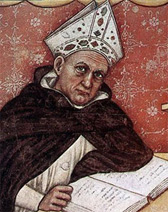
Albertus Magnus
Medieval German philosopher, theologian, and natural scientist known as Albert the Great and Doctor Universalis. He was a teacher of Thomas Aquinas and wrote extensively on Aristotelian philosophy, theology, botany, zoology, mineralogy, and astronomy.
Born on ?? ??, 1207
Died on November 15, 1280
Age at death: 73
Profession: Philosopher
Place of Birth: Lauingen, Swabia, Holy Roman Empire (present-day Germany)
Place of Death: Cologne, Holy Roman Empire (present-day Germany)
Albertus Magnus (c. 1200 – November 15, 1280), also known as Albert the Great or Albert of Cologne, was a German Dominican friar, philosopher, theologian, bishop, and natural philosopher. He received the title Doctor Universalis, meaning Universal Doctor, because of the breadth of his scholarship. His writings examined logic, metaphysics, theology, astronomy, botany, zoology, mineralogy, and subjects associated with medieval alchemy and astrology. He studied the works of Aristotle and their interpretations by Islamic philosophers, helping introduce Aristotelian natural philosophy into medieval Latin scholarship. Among his students was Thomas Aquinas, whose philosophical and theological work developed partly from Albert's teaching. He was canonized by Pope Pius XI in 1931 and is recognized by the Catholic Church as a Doctor of the Church.
Early Life and Education
Albertus Magnus was born in Lauingen, in the historical region of Swabia, now part of Germany. His exact birth year is unknown. Historians generally place his birth around 1200, although dates between 1193 and 1207 have appeared in older biographies.
He belonged to a family associated with the lesser nobility and the Counts of Bollstädt. Little reliable information survives about his childhood or early education.
As a young man, he traveled to northern Italy and studied at the University of Padua, where he encountered the writings of Aristotle and developed an interest in philosophy and natural science.
In 1223, he joined the Dominican Order, also known as the Order of Preachers, after meeting Jordan of Saxony, the order's master general.
He subsequently traveled to Cologne for theological training and began teaching in Dominican institutions. During the following years, he lectured in Hildesheim, Freiburg im Breisgau, Regensburg, and Strasbourg.
Teaching at the University of Paris
In the early 1240s, Albertus Magnus went to Paris to complete his advanced theological education at the University of Paris.
He received the degree of Master of Theology in 1245 and occupied a Dominican teaching position until 1248.
At that time, European universities were engaged in debates concerning the relationship between Christian theology and the philosophical writings of ancient Greek thinkers.
The works of Aristotle were becoming increasingly available in Latin translation, often accompanied by explanations from Islamic philosophers.
Albert studied these sources and sought to examine their arguments systematically. His aim was to distinguish philosophical conclusions based on reason from theological teachings grounded in revelation while considering how the two forms of knowledge could be reconciled.
During his years in Paris, he became the teacher of Thomas Aquinas, who later accompanied him to Cologne.
Founding the Dominican School in Cologne
In 1248, Albertus Magnus returned to Cologne to establish a Dominican Studium Generale, an advanced center for theological and philosophical education.
He directed and taught at the institution until 1254. Thomas Aquinas continued studying under him during part of this period before returning to Paris.
Albert lectured on theology, logic, metaphysics, and natural philosophy. His teaching included detailed examinations of Aristotelian works and the interpretations of earlier commentators.
He also contributed to the organization of Dominican education, promoting systematic philosophical study within the order's theological curriculum.
Aristotle and Islamic Philosophical Thought
A central part of the scholarship of Albertus Magnus involved explaining the writings of Aristotle to Latin-speaking European scholars.
His philosophical studies drew on interpretations by Muslim thinkers including Al-Farabi, Avicenna, and Averroes. These scholars had developed extensive commentaries on logic, metaphysics, medicine, and the natural sciences.
Albert examined their arguments and incorporated selected concepts into his philosophical works. He also criticized interpretations he considered inconsistent with reason or Christian doctrine.
His writings helped distinguish Aristotle's original philosophical arguments from later commentaries, particularly in discussions of the nature of the soul, human knowledge, causation, and the structure of the universe.
His work was concerned with the relationship between philosophical reasoning and religious belief. He maintained that genuine knowledge could not ultimately contradict truth, although different disciplines could investigate different aspects of reality using distinct methods.
This approach influenced Thomas Aquinas, who subsequently developed an extensive philosophical and theological system drawing on Aristotle and Christian doctrine.
Faith, Reason, and Medieval Philosophy
Albertus Magnus treated philosophy and theology as related but distinguishable fields of inquiry.
He argued that natural phenomena could be studied through observation and rational investigation, while theological questions concerning divine revelation required methods appropriate to religious doctrine.
His philosophical writings addressed the relationship between the human intellect and the senses, the nature of matter and form, the causes of motion, and the distinction between physical and metaphysical explanation.
He also examined problems concerning free will, morality, knowledge, and the immortality of the soul.
His theological work included commentaries on biblical texts, the writings of Peter Lombard, and the works attributed to Pseudo-Dionysius the Areopagite.
Research in Botany
Albertus Magnus wrote extensively about plants in De Vegetabilibus et Plantis (On Vegetables and Plants), drawing on ancient sources and his own observations.
His botanical studies incorporated information from Aristotle, Theophrastus, and other classical writers, but he also examined plants growing in European environments.
He described trees, herbs, cultivated crops, fruits, and other vegetation, paying attention to their structure, growth, and reproductive processes.
His classifications distinguished different groups of plants according to visible characteristics. They included fungi and flowering plants, although the system differed substantially from modern botanical taxonomy.
Albert investigated the shapes of leaves, flowers, and fruits, sometimes comparing their forms with familiar objects or animals.
He also considered the role of heat, sunlight, soil, and moisture in plant growth.
His writings discussed grafting and the possibility that cultivation could change certain characteristics of plants. He examined differences in fruit varieties and the movement of sap through plant tissues.
Albert described the characteristics of several plants that had entered European agriculture through Mediterranean trade, including spinach.
His botanical writings contain a mixture of direct observations, information obtained from other writers, and assumptions reflecting the scientific understanding of the thirteenth century.
Studies of Animals and Embryology
In De Animalibus (On Animals), Albertus Magnus examined animal anatomy, reproduction, behavior, and classification.
The work comprised twenty-six books and incorporated material from Aristotle's zoological writings, additional medieval sources, and Albert's own observations.
He discussed mammals, birds, reptiles, fish, mollusks, crustaceans, and insects.
His descriptions included animals found in northern Europe, along with species known primarily through written accounts.
Albert compared the circulatory structures of birds and fish with descriptions found in classical literature. In some cases, he corrected or questioned earlier authorities when his observations differed from their claims.
He also studied embryological development by examining chicken eggs at different stages of incubation.
His discussions covered the formation of organs, the development of blood vessels, and the role of structures such as the umbilical cord and placenta in reproduction.
Although some conclusions reflected inaccurate medieval theories of physiology, his writings demonstrated an interest in direct observation rather than exclusive dependence on inherited authorities.
Mineralogy, Fossils, and Alchemy
Albertus Magnus studied minerals, metals, precious stones, and geological processes. His principal work on these subjects was De Mineralibus, also known as On Minerals.
He described the physical characteristics of numerous minerals and gemstones and examined their possible origins and properties.
His observations were informed partly by travels through regions containing mines and mineral deposits.
Albert examined the formation of metals and the techniques used to work and purify them. He was also familiar with medieval alchemical theories concerning the transformation of substances.
Later writers attributed numerous chemical discoveries to him, including methods associated with nitric acid and the purification of gold. However, the authorship of several alchemical texts circulated under his name is uncertain, and these discoveries cannot all be reliably assigned to him.
His mineralogical studies also addressed fossils. He recognized that some fossil remains originated from organisms that had once been alive and subsequently undergone mineralization.
His explanations of fossils combined natural processes with ideas drawn from medieval philosophy and theology.
Astronomy and Astrology
In addition to biology and mineralogy, Albertus Magnus examined astronomy, celestial motion, and the influence traditionally attributed to heavenly bodies.
His studies drew on the astronomical framework inherited from Aristotle and Claudius Ptolemy, together with medieval Latin and Arabic scientific literature.
He discussed the structure of the cosmos, planetary movement, and the relationship between celestial phenomena and events in the natural world.
Although he treated some forms of celestial influence as worthy of philosophical consideration, he criticized interpretations that removed human freedom or attributed absolute power over human decisions to the stars.
His work thus reflected the close historical relationship between astronomy and astrology in medieval scholarship.
Dominican Leadership and Appointment as Bishop
In 1254, Albertus Magnus was elected provincial superior of the Dominican province of Teutonia, which covered a large part of the German-speaking territories of the Holy Roman Empire.
He traveled extensively to visit Dominican houses and supervise their religious and educational activities.
In 1256, he appeared before the papal court at Anagni, where he defended the mendicant religious orders during disputes involving university teachers and secular clergy.
He also addressed questions concerning philosophical doctrines associated with Averroism and the influence of celestial bodies.
In 1260, Pope Alexander IV appointed Albert Bishop of Regensburg despite opposition from Dominican leaders who preferred him to remain engaged in teaching and scholarship.
His responsibilities included administering the diocese, addressing financial difficulties, and supervising religious institutions.
He resigned from the bishopric in 1262, after approximately two years, and returned to Dominican intellectual and religious activities.
Papal Missions and Later Teaching
After leaving Regensburg, Albertus Magnus undertook additional religious and diplomatic assignments.
Under Pope Urban IV, he was commissioned to preach in support of a crusade in German-speaking territories during 1263–1264. This mission occurred before the Eighth Crusade of 1270 and should not be confused with that later expedition.
He subsequently taught and worked in cities including Würzburg and Strasbourg.
Albert also served as a mediator in disputes between the city of Cologne and its archbishops. His involvement in these negotiations was recorded on several occasions during the thirteenth century.
Around 1270, he returned to Cologne, where he continued teaching, writing, and participating in Dominican religious life.
In 1274, he attended the Second Council of Lyon, convened by Pope Gregory X.
The council addressed relations between the Latin and Greek churches, ecclesiastical reform, and plans for a new crusade.
Albert also supported the recognition of Rudolf I of Habsburg as ruler of the Germans.
Relationship with Thomas Aquinas
Albertus Magnus maintained an intellectual relationship with his former student Thomas Aquinas throughout their careers.
Both thinkers examined the relationship between Aristotelian philosophy and Christian theology, although they did not always reach identical conclusions.
Aquinas died on March 7, 1274, while traveling to the Second Council of Lyon.
Following his death, some of his philosophical positions became controversial within ecclesiastical and university circles.
In 1277, Albert traveled to Paris to defend aspects of his former student's teachings against criticism.
His intervention formed part of the wider debates concerning the place of Aristotelian philosophy in medieval Christian education.
Death
Albertus Magnus died on November 15, 1280, in Cologne, in the Holy Roman Empire.
Because his exact birth date is uncertain, his age at death cannot be established precisely.
He was buried in Cologne, where his remains are now housed in the crypt of St. Andrew's Church.
In 1931, Pope Pius XI canonized Albert and declared him a Doctor of the Church.
In 1941, Pope Pius XII designated him the patron saint of natural scientists.
Selected Works
Philosophy and Theology:
De Natura Boni (On the Nature of Good)
De Bono (On the Good)
De Homine (On Man)
Summa de Creaturis (Summa on Created Things)
Commentary on the Sentences of Peter Lombard
De Unitate Intellectus Contra Averroem (On the Unity of the Intellect Against Averroes)
Summa Theologiae (Summa of Theology; unfinished)
Natural Philosophy and Science:
De Vegetabilibus et Plantis (On Vegetables and Plants)
De Animalibus (On Animals)
De Mineralibus (On Minerals)
De Meteoris (On Meteorology)
De Caelo et Mundo (On the Heavens and the World)
De Generatione et Corruptione (On Generation and Corruption)
De Sensu et Sensato (On Sense and Sensible Objects)
Aristotelian Commentaries:
Commentary on Aristotle's Physics
Commentary on Aristotle's Metaphysics
Commentary on Aristotle's Ethics
Commentary on Aristotle's Politics
Commentary on Aristotle's De Anima
Commentary on Aristotle's Posterior Analytics
Selected Historical Dates
c. 1200 – Born in Lauingen, Swabia
1223 – Joined the Dominican Order at Padua
1245 – Became Master of Theology at the University of Paris
1248 – Established the Dominican Studium Generale in Cologne
1254 – Elected provincial superior of the Dominican province of Teutonia
1260 – Appointed Bishop of Regensburg
1262 – Resigned from the bishopric
1263–1264 – Undertook papal preaching assignments in German-speaking territories
1274 – Attended the Second Council of Lyon
1277 – Defended the philosophical teachings of Thomas Aquinas in Paris
1280 – Died in Cologne
1931 – Canonized and declared a Doctor of the Church
1941 – Designated patron saint of natural scientists
Source: Biyografiler.com
Frequently asked questions about Albertus Magnus
Who is Albertus Magnus?, Albertus Magnus biography, Albertus Magnus life story, Albertus Magnus age, Albertus Magnus facts, Albertus Magnus birthplace, Albertus Magnus photos, Albertus Magnus videos, Albertus Magnus career
Related Biographies

Lamine Yamal
Professional footballer

Erling Haaland
Professional footballer

Kylian Mbappe
Professional footballer

Keanu Reeves
Actor

Bad Bunny
Rapper, Songwriter

Ronaldinho
Professional footballer

Aleksey Navalni
Lawyer, Politician

Aleksey Nikolayevich Tolstoy
Novelist, Poet, Writer

Alessandra Ambrosio
Model, Actress

Alessandro Safina
Singer

Alessandro Volta
Physicist, Chemist, Inventor

Alexander Albon
Formula 1 Driver

Alan Rickman
Actor, Film Director

Albert Pike
Poet, Soldier, Lawyer

Albert Uderzo
Illustrator, Cartoonist

Alberto Ginastera
Composer

Albertus Magnus
Philosopher

Patrick Stewart
Actor