
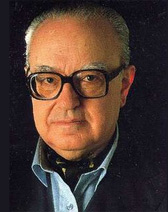
Alberto Ginastera
Argentine classical composer known for his ballets Panambí and Estancia, the operas Don Rodrigo and Bomarzo, and orchestral and instrumental works combining Argentine musical traditions with twentieth-century modernism.
Born on April 11, 1916
Died on June 25, 1983
Age at death: 67
Profession: Composer
Place of Birth: Buenos Aires, Argentina
Place of Death: Geneva, Switzerland
Alberto Ginastera (April 11, 1916 – June 25, 1983), whose full name was Alberto Evaristo Ginastera, was an Argentine composer associated with twentieth-century classical music. His compositions included operas, ballets, orchestral works, concertos, chamber music, and film scores. His early works incorporated Argentine folk rhythms and musical traditions, while his later compositions employed techniques including twelve-tone writing, polytonality, and microtonality. Among his compositions are Panambí, Estancia, Variaciones concertantes, Don Rodrigo, Bomarzo, and Beatrix Cenci. He also worked as a music educator and held academic positions in Argentina before settling in Geneva, Switzerland, in 1969.
Early Life and Musical Education
Alberto Ginastera was born on April 11, 1916, in Buenos Aires, Argentina. He began studying music privately during childhood and subsequently attended the Conservatorio Williams and the National Conservatory of Music in Buenos Aires.
He studied composition, piano, and music theory, completing his conservatory education in 1938. During his student years, he began composing works influenced by Argentine folk music, particularly the rhythms and melodies associated with rural traditions.
His early compositions included Concierto argentino (1935), written for piano and orchestra, and the ballet Panambí, composed between 1934 and 1937.
After graduating, he taught music at the Liceo Militar General San Martín and continued developing his career as a composer.
Early Compositions and Argentine Nationalism
During the late 1930s and early 1940s, Alberto Ginastera developed a musical style incorporating Argentine folk rhythms, traditional dances, and contemporary classical techniques.
His ballet Panambí drew on Indigenous South American legends and employed orchestral colors associated with Stravinskian modernism. Its orchestral suite helped bring his music to wider attention.
In 1941, he composed Estancia, a ballet depicting rural life on an Argentine ranch. The composition incorporated rhythms associated with the gaucho tradition and Argentine folk dances.
The ballet's orchestral suite includes the Malambo, a rhythmically energetic movement based on a traditional Argentine dance. The suite became one of Ginastera's frequently performed orchestral works.
Other compositions from this period included Danzas argentinas (1937), Malambo for piano (1940), and Cinco canciones populares argentinas (1943).
Guggenheim Fellowship and Academic Career
In 1946, Alberto Ginastera traveled to the United States with the support of a Guggenheim Fellowship. He remained there during 1946–1947, studying contemporary musical developments and establishing connections with American musicians and institutions.
During this period, he became acquainted with composer Aaron Copland, whose approach to combining national musical traditions with modern composition provided a point of comparison with Ginastera's own work.
After returning to Argentina, he joined the teaching staff of the National Conservatory and continued composing orchestral and instrumental music.
He subsequently helped establish educational institutions devoted to advanced music studies and became dean of the Faculty of Musical Arts and Sciences at the Pontifical Catholic University of Argentina.
His teaching and administrative activities were repeatedly affected by political changes in Argentina. He lost academic positions on two occasions following conflicts with governments whose policies he opposed.
Musical Style and Three Creative Periods
Alberto Ginastera divided his compositions into three principal stylistic periods: Objective Nationalism, Subjective Nationalism, and Neo-Expressionism.
Objective Nationalism (1934–1948): During this period, he incorporated recognizable Argentine folk rhythms, melodies, dances, and rural subjects into works such as Panambí, Estancia, and Danzas argentinas.
Subjective Nationalism (1948–1958): His music became less directly dependent on identifiable folk melodies. Instead, he employed original musical themes and rhythmic structures intended to evoke Argentine traditions. Works from this period included Piano Sonata No. 1 (1952), Variaciones concertantes (1953), and Pampeana No. 3 (1954).
Neo-Expressionism (1958–1983): Ginastera increasingly adopted modernist techniques, including twelve-tone composition, serial procedures, polytonality, and microtonal writing. His operas and later concertos belong to this period.
During his final years, he also returned to certain tonal and folk-derived elements associated with his earlier compositions.
Operas and International Recognition
Alberto Ginastera composed three completed operas: Don Rodrigo, Bomarzo, and Beatrix Cenci.
His first opera, Don Rodrigo, Op. 31, was composed between 1963 and 1964, with a libretto by Alejandro Casona. It premiered at the Teatro Colón in Buenos Aires in 1964 and received its United States premiere at the New York City Opera in 1966.
The opera helped establish Ginastera's international reputation as a dramatic composer. Its New York production also marked an early professional appearance by tenor Placido Domingo.
His second opera, Bomarzo, Op. 34, was composed between 1966 and 1967, with a libretto by Argentine novelist Manuel Mujica Lainez. The story was inspired by the life of Pier Francesco Orsini, a Renaissance nobleman associated with the gardens of Bomarzo in Italy.
Bomarzo premiered in Washington, D.C., in 1967. Its treatment of sexuality and violence generated controversy, and the Argentine military government prohibited its planned Buenos Aires production. The opera was not performed in Argentina until 1972.
His third completed opera, Beatrix Cenci, Op. 38, premiered in Washington, D.C., in 1971. It was based on the historical story of Beatrice Cenci and drew on literary treatments of the subject, including Percy Bysshe Shelley's play The Cenci.
Ginastera also began work on a fourth opera, Barrabás, which remained unfinished at his death.
Move to Switzerland and Later Career
In 1969, Alberto Ginastera left Argentina amid political and professional conflicts and settled in Geneva, Switzerland.
His move followed the breakdown of his first marriage and changes in his academic career. He subsequently married Argentine cellist Aurora Nátola in 1971.
During his years in Switzerland, Ginastera continued writing orchestral, chamber, and vocal works. Several compositions were written for or inspired by his second wife, including Cello Concerto No. 2, Op. 50, completed in 1981.
His later works included Milena (1971), a composition inspired by correspondence involving writer Franz Kafka, and Popol Vuh, an orchestral work drawing on the mythology of the Maya people of Central America.
Between 1979 and 1980, he composed Iubilum, Op. 51, to commemorate the four-hundredth anniversary of the founding of Buenos Aires. The work was premiered at the Teatro Colón in 1980.
He continued composing until the final years of his life, leaving several projects unfinished.
Personal Life and Marriages
Alberto Ginastera married Mercedes de Toro in 1941. They had two children, Alejandro Ginastera and Georgina Ginastera.
The marriage ended in divorce in 1969.
In 1971, Ginastera married cellist Aurora Nátola, with whom he lived in Geneva. His later compositions included works written for the cello and dedicated to her.
Death
Alberto Ginastera died on June 25, 1983, in Geneva, Switzerland, at the age of 67.
He was buried at the Cimetière des Rois in Geneva.
Works
Operas:
1963–1964 – Don Rodrigo, Op. 31
1966–1967 – Bomarzo, Op. 34 (Banned in Argentina until 1972)
1971 – Beatrix Cenci, Op. 38 (Based on the story also dramatized in Percy Bysshe Shelley's The Cenci)
Unfinished – Barrabás
Ballets:
1934–1937 – Panambí, Op. 1
1941 – Estancia, Op. 8
Orchestral Works:
1943 – Obertura para el "Fausto" criollo, Op. 9
1947 – Ollantay: Three Symphonic Movements, Op. 17
1953 – Variaciones concertantes, Op. 23
1954 – Pampeana No. 3, Op. 24
1965 – Concerto per corde, Op. 33
1967 – Estudios sinfónicos, Op. 35
1975–1983 – Popol Vuh, Op. 44 (Unfinished)
1976 – Glosses sobre temes de Pau Casals, Op. 46, for string orchestra
1976–1977 – Glosses sobre temes de Pau Casals, Op. 48, for full orchestra
1979–1980 – Iubilum, Op. 51
Concertos:
1935 – Concierto argentino for piano and orchestra
1956–1965 – Harp Concerto, Op. 25
1961 – Piano Concerto No. 1, Op. 28
1963 – Violin Concerto, Op. 30
1968 – Cello Concerto No. 1, Op. 36
1972 – Piano Concerto No. 2, Op. 39
1980–1981 – Cello Concerto No. 2, Op. 50
Piano Works:
1937 – Danzas argentinas, Op. 2
1940 – Tres piezas, Op. 6
1940 – Malambo, Op. 7
1941 – Pequeña danza (From the ballet Estancia, Op. 8)
1944 – Doce preludios americanos, Op. 12
1946 – Suite de danzas criollas, Op. 15 (Revised 1956)
1947 – Rondó sobre temas infantiles argentinos, Op. 19
1952 – Piano Sonata No. 1, Op. 22
1970 – Arrangement of an organ toccata by Domenico Zipoli
1981 – Piano Sonata No. 2, Op. 53
1982 – Piano Sonata No. 3, Op. 54
Unfinished – Danzas argentinas para los niños:
1. Moderato: para Alex
2. Paisaje: para Georgina
Organ Works:
1947 – Toccata, Villancico y Fuga, Op. 18
1980 – Variazioni e Toccata sopra "Aurora lucis rutilat", Op. 52
Movements of Variazioni e Toccata sopra "Aurora lucis rutilat":
Variation 1 – Maestoso
Variation 2 – Tempo giusto
Variation 3 – Impetuoso, l'istesso tempo
Variation 4 – Vivacissimo
Variation 5 – L'istesso tempo
Variation 6 – L'istesso tempo
Variation 7 – Sereno
Variation 8 – Estatico
Variation 9 – Quasi allegretto
Variation 10 – Pastorale
Variation 11 – Andantino poetico
Variation 12 – Lento
Toccata – Final: Tema
Vocal and Choral Works:
1938 – Dos canciones, Op. 3, for voice and piano
1938 – Cantos del Tucumán, Op. 4, for voice, flute, harp, percussion, and violin
1938 – Salmo 150, Op. 5, for choir
1943 – Cinco canciones populares argentinas, Op. 10, for voice and piano
1943 – Las horas de una estancia, Op. 11, for voice and piano
1946 – Lamentaciones de Jeremías Propheta, Op. 14, for choir
1960 – Cantata para América mágica, Op. 27, for dramatic soprano and percussion orchestra
1964 – Cantata Bomarzo, Op. 32, for soloists, narrator, and chamber orchestra
1971 – Milena, Op. 37, for soprano and orchestra
1973 – Serenata, for baritone, cello, wind quintet, percussion, harp, and double bass
1974–1975 – Turbae ad Passionem Gregorianam, Op. 43, for soloists, choir, men's choir, and orchestra
1976 – Canción del beso robado, for voice and piano
Chamber and Solo Instrumental Works:
1945 – Duo, Op. 13, for flute and oboe
1947 – Pampeana No. 1, Op. 16, for violin and piano
1948 – String Quartet No. 1, Op. 20
1950 – Pampeana No. 2, Op. 21, for cello and piano
1958 – String Quartet No. 2, Op. 26 (Revised 1968)
1963 – Piano Quintet, Op. 29
1973 – String Quartet No. 3, Op. 40, for soprano and string quartet
1973 – Puneña No. 1, Op. 41, for flute (Unfinished)
1976 – Puneña No. 2, Op. 45, for solo cello, subtitled Hommage à Paul Sacher
1976 – Guitar Sonata, Op. 47 (Revised 1981)
1979 – Sonata for Cello and Piano, Op. 49
Film Scores
1940 – Don Basilio mal casado
1941 – Doña Clorinda la descontenta
1942 – Malambo
1945 – Rosa de América
1947 – Las antiguas semillas
1949 – Nace la libertad
1950 – El puente
1952 – Facundo, el tigre de los llanos
1953 – Caballito criollo
1954 – Su seguro servidor
1956 – Los maridos de mamá
1956 – Enigma de mujer
1958 – Primavera de la vida
1958 – Hay que bañar al nene
1958 – El límite
1960 – Una María del corazón
1961 – La doncella prodigiosa
Source: Biyografiler.com
Frequently asked questions about Alberto Ginastera
Who is Alberto Ginastera?, Alberto Ginastera biography, Alberto Ginastera life story, Alberto Ginastera age, Alberto Ginastera facts, Alberto Ginastera birthplace, Alberto Ginastera photos, Alberto Ginastera videos, Alberto Ginastera career
Related Biographies

Lamine Yamal
Professional footballer

Erling Haaland
Professional footballer

Kylian Mbappe
Professional footballer

Keanu Reeves
Actor

Bad Bunny
Rapper, Songwriter

Ronaldinho
Professional footballer

Aleksey Navalni
Lawyer, Politician

Aleksey Nikolayevich Tolstoy
Novelist, Poet, Writer

Alessandra Ambrosio
Model, Actress

Alessandro Safina
Singer

Alessandro Volta
Physicist, Chemist, Inventor

Alexander Albon
Formula 1 Driver

Alan Rickman
Actor, Film Director

Albert Pike
Poet, Soldier, Lawyer

Albert Uderzo
Illustrator, Cartoonist

Alberto Ginastera
Composer

Albertus Magnus
Philosopher

Patrick Stewart
Actor