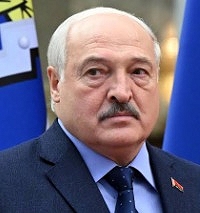
Aleksandr Lukashenko
First President of Belarus, in office since July 20, 1994. Re-elected for a seventh term in January 2025, he has governed the country for more than three decades amid disputes over election legitimacy, political repression, and relations with Russia and the European Union.
Born on August 30, 1954
Age: 72
Profession:
Place of Birth: Kopys, Vitebsk Region, Byelorussian SSR, Soviet Union (present-day Belarus)
Aleksandr Lukashenko, also known as Alexander Lukashenko, was born on August 30, 1954, in Kopys, in the former Soviet republic of Belarus. His full name is Aleksandr Grigoryevich Lukashenko. He is a Belarusian politician who has served as the first and only President of the independent Republic of Belarus since July 20, 1994. Before entering national politics, he served in the Soviet armed forces and managed agricultural enterprises. He was elected president in Belarus's first presidential election in 1994, campaigning against corruption and promising economic stability through continued state control of major industries. His subsequent administrations expanded presidential authority, restricted political opposition, and maintained close relations with Russia. His electoral victories after 1994 have been disputed by opposition groups, international election observers, and Western governments. In January 2025, he was declared the winner of a seventh presidential term with 86.82 percent of the vote, according to official Belarusian results. The European Union rejected the election's legitimacy, citing restrictions on political competition and independent media. Aleksandr Lukashenko took the oath of office for his seventh term on March 25, 2025.
Early Life and Family Background
Aleksandr Lukashenko was born on August 30, 1954, in Kopys, a settlement in the Vitebsk region of the Byelorussian Soviet Socialist Republic, then part of the Soviet Union.
He was raised by his mother, Yekaterina Lukashenko, who worked in agriculture and as a manual laborer. Reliable public biographical records contain little information about his father, and Lukashenko grew up in a single-parent household.
He spent his childhood in rural Belarus, where agricultural production and collective farming were central parts of local economic life.
After completing his secondary education, he entered the Mogilev Pedagogical Institute, now known as Mogilev State A. Kuleshov University.
He graduated in 1975 with a qualification in history and teaching.
Military Service and Agricultural Education
Following his graduation, Aleksandr Lukashenko served in the Soviet Border Troops from 1975 to 1977.
He subsequently held positions associated with the Komsomol, the youth organization of the Communist Party of the Soviet Union.
Between 1980 and 1982, he completed another period of military service in the Soviet Army. During this time, he served as a political officer in a military unit connected with the 120th Guards Motor Rifle Division in Minsk.
In 1979, he joined the Communist Party of the Soviet Union.
Alongside his professional duties, he continued his education at the Belarusian Agricultural Academy, graduating in 1985 with a qualification in agricultural economics.
Management of State and Collective Farms
Before entering parliamentary politics, Aleksandr Lukashenko worked in agricultural administration and industrial management.
From 1982 to 1985, he served as deputy chairman of a collective farm.
He subsequently held management positions at a construction materials enterprise and at the Gorodets state farm in the Shklov district of the Mogilev region.
These positions involved supervising agricultural production, labor organization, and the distribution of resources within the Soviet economic system.
His experience in state agricultural enterprises later influenced his preference for retaining government control over major sectors of the Belarusian economy.
Entry into Politics and Opposition to the Dissolution of the Soviet Union
In 1990, Aleksandr Lukashenko was elected to the Supreme Soviet of the Byelorussian SSR, the republic's parliamentary legislature.
During the political changes accompanying the final years of the Soviet Union, he opposed the rapid dismantling of Soviet institutions.
In December 1991, he was recorded as the only member of the Belarusian Supreme Soviet to vote against ratification of the Belavezha Accords, which formalized the dissolution of the Soviet Union.
Following Belarusian independence, he became a critic of the country's new political leadership and its economic policies.
In April 1993, he was appointed chairman of a parliamentary commission investigating corruption.
The commission's investigations gave him a national platform from which to criticize government officials and political opponents.
1994 Presidential Election
After the dissolution of the Soviet Union in 1991, Belarus experienced substantial economic difficulties, including inflation, declining industrial production, and uncertainty concerning the transition from a centrally planned economy.
The country's first post-independence government faced criticism over economic conditions and allegations of corruption.
The adoption of a new constitution in March 1994 established the office of President of Belarus and introduced direct presidential elections.
Aleksandr Lukashenko entered the election as an anti-corruption candidate who opposed rapid privatization and favored maintaining extensive state involvement in economic affairs.
His principal competitors included Prime Minister Vyacheslav Kebich, nationalist politician Zianon Pazniak, and former parliamentary chairman Stanislav Shushkevich.
In the first round, held on June 23, 1994, Lukashenko received approximately 45.1 percent of the vote, while Kebich received approximately 17.4 percent.
In the second round on July 10, Lukashenko defeated Kebich with approximately 80.1 percent of the vote.
He formally assumed office on July 20, 1994, becoming the first President of the independent Republic of Belarus.
Economic Policies and State Control
After taking office, Aleksandr Lukashenko pursued economic policies that retained many characteristics of the Soviet system.
His administration opposed large-scale privatization and maintained state ownership or control of major industrial enterprises, agricultural organizations, and infrastructure.
The government introduced measures to regulate prices, wages, and the activities of state-owned businesses.
Supporters of his economic policies argued that the approach protected industrial employment and limited some of the social disruption experienced by other former Soviet republics during the 1990s.
Critics argued that extensive state intervention restricted private enterprise, weakened market competition, and increased the economy's dependence on government subsidies and Russian energy supplies.
Belarus developed a close economic relationship with Russia, which became a principal market for Belarusian manufactured goods and a major supplier of energy resources.
Constitutional Changes and Expansion of Presidential Authority
In 1996, Aleksandr Lukashenko organized a constitutional referendum that substantially expanded presidential powers.
The amendments replaced the existing legislature with a two-chamber National Assembly, extended the presidential term, and increased the president's influence over government institutions.
Opposition politicians and international organizations criticized the referendum and challenged the legality of the constitutional changes.
In 2004, another referendum removed the existing constitutional limit of two presidential terms, allowing Lukashenko to stand for additional elections.
Over time, his administration consolidated authority over executive institutions, law enforcement, public broadcasting, and important sectors of the national economy.
Political opponents, independent media organizations, and human rights groups documented restrictions on public demonstrations, opposition parties, and freedom of expression.
Presidential Elections and Political Opposition
Aleksandr Lukashenko was officially declared the winner of subsequent presidential elections in 2001, 2006, 2010, 2015, 2020, and 2025.
International observers repeatedly criticized the electoral process, citing restrictions on opposition campaigning, unequal media access, and deficiencies in vote counting and transparency.
The 2006 presidential election led to demonstrations in Minsk and renewed criticism of the government by European institutions.
Following the 2010 presidential election, security forces detained opposition candidates and demonstrators protesting the official results.
The treatment of political opponents and independent journalists became a recurring issue in relations between Belarus and Western governments.
European Union Sanctions
On April 10, 2006, the European Union imposed travel restrictions on Aleksandr Lukashenko and a group of senior Belarusian officials following concerns over the presidential election and human rights violations.
On May 18, 2006, the EU introduced additional financial restrictions, including asset freezes targeting Lukashenko and other government representatives.
Relations between Belarus and the European Union subsequently fluctuated. Some sanctions were suspended or lifted during periods of diplomatic engagement, particularly after the release of political prisoners in 2015.
Following the disputed 2020 presidential election and the suppression of protests, the EU introduced extensive new sanctions.
These measures targeted individuals and organizations accused of involvement in political repression, electoral misconduct, and human rights abuses.
Additional economic restrictions were introduced following Belarus's support for Russia's military operations against Ukraine.
On February 26, 2026, the Council of the European Union extended the sanctions connected with domestic repression and Belarusian support for Russia's war against Ukraine until February 28, 2027.
Foreign Relations and Cooperation with Russia
Throughout his presidency, Aleksandr Lukashenko maintained close political, military, and economic relations with Russia.
In 1999, Belarus and Russia signed a treaty establishing the Union State, a framework intended to promote integration between the two countries.
The relationship included cooperation in energy, defense, trade, and security policy, although disagreements periodically emerged over gas prices, oil supplies, and the extent of political integration.
Lukashenko also pursued relations with other countries outside the European Union, including China, Iran, Cuba, Venezuela, North Korea, Turkmenistan, Qatar, Sudan, and Turkey.
His government maintained relations with Iraq before the 2003 invasion and with Libya before the overthrow of Muammar Gaddafi in 2011.
Belarus's foreign policy included efforts to attract investment and obtain access to international markets while preserving its close security relationship with Russia.
2020 Presidential Election and Nationwide Protests
On August 9, 2020, Aleksandr Lukashenko was declared the winner of Belarus's presidential election for a sixth term.
The official results attributed approximately 80 percent of the vote to Lukashenko and about 10 percent to opposition candidate Sviatlana Tsikhanouskaya.
Tsikhanouskaya and opposition groups rejected the official results, alleging widespread electoral fraud.
Large demonstrations followed in Minsk and other Belarusian cities. Protesters demanded a new election, the release of detained demonstrators, and an end to political repression.
Security forces responded with mass arrests, the use of force against demonstrators, and restrictions on independent media.
The European Union and several other governments refused to recognize the election results as legitimate.
Tsikhanouskaya left Belarus and continued her opposition activities from abroad.
Lukashenko rejected allegations of election fraud and characterized the protests as attempts to destabilize the country with foreign support.
Belarus and Russia's War Against Ukraine
Following Russia's full-scale invasion of Ukraine on February 24, 2022, Belarus became involved in the conflict through its cooperation with the Russian military.
Belarusian territory was used by Russian forces to launch military operations toward northern Ukraine, including the Kyiv region.
Aleksandr Lukashenko maintained that Belarusian troops were not participating directly in the invasion as a separate national combat force.
Nevertheless, his government's provision of territorial access, military infrastructure, and logistical assistance to Russia led to additional international sanctions.
In 2023, Belarus also agreed to host Russian tactical nuclear weapons, increasing the military significance of its relationship with Moscow.
The European Union and other Western governments condemned Belarus's support for Russian military operations.
2022 Constitutional Referendum
In February 2022, Belarus held a referendum on constitutional amendments supported by Aleksandr Lukashenko.
The changes expanded the constitutional position of the All-Belarusian People's Assembly, a political body with powers relating to national policy and institutional oversight.
The amendments also introduced additional provisions concerning presidential authority and the status of former presidents.
A two-term presidential limit was restored, but the provision was structured to apply only to terms following the next presidential election, allowing Lukashenko to remain eligible for further terms.
Opposition organizations criticized the referendum because it was conducted under conditions of restricted political competition and limited independent public debate.
2025 Presidential Election and Seventh Term
On January 26, 2025, Belarus held another presidential election.
According to the country's Central Election Commission, Aleksandr Lukashenko received 86.82 percent of the vote, equivalent to approximately 5.14 million ballots.
The official results secured him a seventh presidential term.
The opposition and the European Union rejected the legitimacy of the election, pointing to the exclusion or suppression of political opponents, restrictions on civil society, and the lack of conditions for independent electoral observation.
The Organization for Security and Co-operation in Europe did not conduct a full election observation mission because the invitation from Belarusian authorities was issued too late to permit its normal procedures.
Lukashenko was inaugurated for his seventh term on March 25, 2025, at the Palace of Independence in Minsk.
As of October 2026, he remained President of Belarus.
International Investigations and Human Rights Concerns
During the 2020s, international organizations continued examining allegations of political repression in Belarus.
United Nations human rights experts documented arbitrary detention, torture allegations, restrictions on opposition activity, and the persecution of journalists and civil society organizations.
In March 2026, the International Criminal Court opened an investigation into alleged crimes against humanity connected with the deportation and persecution of political opponents.
The investigation concerned allegations involving Belarusian state authorities and did not constitute a criminal conviction of Aleksandr Lukashenko.
His government rejected international accusations of systematic political persecution and maintained that its security measures were necessary to protect public order and national sovereignty.
Personal Life and Family
Aleksandr Lukashenko married Galina Zhelnerovich in 1975. They have two sons, Viktor Lukashenko, born in 1975, and Dmitry Lukashenko, born in 1980.
Although the couple have lived separately for many years, they have not publicly announced a legal divorce.
Galina Lukashenko has generally remained outside her husband's official political activities and has lived in the Shklov region.
Lukashenko has a younger son, Nikolai Lukashenko, born in 2004. Public biographical accounts have identified former presidential physician Irina Abelskaya as Nikolai's mother, although Lukashenko has generally avoided discussing the circumstances of his son's birth.
Nikolai has accompanied his father on official visits, diplomatic meetings, and public events.
Lukashenko is known for his interest in ice hockey and has participated in recreational hockey matches during his presidency.
Published Works
République de Bélarus: le chemin de l'avenir (Republic of Belarus: The Path to the Future)
Presidential Election History
1994 – First presidential election: Won the second round with approximately 80.1 percent of the vote
2001 – Re-elected president
2006 – Re-elected in a disputed election followed by opposition demonstrations
2010 – Re-elected in an election followed by arrests of opposition politicians and protesters
2015 – Re-elected president
2020 – Officially declared the winner of a sixth term; results rejected by the European Union and opposition groups
2025 – Officially declared the winner of a seventh term with 86.82 percent of the vote; inaugurated March 25, 2025
Source: Biyografiler.com
Frequently asked questions about Aleksandr Lukashenko
Who is Aleksandr Lukashenko?, Aleksandr Lukashenko biography, Aleksandr Lukashenko life story, Aleksandr Lukashenko age, Aleksandr Lukashenko facts, Aleksandr Lukashenko birthplace, Aleksandr Lukashenko photos, Aleksandr Lukashenko videos, Aleksandr Lukashenko career
Related Biographies

Lamine Yamal
Professional footballer

Kylian Mbappe
Professional footballer

Keanu Reeves
Actor

Erling Haaland
Professional footballer

Brad Pitt
Actor

Leonardo DiCaprio
Actor

Anton Dvorak
Composer

Antoine Lavoisier
Chemist

Antoine Bourdelle
Sculptor

Anthony van Dyck
Painter

Anthony Stewart Head
Actor, Singer

Antoni Gaudi
Architect

Gadi Eisenkot
Politician, Military Commander

Elizabeth Taylor
Actress

Susie Wiles
Political Consultant

Alberto Ascari
Formula 1 Driver

Michael Jordan
Professional Basketball Player

Ann-Margret
Actress, Singer