
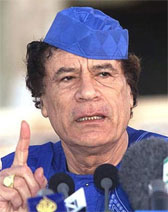
Muammar Gaddafi
Born on June 7, 1942
Died on October 20, 2011
Age at death: 69
Profession: Politician, Military Officer, Dictator
Place of Birth: Near Sirte, Libya
Place of Death: Sirte, Libya
Muammar Gaddafi, full name Muammar Abu Minyar al-Gaddafi, was a Libyan revolutionary leader and political figure who ruled Libya for more than four decades. He was born on 7 June 1942 near the Mediterranean coastal city of Sirte, Libya, into a Bedouin family. In his youth, he deeply admired Egyptian President Gamal Abdel Nasser and was strongly influenced by Nasser’s ideology of Arab socialism and Arab nationalism. During the 1956 Suez Crisis, Gaddafi actively participated in anti-Israel protest demonstrations.
Muammar Gaddafi studied history at the Faculty of Law at the University of Libya, graduating in 1963. He later enrolled at the Military Academy in Benghazi, where he and his fellow cadets founded a clandestine organization that would later become known as the Free Officers Movement in 1959. After graduating, Gaddafi traveled to the United Kingdom in 1966 to receive advanced military training.
On 1 September 1969, young officers led by Muammar Gaddafi carried out a bloodless coup against King Idris I of Libya. At the time of the coup, King Idris was in Turkey receiving medical treatment at the thermal baths of Bursa. His nephew and crown prince Sayyid Hasan ar-Rida announced his abdication via radio and was placed under house arrest. The monarchy was abolished, and the Libyan Arab Republic was proclaimed.
Seizing power at just 27 years of age, Gaddafi rapidly transformed Libya into a stronghold for anti-Western movements. Numerous organizations claiming to fight imperialism received military and financial support from Libya. Following the coup, Gaddafi was appointed Chairman of the Revolutionary Command Council, and in 1970 he also assumed the role of Prime Minister. That same year, he introduced a new constitution declaring Libya a “free Arab democratic republic” and ordered the closure of U.S. and British military bases in the country.
In 1974, during the Cyprus Peace Operation, Muammar Gaddafi provided support to Turkey. Throughout the 1970s, he developed his political philosophy, which he termed Islamic socialism, and articulated it in his three-volume work The Green Book, published between 1975 and 1979. In this work, Gaddafi rejected both Marxism and capitalism, proposing instead what he described as a “universal Third Way.”
A fervent advocate of Arab unity, Gaddafi sought to position himself as the ideological successor to Gamal Abdel Nasser following Nasser’s death on 28 September 1970. His attempts to unify Libya with Tunisia failed in 1974, while efforts to achieve full political union with Egypt collapsed amid mutual accusations. In 1977, tensions escalated into armed conflict and the severance of diplomatic relations between Egypt and Libya.
In November 1985, it was revealed that the CIA had conducted covert operations against the Gaddafi regime. Following attacks on Israeli airline offices in Rome and Vienna by Palestinian militants associated with the Abu Nidal Organization in December 1985, the United States accused Libya of supporting these actions. Washington claimed that Libya’s activities posed a threat to U.S. national security and foreign policy interests.
Inspired by popular uprisings that ended the long-standing regimes of Zine El Abidine Ben Ali in Tunisia and Hosni Mubarak in Egypt, unrest erupted in Libya in February 2011, severely destabilizing Gaddafi’s rule. After months of civil war, opposition forces entered Gaddafi’s Bab al-Azizia compound in Tripoli on 23 August 2011.
On 20 October 2011, Muammar Gaddafi was captured in his hometown of Sirte by fighters of the National Transitional Council. He was killed under violent circumstances, with reports of lynching provoking international controversy and condemnation. Gaddafi was buried on 25 October 2011 at an undisclosed location in the desert.
Each year, commemorations of the 17 February Revolution are held in Martyrs’ Square in Tripoli, marking the uprising that brought an end to Muammar Gaddafi’s 42-year rule over Libya.
Source: Biyografiler.com
Frequently asked questions about Muammar Gaddafi
Who is Muammar Gaddafi?, Muammar Gaddafi biography, Muammar Gaddafi life story, Muammar Gaddafi age, Muammar Gaddafi facts, Muammar Gaddafi birthplace, Muammar Gaddafi photos, Muammar Gaddafi videos, Muammar Gaddafi career

Lamine Yamal
Professional footballer

Erling Haaland
Professional footballer

Sam Altman
Entrepreneur, Investor, CEO

Kylian Mbappe
Professional footballer

Giorgia Meloni
Politician, Journalist

Alice Weidel
Politician, Economist


Hongjoong
Singer, Rapper, Songwriter, Composer

Ludacris
Rapper, Actor

Kwon Eunbi
Singer

Sarah Wayne Callies
Actress, Screenwriter, Producer, Director

LaTavia Roberson
Singer, Actress, Entrepreneur

Elena Andreyevna Rybakina
Professional Tennis Player
Alice Weidel
Politician, Economist
Sam Altman
Entrepreneur, Investor, CEO
Lamine Yamal
Professional footballer

Lady Gaga
Singer, Musician, Songwriter, Actress, Producer

Monica Bellucci
Actress, Model