
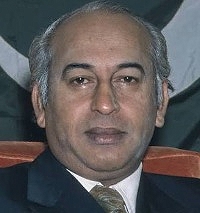
Zulfikar Ali Bhutto
Pakistani politician who founded the Pakistan People's Party in 1967, served as President of Pakistan from 1971 to 1973, and as Prime Minister from 1973 to 1977. He was removed from office in a military coup and executed in 1979.
Born on January 5, 1928
Died on April 4, 1979
Age at death: 51
Profession: Former President, Politician, Lawyer
Place of Birth: Larkana, Sindh, British India (present-day Pakistan)
Place of Death: Rawalpindi, Pakistan
Zulfikar Ali Bhutto was born on January 5, 1928, in Larkana, Sindh, then part of British India. He was a Pakistani lawyer and politician who served as President of Pakistan from December 20, 1971, to August 14, 1973, and as Prime Minister from August 14, 1973, to July 5, 1977. He founded the Pakistan People's Party (PPP) in 1967 and led the country following the 1971 war that resulted in the independence of Bangladesh. His government introduced the 1973 Constitution, nationalized major industries, and pursued a nuclear development program. On July 5, 1977, he was removed from office in a military coup led by General Muhammad Zia-ul-Haq. After being convicted in a murder conspiracy case, he was executed on April 4, 1979. In March 2024, the Supreme Court of Pakistan ruled that his trial and appeal had not met the requirements of a fair trial and due process.
Early Life and Family
Zulfikar Ali Bhutto was born on January 5, 1928, in Larkana, in the Sindh region of British India, now part of Pakistan. He belonged to a wealthy landowning family with extensive agricultural property in the Larkana district.
His father, Shah Nawaz Bhutto, was a landowner and politician who served as the prime minister, or dewan, of the princely state of Junagadh. His mother was Khursheed Begum.
The family's political and economic position allowed Bhutto to receive an education in India, the United States, and Britain.
He spent part of his childhood in Bombay, now Mumbai, where he attended the Cathedral and John Connon School. During his school years, the political movement demanding a separate Muslim-majority state in British India was gaining support.
Education in the United States and Britain
In 1947, Zulfikar Ali Bhutto enrolled at the University of Southern California in Los Angeles. He subsequently transferred to the University of California, Berkeley, where he studied political science.
He graduated from Berkeley in 1950. During his university years, he became interested in international politics, constitutional government, and socialist economic ideas.
He continued his education at Christ Church, Oxford, part of the University of Oxford in England, where he studied law. He completed his studies in 1952 and qualified as a barrister at Lincoln's Inn in London in 1953.
After returning to Pakistan, he established a legal practice in Karachi. He also taught law at Sindh Muslim Law College during the 1950s.
In 1957, Bhutto joined Pakistan's delegation to the United Nations. The following year, he participated in international discussions concerning maritime law and the legal status of the seas.
Beginning of His Political Career
Zulfikar Ali Bhutto entered national politics during the presidency of Iskander Mirza. In 1958, he was appointed Minister of Commerce in Pakistan's federal government.
In October 1958, General Muhammad Ayub Khan seized power through a military coup. Bhutto retained a position in the government and subsequently held several ministerial responsibilities.
He became closely involved in Pakistan's foreign policy and developed working relationships with senior officials in the military administration.
In January 1963, Bhutto was appointed Minister of Foreign Affairs following the death of Muhammad Ali Bogra.
Minister of Foreign Affairs (1963–1966)
During his tenure as foreign minister, Zulfikar Ali Bhutto supported closer diplomatic relations between Pakistan and China. He also pursued relations with the Soviet Union while seeking greater independence from the Western alliances in which Pakistan participated.
Bhutto played a role in negotiations that resulted in the 1963 Sino-Pakistan Boundary Agreement, which established a provisional border arrangement between Pakistan and China in the Kashmir region.
His foreign policy was closely connected to Pakistan's territorial dispute with India, particularly over Kashmir.
In 1965, India and Pakistan fought a war following escalating military confrontations in Kashmir and along the international border.
The conflict ended with a ceasefire. In January 1966, President Muhammad Ayub Khan and Indian Prime Minister Lal Bahadur Shastri signed the Tashkent Declaration, following negotiations mediated by Soviet Premier Alexei Kosygin.
Bhutto opposed important aspects of the settlement and disagreed with Ayub Khan over the government's approach toward India.
He left the cabinet in June 1966. The disagreement marked the end of his cooperation with Ayub Khan's administration.
Founding the Pakistan People's Party
On November 30, 1967, Zulfikar Ali Bhutto founded the Pakistan People's Party (PPP) at a political gathering in Lahore.
The party supported parliamentary government, social and economic reforms, and greater political participation by workers and lower-income communities.
Its program combined democratic socialism with Islamic political references. Bhutto promoted policies calling for economic redistribution, land reform, and public ownership of major industries.
The party adopted the slogan Roti, Kapra aur Makan, meaning food, clothing, and shelter.
Bhutto became an opponent of President Muhammad Ayub Khan and publicly criticized his administration for authoritarian government and political repression.
In November 1968, Bhutto was arrested during the opposition movement against Ayub Khan. Student demonstrations, labor protests, and opposition campaigns spread across Pakistan.
He was released in 1969, during the political crisis that led Ayub Khan to resign in March of that year.
Power passed to General Agha Muhammad Yahya Khan, who imposed martial law and announced plans for national elections.
The 1970 General Election
Pakistan held general elections on December 7, 1970, while the country still consisted of geographically separated eastern and western regions.
The Awami League, led by Sheikh Mujibur Rahman, won an overall majority in the National Assembly, securing 160 of the 300 directly elected general seats, primarily in East Pakistan.
Zulfikar Ali Bhutto's Pakistan People's Party won 81 general seats, almost entirely in West Pakistan, becoming the largest party in the western part of the country.
The results created a political conflict over the transfer of power. Sheikh Mujibur Rahman's party had sufficient seats to form a government, but negotiations between the Awami League, Bhutto, and President Yahya Khan failed to produce an agreement.
Bhutto opposed the transfer of power without an agreement on constitutional arrangements and the distribution of authority between East and West Pakistan.
In March 1971, Yahya Khan postponed the opening session of the National Assembly. The decision was followed by mass protests and a political confrontation in East Pakistan.
The Bangladesh Liberation War (1971)
On March 25, 1971, the Pakistani military launched Operation Searchlight in East Pakistan to suppress the Bengali independence movement.
The operation involved widespread violence against civilians, political activists, students, and members of the Bengali population. Large numbers of refugees fled into neighboring India.
Bangladesh declared independence in March 1971, and the conflict developed into the Bangladesh Liberation War.
In December 1971, the Indian armed forces entered the war against Pakistan. Pakistani forces in East Pakistan surrendered in Dhaka on December 16, 1971.
Bangladesh emerged as an independent state, and Pakistan lost its eastern territory.
The defeat led to the resignation of President Yahya Khan. On December 20, 1971, Zulfikar Ali Bhutto assumed the presidency of Pakistan and became the country's first civilian Chief Martial Law Administrator.
President of Pakistan (1971–1973)
Zulfikar Ali Bhutto took office at a time when Pakistan was dealing with military defeat, the loss of East Pakistan, economic problems, and the return of prisoners of war.
His administration began reorganizing the country's political institutions and initiated reforms in the economy, education, and public administration.
In January 1972, the government announced the nationalization of several major industrial enterprises, including businesses in steel, chemicals, and heavy engineering.
Bhutto also introduced land reform measures intended to reduce the concentration of agricultural property. However, implementation was uneven, and large landowners retained considerable economic influence.
His government expanded the state's role in banking, insurance, industry, and education.
The Simla Agreement with India (1972)
On July 2, 1972, Zulfikar Ali Bhutto signed the Simla Agreement with Indian Prime Minister İndira Gandhi.
The agreement followed the 1971 war and established principles for the normalization of relations between Pakistan and India.
The two governments agreed to resolve their differences through bilateral negotiations and peaceful means.
The agreement also converted the ceasefire line in Kashmir into the Line of Control, which both sides undertook to respect without prejudice to their respective positions.
Negotiations following the agreement contributed to the withdrawal of forces from occupied territories and arrangements concerning Pakistani prisoners of war.
The 1973 Constitution and Appointment as Prime Minister
One of the principal constitutional developments during Zulfikar Ali Bhutto's presidency was the adoption of Pakistan's 1973 Constitution.
The National Assembly approved the new constitution on April 10, 1973. It was authenticated on April 12 and came into effect on August 14, 1973.
The constitution established a federal parliamentary system, with executive authority exercised by the prime minister and a largely ceremonial presidency.
It also introduced a bicameral national legislature consisting of the National Assembly and the Senate.
On August 14, 1973, Bhutto became Prime Minister of Pakistan under the new constitution. Fazal Ilahi Chaudhry succeeded him as president.
Prime Minister of Pakistan (1973–1977)
As prime minister, Zulfikar Ali Bhutto continued implementing economic and administrative policies involving state ownership, public investment, and industrial development.
His government nationalized commercial banks in 1974 and expanded state involvement in several other economic sectors.
The administration introduced labor legislation and measures concerning wages, employee benefits, and trade union rights.
Although the policies increased public ownership, nationalization also generated opposition among business owners and criticism concerning the management and performance of state-controlled industries.
Bhutto's government faced political conflict with opposition parties and provincial leaders, particularly in Balochistan.
In 1973, the federal government dismissed the elected provincial government in Balochistan. A subsequent insurgency led to extensive military operations in the region.
Opposition parties accused the administration of restricting political activity and using state institutions against its critics.
Pakistan's Nuclear Program
Zulfikar Ali Bhutto supported the expansion of Pakistan's nuclear research and development program.
Following the country's defeat in the 1971 war, his government made nuclear development a national priority.
In January 1972, Bhutto convened a meeting of scientists in Multan to discuss the development of nuclear technology.
India's first nuclear test in May 1974 increased the importance that Pakistan's government attached to developing its own nuclear capabilities.
Bhutto supported research and institutional development that contributed to Pakistan's later nuclear weapons program.
Physicist Abdus Salam, who later received the 1979 Nobel Prize in Physics, was among the scientists associated with Pakistan's scientific institutions during this period.
Engineer Abdul Qadeer Khan became involved in Pakistan's uranium enrichment program in the mid-1970s.
Recognition of Bangladesh and the 1974 Islamic Summit
In February 1974, Zulfikar Ali Bhutto hosted the second summit of the Organization of the Islamic Conference in Lahore.
The meeting brought together representatives from Muslim-majority countries and addressed political, economic, and diplomatic cooperation.
Among the participants were Saudi King Faisal bin Abdulaziz Al Saud, Libyan leader Muammar Gaddafi, and Egyptian President Anwar Sadat.
During the summit, Pakistan formally recognized the independence of Bangladesh.
Bangladeshi leader Sheikh Mujibur Rahman subsequently attended the Lahore summit.
The recognition followed negotiations over diplomatic relations and unresolved issues resulting from the 1971 war.
Pakistan and India also took steps toward restoring diplomatic and commercial relations during the following years.
Religious and Constitutional Policies
In September 1974, Pakistan's parliament adopted a constitutional amendment defining the Ahmadi community as non-Muslim for constitutional and legal purposes.
The amendment was passed during Zulfikar Ali Bhutto's government following political agitation concerning the community's religious status.
The decision became part of Pakistan's constitutional framework and was followed by additional restrictions on Ahmadis under subsequent administrations.
The 1977 General Election and Political Crisis
On March 7, 1977, Pakistan held general elections. According to the official results, Zulfikar Ali Bhutto's Pakistan People's Party won a substantial parliamentary majority.
The opposition alliance, known as the Pakistan National Alliance (PNA), accused the government of manipulating the election results.
Opposition parties rejected the results and organized demonstrations across the country.
The protests were followed by strikes, clashes with security forces, and political violence.
Bhutto's government entered negotiations with opposition representatives over possible new elections and other political arrangements.
Before an agreement could be implemented, the military intervened.
The Military Coup of July 5, 1977
On July 5, 1977, Pakistan's army chief, General Muhammad Zia-ul-Haq, overthrew Zulfikar Ali Bhutto's government in a military coup.
The military suspended constitutional political activity, imposed martial law, and dissolved national and provincial assemblies.
Bhutto was removed from the office of prime minister and initially placed under detention.
General Zia-ul-Haq assumed control of the country, initially promising elections. His military government subsequently extended its rule.
Bhutto was released for a short period but was arrested again in September 1977 in connection with a murder conspiracy investigation.
Murder Trial and Death Sentence
Zulfikar Ali Bhutto was accused of involvement in a 1974 attack targeting opposition politician Ahmed Raza Kasuri.
Kasuri survived the attack, but his father, Nawab Muhammad Ahmed Khan Kasuri, was killed.
Prosecutors alleged that Bhutto had ordered the attack through members of the Federal Security Force.
Bhutto denied the accusations and maintained that the proceedings were politically motivated.
The case was heard by the Lahore High Court. On March 18, 1978, the court convicted Bhutto and sentenced him to death.
His lawyers appealed to the Supreme Court of Pakistan. In February 1979, the Supreme Court upheld the death sentence by a majority decision of four judges to three.
Appeals for clemency were made by political leaders and governments from several countries.
General Muhammad Zia-ul-Haq, who had assumed the presidency in September 1978, did not grant clemency.
Execution
Zulfikar Ali Bhutto was executed by hanging on April 4, 1979, at Rawalpindi Central Jail in Rawalpindi, Pakistan. He was 51 years old.
His body was transported to the family's ancestral burial ground at Garhi Khuda Bakhsh near Larkana, where he was buried.
His execution took place under the military government of Muhammad Zia-ul-Haq, which remained in power after Bhutto's death.
2024 Supreme Court Review of His Trial
Decades after Zulfikar Ali Bhutto's execution, the legality and fairness of his trial remained the subject of judicial proceedings.
In 2011, Pakistani President Asif Ali Zardari submitted a presidential reference to the Supreme Court of Pakistan requesting a review of the legal proceedings that had resulted in Bhutto's conviction and execution.
On March 6, 2024, a nine-member bench of the Supreme Court issued a unanimous advisory opinion concerning the case.
Chief Justice Qazi Faez Isa announced that the proceedings before the Lahore High Court and the Supreme Court had not met the constitutional requirements of a fair trial and due process.
The court concluded that both the original trial and the appeal had failed to satisfy fundamental legal protections.
However, the Supreme Court also stated that the existing constitutional and legal framework did not provide a mechanism to overturn the original conviction through the presidential reference procedure.
The 2024 opinion therefore recognized serious deficiencies in the proceedings without formally setting aside the 1979 judgment.
Personal Life and Family
Zulfikar Ali Bhutto married Shireen Amir Begum, a relative from his extended family, during his youth. The marriage did not produce children.
On September 8, 1951, he married Nusrat Bhutto, born Nusrat Ispahani, in Karachi.
Nusrat Bhutto was of Iranian origin and later became politically active in the Pakistan People's Party.
The couple had four children: two daughters, Benazir Bhutto and Sanam Bhutto, and two sons, Murtaza Bhutto and Shahnawaz Bhutto.
Their eldest child, Benazir Bhutto, was born on June 21, 1953. She later became Prime Minister of Pakistan, serving from 1988 to 1990 and again from 1993 to 1996.
Murtaza Bhutto, born in 1954, also entered politics. He was killed in a police shooting in Karachi on September 20, 1996.
Sanam Bhutto was born in 1957. The youngest child, Shahnawaz Bhutto, was born in 1958 and died in France in July 1985.
Benazir Bhutto was assassinated on December 27, 2007, after attending an election campaign gathering in Rawalpindi.
Nusrat Bhutto died on October 23, 2011.
Political Career
1957 - Member of Pakistan's Delegation to the United Nations1958 - Minister of Commerce
1963–1966 - Minister of Foreign Affairs
1967 - Founder and Chairman of the Pakistan People's Party
1968 - Arrested During Opposition Protests Against Muhammad Ayub Khan
1970 - Leader of the Pakistan People's Party in the General Election
December 20, 1971 – August 14, 1973 - President of Pakistan
1972 - Signed the Simla Agreement with Indian Prime Minister İndira Gandhi
1973 - Oversaw the Adoption of Pakistan's New Constitution
August 14, 1973 – July 5, 1977 - Prime Minister of Pakistan
1974 - Hosted the Second Islamic Summit in Lahore
1974 - Pakistan Formally Recognized Bangladesh During His Government
March 7, 1977 - Pakistan People's Party Won the General Election According to Official Results
July 5, 1977 - Removed from Office by General Muhammad Zia-ul-Haq
March 18, 1978 - Sentenced to Death by the Lahore High Court
April 4, 1979 - Executed in Rawalpindi
March 6, 2024 - Supreme Court of Pakistan Ruled That His Trial Had Not Met Fair Trial and Due Process Requirements
Source: Biyografiler.com
Frequently asked questions about Zulfikar Ali Bhutto
Who is Zulfikar Ali Bhutto?, Zulfikar Ali Bhutto biography, Zulfikar Ali Bhutto life story, Zulfikar Ali Bhutto age, Zulfikar Ali Bhutto facts, Zulfikar Ali Bhutto birthplace, Zulfikar Ali Bhutto photos, Zulfikar Ali Bhutto videos, Zulfikar Ali Bhutto career
Related Biographies


Lamine Yamal
Professional footballer

Kylian Mbappe
Professional footballer

Brad Pitt
Actor

Erling Haaland
Professional footballer

Gadi Eisenkot
Politician, Military Commander

Leonardo DiCaprio
Actor

Martha Argerich
Pianist

Maya Angelou
Poet, Actress, Civil Rights Leader

Maya Hawke
Actress, Model

Maya Lin
Architect, Artist

Max von Sydow
Actor

Megan Rapinoe
Former Professional Footballer

Vince Gilligan
Screenwriter, Director, Producer
Erling Haaland
Professional footballer
Lamine Yamal
Professional footballer

Jensen Huang
Entrepreneur, CEO, Engineer

Scott Bessent
Politician, Investor

Ronaldinho
Professional footballer