
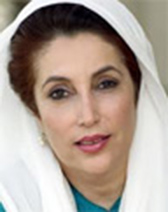
Benazir Bhutto
First female Prime Minister in the Muslim world and a central figure in Pakistan’s democratic struggle
Born on June 21, 1953
Died on December 27, 2007
Age at death: 54
Profession: Politician
Place of Birth: Karachi, Pakistan
Place of Death: Rawalpindi, Pakistan
Benazir Bhutto was a Pakistani politician who became one of the most prominent and controversial figures in South Asian politics. Serving twice as Prime Minister of Pakistan, she made history as the first woman to lead a Muslim-majority nation. Her career unfolded against the backdrop of military rule, political exile, family tragedy, and violent instability. As the daughter of former Prime Minister Zulfikar Ali Bhutto, she inherited both a powerful political legacy and a legacy of confrontation with authoritarian power. Over the course of her life, Benazir Bhutto emerged as a symbol of democratic resistance, political resilience, and the turbulent dynamics of Pakistani governance.
Early Life and Background
Benazir Bhutto was born on June 21, 1953, in Karachi, Pakistan, as the eldest daughter of Zulfikar Ali Bhutto and Begum Nusrat Bhutto. Her father was one of Pakistan’s most influential political leaders and served as Prime Minister from 1971 to 1977, shaping the country’s political landscape during a period of national reconstruction following the separation of Bangladesh. Growing up in a politically powerful family exposed Benazir Bhutto early to the complexities of governance, diplomacy, and public life.
Her early education took place in Pakistan, where she completed her schooling before traveling abroad for higher education. In 1969 she enrolled at Radcliffe College, part of Harvard University, where she studied comparative government. During her years in the United States, she was exposed to Western democratic institutions and political philosophy, experiences that later shaped her views on governance and constitutional rule. She graduated from Harvard in 1973.
Later that same year, Benazir Bhutto entered Oxford University, where she studied international law and diplomacy. While at Oxford, she became deeply involved in student politics and eventually served as president of the Oxford Union, one of the most prestigious debating societies in the world. This role demonstrated her early leadership abilities and provided a training ground for the political career that awaited her in Pakistan.
Return to Pakistan and the Military Coup
In 1977, Benazir Bhutto returned to Pakistan shortly after completing her studies. That same year, her father’s government was overthrown in a military coup led by General Muhammad Zia-ul-Haq. The coup marked the beginning of a period of authoritarian rule that profoundly shaped her life and political trajectory.
Following the coup, the Bhutto family faced severe political persecution. Zulfikar Ali Bhutto was arrested and later sentenced to death after a controversial trial widely criticized by international observers. During this time, Benazir Bhutto was repeatedly placed under house arrest by the military regime. In 1979 her father was executed, an event that transformed her from a political heir into a central figure of resistance against the dictatorship.
The Bhutto family’s tragedies did not end with the execution of her father. In 1980 her brother Shahnawaz Bhutto was found dead in his apartment under circumstances that remain unresolved. Years later, another brother, Murtaza Bhutto, was killed in a police confrontation in 1996. These personal losses deepened the sense of political martyrdom surrounding the Bhutto family and intensified Benazir Bhutto’s role as the symbolic leader of the Pakistan Peoples Party.
Exile and Political Mobilization
After years of harassment and detention by the military regime, Benazir Bhutto left Pakistan in 1984 and settled in the United Kingdom. From exile, she continued to lead the Pakistan Peoples Party and organized international campaigns demanding the restoration of democracy in Pakistan. Her presence in London transformed her into an international political figure who frequently addressed foreign governments, journalists, and human rights organizations.
On April 10, 1986, she returned to Pakistan to an enormous public reception. Hundreds of thousands of supporters gathered to welcome her in Lahore, signaling the enduring popularity of the Bhutto political legacy. Following her return, Benazir Bhutto launched a nationwide campaign advocating for free elections and the end of military rule.
Marriage and Personal Life
On December 18, 1987, Benazir Bhutto married Asif Ali Zardari in Karachi. The marriage united two politically connected families and later played a significant role in Pakistan’s political sphere. The couple had three children: Bilawal Bhutto Zardari, Bakhtawar Bhutto Zardari, and Aseefa Bhutto Zardari.
Despite the personal nature of her family life, politics remained central to her identity. Her husband later became a controversial political figure himself and eventually served as President of Pakistan, continuing the Bhutto family's enduring presence in national politics.
Prime Minister of Pakistan
The military regime led by Muhammad Zia-ul-Haq came to an abrupt end in 1988 when the general died in a mysterious airplane crash. This event opened the door for democratic elections. Shortly afterward, Benazir Bhutto led the Pakistan Peoples Party to victory.
On December 1, 1988, only three months after the birth of her first child, she was sworn in as Prime Minister of Pakistan. At the age of thirty-five, she became the youngest Prime Minister in the country’s history and the first woman to lead a Muslim-majority nation. Her election attracted global attention and was often compared to other historic female leaders such as Indira Gandhi and later figures like Margaret Thatcher.
Her first administration faced significant opposition from conservative political forces and the military establishment. In 1990 her government was dismissed amid allegations of corruption and mismanagement. However, Benazir Bhutto returned to power after winning the 1993 elections and served a second term as Prime Minister until 1996.
Corruption Allegations and Exile
Throughout the 1990s, Benazir Bhutto and her husband faced numerous accusations of corruption, many of which became central issues in Pakistani politics. After the dismissal of her second government in 1996, legal cases were pursued against the couple. During the political turmoil that followed, she spent years living in self-imposed exile in London and Dubai.
During this period, Pakistani courts sentenced her to prison in absentia on corruption-related charges. However, many of her supporters argued that these accusations were politically motivated attempts to remove the Bhutto family from the political arena.
In 2007, following negotiations with President Pervez Musharraf, an amnesty agreement cleared many of the charges against her. This political compromise allowed Benazir Bhutto to return to Pakistan after nearly eight years in exile.
Return to Pakistan and Assassination
Benazir Bhutto returned to Pakistan on October 18, 2007. Her arrival in Karachi triggered massive celebrations among her supporters but was immediately overshadowed by violence. A suicide bombing targeted her convoy on the night of her return, killing more than 130 people. Although she survived the attack, the event demonstrated the extreme risks surrounding her political comeback.
Despite persistent death threats, Benazir Bhutto continued campaigning for the upcoming parliamentary elections. She openly criticized extremist groups and called for a return to democratic governance in Pakistan.
On December 27, 2007, while campaigning in Rawalpindi, she was assassinated in a combined shooting and suicide bombing attack. The assassination killed her along with more than two dozen others and injured over a hundred people. The event shocked the international community and plunged Pakistan into widespread unrest.
Death
Benazir Bhutto was buried on December 28, 2007, in the Bhutto family mausoleum in Garhi Khuda Bakhsh. Hundreds of thousands of mourners attended her funeral, reflecting the deep emotional and political impact she had on Pakistan’s population.
Following her death, President Pervez Musharraf declared three days of national mourning. The assassination triggered widespread protests and riots across Pakistan, with attacks on vehicles, businesses, and public infrastructure leading to additional casualties. Her death intensified the sense of political instability that had long characterized the country’s modern history.
Source: Biyografiler.com
Frequently asked questions about Benazir Bhutto
Who is Benazir Bhutto?, Benazir Bhutto biography, Benazir Bhutto life story, Benazir Bhutto age, Benazir Bhutto facts, Benazir Bhutto birthplace, Benazir Bhutto photos, Benazir Bhutto videos, Benazir Bhutto career
Related Biographies

Lamine Yamal
Professional footballer

Erling Haaland
Professional footballer

Austin Abrams
Actor

Keanu Reeves
Actor

Kylian Mbappe
Professional footballer

Brad Pitt
Actor


Hongjoong
Singer, Rapper, Songwriter, Composer

Ludacris
Rapper, Actor

Kwon Eunbi
Singer

Sarah Wayne Callies
Actress, Screenwriter, Producer, Director

LaTavia Roberson
Singer, Actress, Entrepreneur

Alice Weidel
Politician, Economist

Mackenzie Davis
Actress

Maria Corina Machado
Politician, Political Activist

Bad Bunny
Rapper, Songwriter

Jensen Huang
Entrepreneur, CEO

Kevin Warsh
Economist