
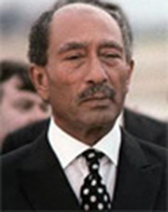
Anwar Sadat
Third President of Egypt and Nobel Peace Prize laureate
Born on December 25, 1918
Died on October 6, 1981
Age at death: 63
Profession: Former President, Military Officer, Politician
Place of Birth: Abu al-Kum, Monufia Governorate, Egypt
Place of Death: Cairo, Egypt
Anwar Sadat was the third President of Egypt, serving from 1970 until his assassination in 1981. He was a central figure in modern Middle Eastern history, remembered for his dramatic shift in Egypt’s foreign policy, his pivotal role in the Arab–Israeli peace process, and his deeply controversial domestic and international legacy.
Early Life and Education
Anwar Sadat was born on December 25, 1918, in the village of Abu al-Kum, located in Egypt’s Monufia Governorate. He was one of thirteen children born into a large family. His given name, Anwar, was chosen in reference to Enver Pasha, reflecting the nationalist and political sentiments of the era.
After completing his primary and secondary education, Sadat entered military school and graduated from the Egyptian Military Academy in 1938. During his early years as an officer, he became involved in clandestine activities aimed at ending British dominance in Egypt. He participated in conspiracies supported by Nazi Germany, was arrested by British authorities, and later escaped from prison.
Early Political Activity and the Free Officers
Following his escape and continued opposition to British rule and the Egyptian monarchy, Anwar Sadat joined the secret Free Officers Movement founded by Gamal Abdel Nasser. The organization sought to overthrow King Farouk I of Egypt and dismantle both foreign influence and the royal system.
When the Free Officers seized power in 1952, Sadat emerged as a prominent spokesperson for the new revolutionary regime. After the brief presidency of Muhammad Naguib, Gamal Abdel Nasser consolidated full control of the state, with Sadat becoming one of his closest associates and trusted political operatives.
Rise Within the State Apparatus
During the consolidation of the post-revolutionary government, Anwar Sadat held a series of key political positions. He served as Minister of State in 1956 and as Secretary-General of the Arab Socialist Union between 1957 and 1961.
From 1957 to 1960, he held the position of Deputy Speaker of the National Assembly, followed by nearly a decade as Speaker of the Assembly from 1960 to 1969. On December 20, 1969, President Gamal Abdel Nasser appointed him Vice President of the Republic, a move widely interpreted as positioning him as a loyal yet politically underestimated successor.
Military Career
Parallel to his political ascent, Anwar Sadat continued serving in various ranks of the Egyptian armed forces following his graduation from the military academy in 1938. His military background played a decisive role in shaping his leadership style, public authority, and strategic thinking, particularly during periods of war and national crisis.
Presidency of Egypt
Following the death of Gamal Abdel Nasser on September 28, 1970, Anwar Sadat assumed the presidency of Egypt. Initially regarded by many political elites as a transitional or symbolic figure, he quickly consolidated power and ruled the country for eleven years until his assassination.
Sadat fundamentally reoriented Egypt’s internal and external policies. He distanced the country from the Soviet Union, formally severing relations in 1975, and gradually aligned Egypt with the United States. This strategic realignment brought Sadat into direct diplomatic engagement with U.S. leaders including Richard Nixon and later Jimmy Carter.
Yom Kippur War and Peace with Israel
In 1973, Egypt fought Israel in the Yom Kippur War, a conflict initiated under Sadat’s leadership to restore Egyptian military credibility and alter the regional balance of power. Although militarily inconclusive, the war reshaped diplomatic conditions and reopened negotiations frozen since earlier Arab defeats.
On November 19, 1977, Anwar Sadat made a historic visit to Jerusalem, becoming the first Arab leader to officially visit Israel. This unprecedented move initiated direct negotiations with Israeli Prime Minister Menachem Begin and shocked much of the Arab world.
Under the mediation of U.S. President Jimmy Carter, Sadat and Begin signed the Camp David Accords on September 17, 1978. The agreement led to the return of the Sinai Peninsula—captured by Israel during the Six-Day War—to Egypt. For these efforts, Anwar Sadat and Menachem Begin jointly received the 1978 Nobel Peace Prize.
Personal Life
Anwar Sadat married Jihan Sadat in 1948. The couple had four children: Lubna Sadat, Gamal Sadat, Noha Sadat, and Jihan Sadat. His wife later became a prominent public figure and academic, teaching at several universities in the United States and advocating for women’s rights and social reform.
Assassination
On October 6, 1981, during a military parade commemorating Egypt’s independence, Anwar Sadat was assassinated in Cairo. The attack was carried out by Islamist militants embedded within the military convoy.
The assailants initially threw grenades toward the reviewing stand and then opened fire with automatic weapons, killing Sadat and several senior officials. Sadat was reportedly struck by 72 bullets. The assassination was widely attributed to radical Islamist opposition fueled by his peace treaty with Israel and his broader political realignment.
The principal assassin, Islamist army officer Khalid al-Islambouli, was executed in 1982. Sadat was buried in Cairo beneath the Tomb of the Unknown Soldier, directly opposite the site of his assassination.
Legacy
Anwar Sadat remains one of the most polarizing leaders in modern Middle Eastern history. To supporters, he was a courageous statesman who restored Egyptian sovereignty over the Sinai Peninsula and pursued peace at immense personal risk. To critics, his policies provoked internal unrest and empowered radical opposition.
His presidency permanently altered Egypt’s geopolitical orientation and left a profound imprint on Arab–Israeli relations, ensuring his place as one of the most consequential figures in twentieth-century international politics.
Source: Biyografiler.com
Frequently asked questions about Anwar Sadat
Who is Anwar Sadat?, Anwar Sadat biography, Anwar Sadat life story, Anwar Sadat age, Anwar Sadat facts, Anwar Sadat birthplace, Anwar Sadat photos, Anwar Sadat videos, Anwar Sadat career
Related Biographies

Lamine Yamal
Professional footballer

Erling Haaland
Professional footballer

Kylian Mbappe
Professional footballer

Bad Bunny
Rapper, Songwriter

Austin Abrams
Actor

Keanu Reeves
Actor


Hongjoong
Singer, Rapper, Songwriter, Composer

Ludacris
Rapper, Actor

Kwon Eunbi
Singer

Sarah Wayne Callies
Actress, Screenwriter, Producer, Director

LaTavia Roberson
Singer, Actress, Entrepreneur
Kylian Mbappe
Professional footballer
Lamine Yamal
Professional footballer

Sydney Sweeney
Actress
Austin Abrams
Actor

Jodie Foster
Actress

Che Guevara
Physician, Military Commander