
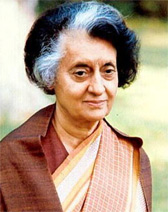
İndira Gandhi
India's first and only female prime minister, serving from 1966 to 1977 and from 1980 to 1984.
Born on November 19, 1917
Died on October 31, 1984
Age at death: 67
Profession: Former Prime Minister
Place of Birth: Allahabad (now Prayagraj), British India
Place of Death: New Delhi, India
Indira Gandhi, born Indira Priyadarshini Nehru on November 19, 1917, in Allahabad (now Prayagraj), British India, was an Indian politician who served as the country's prime minister from January 24, 1966, to March 24, 1977, and again from January 14, 1980, until her assassination on October 31, 1984. She was the first and remains the only woman to serve as Prime Minister of India. The daughter of Jawaharlal Nehru, India's first prime minister, she led the Indian National Congress during major political and economic changes, including the 1971 Indo-Pakistani War, the creation of Bangladesh, the nationalization of major banks and the controversial Emergency period of 1975–1977.
Early Life and Family Background
Indira Gandhi was born into the Nehru family in Allahabad, in what was then British India. Her father, Jawaharlal Nehru, was a leader of the Indian independence movement and later became the first prime minister of independent India. Her mother, Kamala Nehru, was also involved in the struggle against British colonial rule.
As the only child of Jawaharlal Nehru and Kamala Nehru, Indira Gandhi grew up in a household closely associated with the Indian National Congress and the independence movement. Her grandfather, Motilal Nehru, was a lawyer and Congress leader who had served as party president.
During her childhood, the Nehru family home in Allahabad was visited by political figures, including Mahatma Gandhi. Both her father and grandfather were imprisoned during India's struggle for independence. Her mother suffered from recurring illnesses and died in Switzerland in February 1936.
Despite sharing the surname Gandhi, Indira Gandhi was not related by blood or marriage to Mahatma Gandhi. She acquired the surname through her marriage to Feroze Gandhi.
Education and Involvement in the Independence Movement
Indira Gandhi received her education at several institutions in India and Europe. She attended schools in Allahabad, Pune, Bombay, Switzerland and England. She later studied at Visva-Bharati University in Santiniketan, West Bengal, an institution founded by Rabindranath Tagore.
She subsequently attended Somerville College, Oxford, where she studied subjects including history. Her education was interrupted by health problems and the outbreak of the Second World War, and she left without completing a degree.
Her political involvement began during her youth. In 1930, she organized a children's group known as the Vanar Sena, or Monkey Brigade, whose members assisted the independence movement by carrying messages and distributing political material.
Indira Gandhi formally joined the Indian National Congress in 1938. During the Quit India Movement of 1942, she was arrested by British colonial authorities and imprisoned for several months.
Following India's independence and partition in 1947, she worked in areas affected by communal violence and participated in relief activities under the guidance of Mahatma Gandhi.
Marriage and Family Life
On March 26, 1942, Indira Gandhi married Feroze Gandhi, an Indian politician and journalist whom she had known during her years in Europe. Feroze later served as a member of the Indian Parliament and became known for investigating financial irregularities and government corruption.
The couple had two sons, Rajiv Gandhi, born on August 20, 1944, and Sanjay Gandhi, born on December 14, 1946.
Although their marriage experienced difficulties and they lived separately for periods, the couple did not formally divorce. Feroze Gandhi died of a heart attack on September 8, 1960.
Political Career Under Jawaharlal Nehru
After India gained independence in August 1947, Indira Gandhi became closely involved in the political activities of her father, Jawaharlal Nehru, who served as prime minister until his death in 1964.
She managed many of the official hosting duties at the prime minister's residence, accompanied her father on international visits and became familiar with the administration of the newly independent country.
In 1955, she joined the Working Committee of the Indian National Congress and its Central Election Committee. She became a member of the party's Central Parliamentary Board in 1958.
In 1959, Indira Gandhi was elected president of the Indian National Congress, serving until 1960. Her appointment placed her in a formal leadership position within the organization that had led India's independence movement.
After Jawaharlal Nehru died on May 27, 1964, Lal Bahadur Shastri became prime minister. Indira Gandhi entered the Rajya Sabha, India's upper house of Parliament, and was appointed Minister of Information and Broadcasting. She held that position from 1964 to 1966.
Becoming India's First Female Prime Minister
On January 11, 1966, Prime Minister Lal Bahadur Shastri died in Tashkent, one day after signing an agreement intended to end hostilities between India and Pakistan. His death led to a leadership contest within the Indian National Congress.
Indira Gandhi defeated Morarji Desai in the Congress parliamentary party leadership election and was sworn in as Prime Minister of India on January 24, 1966.
Her initial years in office were marked by food shortages, inflation, economic difficulties and internal disagreements within the Congress Party. India remained heavily dependent on food imports, while agricultural production struggled to meet the needs of its growing population.
The government continued agricultural modernization policies associated with the Green Revolution, including the introduction of high-yield crop varieties, irrigation improvements and greater fertilizer use. These measures increased wheat production in parts of India during the following years.
The 1967 Election and Congress Party Split
The 1967 general election weakened the Congress Party's parliamentary position, although it retained enough seats to form the national government. Indira Gandhi continued as prime minister and appointed Morarji Desai, a senior figure associated with the party's conservative wing, as deputy prime minister and finance minister.
Disagreements over economic policy, party leadership and government appointments gradually divided Congress into competing factions.
In July 1969, the government nationalized 14 major commercial banks. Indira Gandhi defended the policy as a means of directing financial resources toward agriculture, industry and broader economic development.
The nationalization decision intensified disagreements between Gandhi and the Congress leadership associated with K. Kamaraj, S. Nijalingappa and Morarji Desai.
In November 1969, the Indian National Congress formally split. Indira Gandhi led the faction commonly known as Congress (R), while her opponents formed Congress (O). She continued governing with parliamentary support from smaller parties.
Her government also pursued the abolition of privy purses, the payments made to former rulers of India's princely states after independence. The privileges and allowances were formally abolished through a constitutional amendment in 1971.
The 1971 General Election and Economic Policies
Indira Gandhi called an early general election in 1971 and campaigned under the slogan "Garibi Hatao", meaning "Remove Poverty". Her campaign focused on poverty reduction, economic development and the expansion of government assistance to disadvantaged communities.
The Congress (R) faction won a large parliamentary majority in the March 1971 election, strengthening her position against opponents within the former Congress organization.
Her administration continued policies involving public ownership of major industries, financial institutions and infrastructure. These included the expansion of state control over coal, insurance and other industrial sectors.
Land reform remained part of the government's program, but implementation varied considerably between Indian states. Rural inequality and landlessness persisted, while inflation and unemployment created increasing public dissatisfaction during the early 1970s.
The 1971 Indo-Pakistani War and the Creation of Bangladesh
One of the major international developments during Indira Gandhi's first period as prime minister was the 1971 conflict between India and Pakistan, which resulted in the independence of Bangladesh.
In March 1971, the Pakistani military launched a crackdown in East Pakistan following a political crisis over the results of the 1970 Pakistani general election. Widespread violence forced millions of refugees to cross into India.
The Indian government supported the Bengali independence movement and provided assistance to the Mukti Bahini, the armed resistance organization fighting Pakistani forces in East Pakistan.
As relations between India and Pakistan deteriorated, Indira Gandhi sought international diplomatic support and visited several countries to explain India's position on the refugee crisis.
In August 1971, India signed the Treaty of Peace, Friendship and Cooperation with the Soviet Union. The agreement strengthened relations between the two countries during a period of regional tension.
War between India and Pakistan began on December 3, 1971. Indian forces and Bengali resistance fighters defeated Pakistani troops in East Pakistan, whose military command surrendered in Dhaka on December 16, 1971.
The conflict resulted in the establishment of independent Bangladesh. Its independence leader, Sheikh Mujibur Rahman, subsequently became the country's first president.
In July 1972, Indira Gandhi and Pakistani President Zulfikar Ali Bhutto signed the Simla Agreement, establishing a framework for bilateral relations following the war.
Economic Difficulties and Political Opposition
Despite her electoral victory and India's military success in 1971, Indira Gandhi's government faced growing economic and political difficulties during the following years.
The international oil crisis of 1973 contributed to inflation, while unemployment and rising prices increased public dissatisfaction. Student demonstrations and opposition movements gained strength in Gujarat and Bihar during 1974.
Political activist Jayaprakash Narayan became a central figure in protests against Gandhi's government. He called for political reform and organized a movement that brought together students, opposition parties and civil society organizations.
During the same period, Indira Gandhi's son Sanjay Gandhi became increasingly involved in public affairs. His proposed automobile manufacturing project, which later developed into Maruti, attracted criticism over government support, licensing decisions and alleged preferential treatment.
The Emergency of 1975–1977
On June 12, 1975, the Allahabad High Court ruled that Indira Gandhi had committed electoral violations during her 1971 parliamentary campaign in Rae Bareli. The case had been brought by opposition politician Raj Narain, who had contested the election against her.
The court invalidated her election and disqualified her from holding elected office for six years. India's Supreme Court subsequently granted a conditional stay that allowed her to remain prime minister while her appeal was considered, but restricted her parliamentary voting rights.
Facing demands for her resignation and growing opposition demonstrations, Indira Gandhi advised President Fakhruddin Ali Ahmed to declare a national Emergency.
The Emergency was proclaimed on June 25, 1975, under Article 352 of the Indian Constitution, and announced publicly the following day.
During the Emergency, the government suspended or restricted civil liberties, imposed censorship on newspapers and detained opposition politicians without ordinary judicial procedures. Among those arrested were Jayaprakash Narayan, Morarji Desai and other political opponents.
The government introduced constitutional and administrative measures that increased executive authority and limited challenges to government decisions.
A controversial population-control campaign was also expanded during this period. Under the political influence of Sanjay Gandhi, officials pursued sterilization targets that resulted in coercive practices, including forced or pressured sterilizations in several regions.
Demolition operations in parts of Delhi, officially presented as urban redevelopment measures, displaced residents and led to additional protests. The Emergency administration faced criticism for police actions, restrictions on civil rights and the use of state authority against political opponents.
In January 1977, Indira Gandhi announced that parliamentary elections would be held in March. The Emergency was formally lifted on March 21, 1977.
Defeat in the 1977 Election
In the March 1977 general election, the Congress Party suffered a major defeat. Opposition groups united under the Janata Party won a parliamentary majority, ending Indira Gandhi's first period as prime minister.
Gandhi lost her own parliamentary seat in Rae Bareli to Raj Narain. On March 24, 1977, Morarji Desai became prime minister, leading India's first national government formed by a non-Congress coalition.
The Janata government established the Shah Commission, chaired by former Chief Justice J. C. Shah, to investigate abuses of authority during the Emergency. The commission examined political detentions, press censorship, sterilization campaigns and allegations involving government officials.
Gandhi was arrested in October 1977 but released shortly afterward when a magistrate found insufficient grounds for her detention.
Political Comeback and the Congress (I)
Following the 1977 electoral defeat, Indira Gandhi worked to regain control of her political organization. Another split occurred in the Congress Party in 1978, resulting in the formation of Congress (I), with the letter I standing for Indira.
She returned to Parliament after winning a by-election in Chikmagalur, Karnataka, in November 1978.
On December 19, 1978, the Lok Sabha voted to expel her from Parliament and imprison her for the remainder of the parliamentary session following findings of breach of privilege and contempt of the House. The dispute concerned obstruction of a parliamentary inquiry into matters connected with Sanjay Gandhi's automobile project.
Her detention lasted approximately one week. Meanwhile, internal disagreements weakened the Janata Party government. Morarji Desai resigned as prime minister in July 1979 and was succeeded by Charan Singh, whose government also failed to secure stable parliamentary support.
Fresh general elections were held in January 1980. Congress (I), led by Indira Gandhi, won a parliamentary majority, and she returned as prime minister on January 14, 1980.
Second Term as Prime Minister
During her second period in office, Indira Gandhi concentrated on restoring administrative control, addressing economic difficulties and managing increasing regional political tensions.
The government continued industrial development and economic planning while maintaining a substantial public-sector role in banking, energy and infrastructure.
Her return to power also brought renewed attention to allegations associated with the Emergency. Several legal proceedings involving Gandhi and members of her administration were discontinued or lost momentum after the change of government.
On June 23, 1980, her younger son, Sanjay Gandhi, died in an aircraft accident in New Delhi. He had been a member of Parliament and an influential political adviser to his mother.
Following Sanjay's death, Indira Gandhi encouraged her elder son, Rajiv Gandhi, who had worked as a commercial airline pilot, to enter politics. Rajiv was elected to Parliament in 1981 and became one of the general secretaries of Congress (I) in 1983.
Foreign Policy and the Non-Aligned Movement
Indira Gandhi maintained India's commitment to the Non-Aligned Movement, an international organization whose members sought to avoid formal alignment with the major military blocs of the Cold War.
Although India maintained close diplomatic and defense relations with the Soviet Union, Gandhi pursued relations with countries in Asia, Africa and the developing world.
Her foreign policy included cooperation with Leonid Brezhnev and other Soviet leaders, diplomatic negotiations with Pakistan and continued involvement in regional security issues.
In March 1983, New Delhi hosted the seventh summit of the Non-Aligned Movement. Indira Gandhi assumed the chairmanship of the movement, succeeding Cuban President Fidel Castro.
During the summit, she addressed issues including nuclear disarmament, international economic inequality and relations between industrialized and developing countries.
Punjab Crisis and Operation Blue Star
During the early 1980s, Indira Gandhi's government faced an escalating political and security crisis in Punjab, where Sikh political organizations demanded greater regional autonomy.
The situation became increasingly violent as armed militants, including followers of Jarnail Singh Bhindranwale, established positions in and around the Golden Temple complex in Amritsar, Sikhism's holiest shrine.
In June 1984, Gandhi authorized a military operation known as Operation Blue Star to remove armed militants from the complex.
Indian Army units entered the Golden Temple complex during the first week of June. Heavy fighting resulted in the deaths of militants, soldiers and civilians. Official casualty figures were disputed, and estimates of the total number killed varied considerably.
The operation caused substantial damage to the Akal Takht, an important building within the Golden Temple complex. The presence of military forces at the sacred site and the resulting casualties provoked widespread anger among Sikhs in India and abroad.
Although the government maintained that the operation was necessary to confront armed militancy, it became one of the most controversial decisions of Indira Gandhi's second administration.
Assassination and Death
On October 31, 1984, Indira Gandhi was assassinated at her official residence in New Delhi by two members of her security detail, Satwant Singh and Beant Singh, both of whom were Sikhs.
The attack occurred as she was walking through the residence grounds to meet British actor and filmmaker Peter Ustinov, who was preparing to interview her for a documentary.
Her bodyguards opened fire at close range. She was taken to the All India Institute of Medical Sciences in New Delhi, where doctors attempted emergency treatment. She died later that day at the age of 66.
The assassination was widely understood as retaliation for Operation Blue Star and the Indian Army's assault on the Golden Temple complex.
Following her death, anti-Sikh violence broke out in Delhi and other parts of India. Thousands of Sikhs were killed in attacks, while homes, businesses and religious sites were destroyed. Subsequent investigations examined the role of political figures, police failures and organized groups in the violence.
Her elder son, Rajiv Gandhi, was sworn in as Prime Minister of India on October 31, 1984. He remained in office until December 1989 and was himself assassinated on May 21, 1991, during an election campaign in Tamil Nadu.
Rajiv's widow, Sonia Gandhi, later entered politics and became president of the Indian National Congress in 1998.
Personal Life
Indira Gandhi married Feroze Gandhi in 1942. Their two sons, Rajiv Gandhi and Sanjay Gandhi, both entered Indian politics. Feroze died in 1960, Sanjay died in an aircraft accident in 1980, and Rajiv became prime minister following his mother's assassination in 1984.
Her grandchildren include Rahul Gandhi and Priyanka Gandhi Vadra, children of Rajiv and Sonia Gandhi, who later became active in the Indian National Congress. Sanjay's wife, Maneka Gandhi, and their son, Varun Gandhi, also pursued political careers.
Political Offices
1959–1960 – President of the Indian National Congress
1964–1966 – Minister of Information and Broadcasting
1966–1977 – Prime Minister of India
1967–1969 – Minister of External Affairs (Additional Charge)
1967–1977 – Minister for Atomic Energy
1969–1970 – Minister of Finance (Additional Charge)
1970–1973 – Minister of Home Affairs
1972–1977 – Minister for Space
1978 – Leader of Congress (I)
1980–1984 – Prime Minister of India
1983–1984 – Chairperson of the Non-Aligned Movement
Honours and Awards
1971 – Bharat Ratna, India's highest civilian award
1972 – Mexican Academy Award for Liberation of Bangladesh
1984 – Lenin Peace Prize (posthumously awarded)
1999 – Named "Woman of the Millennium" in a BBC online poll
Source: Biyografiler.com
Frequently asked questions about İndira Gandhi
Who is İndira Gandhi?, İndira Gandhi biography, İndira Gandhi life story, İndira Gandhi age, İndira Gandhi facts, İndira Gandhi birthplace, İndira Gandhi photos, İndira Gandhi videos, İndira Gandhi career
Related Biographies

Lamine Yamal
Professional footballer

Erling Haaland
Professional footballer

Kylian Mbappe
Professional footballer

Keanu Reeves
Actor

Bad Bunny
Rapper, Songwriter

Austin Abrams
Actor

Alan Moore
Novelist, Screenwriter, Musician

Alan Jones
Formula 1 Driver

Ingvar Kamprad
Businessperson, Entrepreneur

Inge Lehmann
Mathematician

Inga Ibsdotter Lilleaas
Actress

İndira Gandhi
Former Prime Minister

Adewale Akinnuoye-Agbaje
Actor, Former Model
Alan Moore
Novelist, Screenwriter, Musician
Inge Lehmann
Mathematician

Christine Lagarde
Lawyer, Politician
Ingvar Kamprad
Businessperson, Entrepreneur
Alan Jones
Formula 1 Driver