
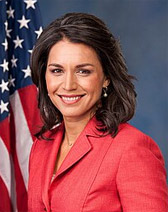
Tulsi Gabbard
From Anti-Intervention Democrat to Republican Director of National Intelligence
Born on April 12, 1981
Age: 45
Profession: Politician
Place of Birth: American Samoa
Tulsi Gabbard is an American politician and military veteran. She served as a member of the United States House of Representatives representing Hawaii’s 2nd congressional district from 2013 to 2021. Originally beginning her political career as a member of the Democratic Party, she was affiliated with that party from 1999 until 2022, formally leaving it in October 2022. On October 22, 2024, she announced her decision to join the Republican Party at a campaign rally supporting Donald Trump. Shortly thereafter, on February 12, 2025, she was appointed as the United States Director of National Intelligence.
Tulsi Gabbard was born on April 12, 1981, in American Samoa and was raised in Hawaii. Her father, Mike Gabbard, is a locally active politician, and her mother is Carol Porter Gabbard. She completed her higher education at Hawaii Pacific University and also received military training at the Alabama Military Academy. At the age of 21, she was elected to the Hawaii State Legislature, becoming one of the youngest women ever to serve in that body.
Following the September 11 terrorist attacks, Tulsi Gabbard voluntarily enlisted in the United States Army and served with the Hawaii Army National Guard. Between 2004 and 2005, she was deployed to Iraq, where she served in a medical unit. Over the course of her military career, she rose to the rank of major and earned veteran status. Her military experience played a central role in shaping her views on foreign policy and national defense.
In 2012, Tulsi Gabbard was elected to the United States Congress for the first time and served from 2013 to 2021. During her tenure, she was a member of the House Foreign Affairs Committee and the House Armed Services Committee. In 2013, she was elected vice chair of the Democratic National Committee, but resigned from that position in 2016, alleging that party leadership had undermined neutrality in the presidential primaries. She subsequently endorsed Bernie Sanders.
Tulsi Gabbard ran as a candidate in the 2020 Democratic presidential primaries but withdrew from the race on March 19, 2020, later endorsing Joe Biden. During the primary debates, she gained attention for her sharp criticism of Kamala Harris. In December 2019, during the impeachment proceedings against Donald Trump, she voted “present,” neither supporting nor opposing impeachment, a decision that sparked significant controversy within her party and the broader public.
In October 2022, Tulsi Gabbard formally left the Democratic Party, describing it as being controlled by “war-mongering elites and woke ideological policies.” Following her departure, she became a political commentator on Fox News, continued hosting her own podcasts, and openly supported Donald Trump. During the 2024 election cycle, she emerged as one of Trump’s most visible supporters and joined the presidential transition team alongside Robert F. Kennedy Jr..
After announcing her formal entry into the Republican Party on October 22, 2024, Tulsi Gabbard was soon nominated as United States Director of National Intelligence. Her appointment placed her in charge of coordinating 18 U.S. intelligence agencies, including the Central Intelligence Agency, the Federal Bureau of Investigation, and the National Security Agency. The nomination sparked intense national debate due to her lack of direct intelligence leadership experience and allegations that she had previously echoed Russian propaganda narratives. Senate confirmation was required for her to formally assume the role.
Criticism of her nomination came primarily from Democratic lawmakers. Democratic Virginia Representative Abigail Spanberger, a member of the House Intelligence Committee, stated on the social media platform X that she was “horrified” by the nomination, accusing Tulsi Gabbard of inexperience and of maintaining proximity to figures such as Bashar al-Assad and Vladimir Putin.
Tulsi Gabbard’s foreign policy views are rooted in a strongly anti-interventionist approach. She has argued that regime-change policies in Iraq, Libya, and Syria strengthened terrorist organizations. While supporting targeted military operations against terrorism, she has consistently opposed large-scale military interventions. Her 2017 visit to Syria, during which she met with Bashar al-Assad, generated widespread controversy; she defended the visit as necessary for diplomacy and counterterrorism efforts.
Her statements regarding the Russia–Ukraine war also provoked backlash. On the day the war began, Tulsi Gabbard suggested that recognizing Russia’s “legitimate security concerns” could have prevented the conflict. One month later, she amplified claims regarding U.S.-funded biological research laboratories in Ukraine. These remarks were criticized by Republican Senator Mitt Romney, who described them as “parroting Russian propaganda.”
On climate and energy policy, Tulsi Gabbard has taken an environmentally focused stance. She supported the Paris Agreement, advocated for increased investment in clean energy, and called for the elimination of fossil fuel subsidies. She opposed nuclear energy and supported bans on fracking and offshore oil drilling.
In economic policy, Tulsi Gabbard has argued for stricter regulation of Wall Street, the breakup of large banks, and an increase in the federal minimum wage. She opposed the 2017 tax reform, stating that it expanded the budget deficit and provided unfair advantages to corporations.
On immigration, Tulsi Gabbard has called for comprehensive reform combining strong border security with humanitarian protections. She supported making the DACA program permanent and opposed family separations and the detention of children.
Throughout her political career, Tulsi Gabbard has positioned herself as an anti-establishment and independent figure. This stance has earned her both a devoted following and sustained criticism. As the first Samoa-descended American and the first Hindu elected to the United States Congress, as well as a military veteran with outspoken foreign policy positions, she stands out as one of the most controversial figures in contemporary American politics.
Tulsi Gabbard has been married twice. Her first marriage was to Eduardo Tamayo from 2002 to 2006. She married her second husband, Abraham Williams, in 2015.
Source: Biyografiler.com
Frequently asked questions about Tulsi Gabbard
Who is Tulsi Gabbard?, Tulsi Gabbard biography, Tulsi Gabbard life story, Tulsi Gabbard age, Tulsi Gabbard facts, Tulsi Gabbard birthplace, Tulsi Gabbard photos, Tulsi Gabbard videos, Tulsi Gabbard career
Related Biographies

Lamine Yamal
Professional footballer

Erling Haaland
Professional footballer

Kylian Mbappe
Professional footballer

Austin Abrams
Actor

Bad Bunny
Rapper, Songwriter

Sam Altman
Entrepreneur, Investor, CEO


Hongjoong
Singer, Rapper, Songwriter, Composer

Ludacris
Rapper, Actor

Kwon Eunbi
Singer

Sarah Wayne Callies
Actress, Screenwriter, Producer, Director

LaTavia Roberson
Singer, Actress, Entrepreneur
Bad Bunny
Rapper, Songwriter

Margot Robbie
Actress
Kylian Mbappe
Professional footballer

Neymar
Professional footballer

Pedro Sanchez
Politician

Ronaldinho
Professional footballer