
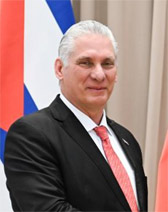
Miguel Diaz-Canel
The first Cuban leader born after the 1959 Cuban Revolution
Born on April 20, 1960
Age: 66
Profession: Politician
Place of Birth: Santa Clara (Placetas), Villa Clara, Cuba
Miguel Díaz-Canel is the first Cuban leader born after the 1959 Cuban Revolution and has served as the President of Cuba since April 19, 2018.
Miguel Díaz-Canel was born on April 20, 1960, in Santa Clara (Placetas), Villa Clara, Cuba. His full name is Miguel Mario Díaz-Canel Bermúdez. He is the son of a factory worker, Miguel Díaz-Canel, and a schoolteacher, Aida Bermúdez.
Miguel Díaz-Canel is Cuba’s 17th President and the First Secretary of the Central Committee of the Cuban Communist Party. He assumed office on April 19, 2018, succeeding Raúl Castro, the brother of Fidel Castro. Born after the 1959 Cuban Revolution, he became the first leader outside the Castro family to hold the country’s highest offices.
He grew up in Villa Clara province and studied electrical engineering at the Central University “Marta Abreu” of Las Villas in Santa Clara, graduating in 1982. In the same year, he joined the Cuban Armed Forces and served until 1985. During his military service, he was assigned to an anti-aircraft missile unit and later to a unit responsible for providing personal security to Raúl Castro and Fidel Castro.
After completing his military service, Miguel Díaz-Canel returned to academic life, teaching engineering courses at the university while becoming actively involved in the Young Communist League. In 1987, he was sent to Nicaragua, a Cuban ally at the time, as a liaison officer for the Communist Party.
In 1994, he was appointed First Secretary of the Cuban Communist Party in Villa Clara province, and later held the same position in Holguín province. During this period, marked by the “Special Period” following the collapse of the Soviet Union, he became known for his austere lifestyle and close engagement with the public. Amid severe fuel shortages, he notably chose to walk or ride a bicycle to work instead of using a state-assigned vehicle.
In 1997, Miguel Díaz-Canel was elected to the 14-member Politburo, becoming its youngest member at the time. His tenure as a provincial party secretary ended in 2003. In 2009, Raúl Castro appointed him Minister of Higher Education, a position he held until 2012.
In 2013, he joined the Council of State and was elected First Vice President, becoming the first person born after the Cuban Revolution to hold that office. During this period, he represented Cuba at the funeral of Venezuelan president Hugo Chavez and held official meetings with Vladimir Putin and Kim Jong-un. In 2015, he attended the United Nations Climate Change Conference in Paris.
As a representative of the post-revolutionary generation, Miguel Díaz-Canel distinguished himself from previous leaders through his clothing style, use of technology, and cultural interests. He is known for his appreciation of rock music, particularly The Beatles, advocated for expanded internet access, and actively used social media. At the same time, he maintained strict adherence to party ideology and drew attention in 2017 with firm statements regarding relations with the United States.
On April 19, 2018, Miguel Díaz-Canel was elected President of Cuba by the National Assembly, receiving 603 out of 604 votes. Following the 2019 constitutional reform, the position was formally defined as the presidency. In April 2021, after Raúl Castro stepped down from party leadership, he also assumed the role of First Secretary of the Central Committee of the Cuban Communist Party.
Miguel Díaz-Canel has been married twice. His first marriage was to Marta Villanueva, with whom he had two children, Miguel Díaz-Canel Villanueva and Jenny Díaz-Canel Villanueva. This marriage ended in divorce. In 2009, he married Lis Cuesta Peraza, and together they have presented a more publicly visible leadership profile.
Throughout his tenure, Miguel Díaz-Canel has continued to govern Cuba amid ongoing economic crises, United States sanctions, and the challenges posed by global pandemic conditions.
Source: Biyografiler.com
Frequently asked questions about Miguel Diaz-Canel
Who is Miguel Diaz-Canel?, Miguel Diaz-Canel biography, Miguel Diaz-Canel life story, Miguel Diaz-Canel age, Miguel Diaz-Canel facts, Miguel Diaz-Canel birthplace, Miguel Diaz-Canel photos, Miguel Diaz-Canel videos, Miguel Diaz-Canel career
Related Biographies

Lamine Yamal
Professional footballer

Erling Haaland
Professional footballer

Kylian Mbappe
Professional footballer

Sam Altman
Entrepreneur, Investor, CEO

Austin Abrams
Actor

Bad Bunny
Rapper, Songwriter


Hongjoong
Singer, Rapper, Songwriter, Composer

Ludacris
Rapper, Actor

Kwon Eunbi
Singer

Sarah Wayne Callies
Actress, Screenwriter, Producer, Director

LaTavia Roberson
Singer, Actress, Entrepreneur

Abbie Cornish
Actress

Demi Moore
Actress

El Greco
Painter

Mike Markkula
Businessperson, Entrepreneur

Mitt Romney
Politician, Business Leader

Michael Douglas
Actor, Film Producer