
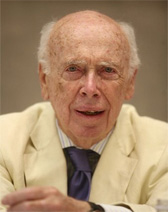
James Dewey Watson
Pioneer of molecular genetics and co-discoverer of the DNA double helix
Born on April 6, 1928
Died on November 6, 2025
Age at death: 97
Profession: Biologist
Place of Birth: Chicago, Illinois, United States
Place of Death: East Northport, New York, United States
James Dewey Watson was an American molecular biologist whose name is inseparably linked to one of the most consequential discoveries in the history of science: the elucidation of the double-helix structure of DNA. Working in close collaboration with British physicist and molecular biologist Francis Crick, Watson helped reveal the molecular framework that explains how genetic information is encoded, replicated, and transmitted. This breakthrough reshaped modern biology and medicine and was honored with the Nobel Prize in Physiology or Medicine in 1962.
Early Life and Education
James Dewey Watson was born on April 6, 1928, in Chicago, Illinois, to Jean Mitchell and James D. Watson. From an early age, he demonstrated exceptional intellectual ability and a strong inclination toward scientific inquiry. He studied zoology at the University of Chicago, where his fascination with genetics, evolution, and the biological basis of life began to mature.
In 1950, Watson entered doctoral studies at Indiana University, increasingly focusing on nucleic acids and the molecular foundations of heredity. His academic promise earned him a research fellowship that took him to Denmark, where he worked at the University of Copenhagen as a researcher in nucleic acid biochemistry. This period introduced him to biochemical approaches that would later prove decisive in his scientific career.
Cambridge Years and the Discovery of DNA Structure
Between 1950 and 1953, Watson conducted research first in Copenhagen and later at the University of Cambridge, concentrating on the structural analysis of DNA. A pivotal moment occurred in 1951, when he examined DNA diffraction patterns obtained through X-ray crystallography by physicist Maurice Wilkins. Recognizing the extraordinary potential of this technique, Watson redirected his efforts toward solving DNA’s molecular structure.
He moved his research to Cambridge University’s Cavendish Laboratory, where he began an intense collaboration with Francis Crick. Drawing on chemical reasoning, model-building techniques, and experimental evidence emerging from the international scientific community, the two scientists proposed the double-helix model of DNA in 1953. The model not only explained DNA’s physical structure but also revealed the mechanism by which genetic information could be faithfully replicated, marking a decisive turning point in biological science.
Academic Career in the United States
After the DNA discovery, Watson returned to the United States. From 1953 to 1955, he worked as a biology research fellow at the California Institute of Technology, where he remained closely connected to leading figures in molecular biology. He then spent the 1955–1956 period once again at Cambridge University, continuing scientific exchanges with Francis Crick before permanently returning to his home country.
In 1956, Watson joined the faculty of Harvard University. His academic ascent was rapid: he became an associate professor in 1958 and was promoted to full professor in 1961. During this period, he emerged as one of the central figures in establishing molecular biology as a dominant scientific discipline in American research and education.
Cold Spring Harbor Laboratory and Scientific Leadership
In 1968, James Dewey Watson assumed the directorship of the Cold Spring Harbor Laboratory on Long Island. Under his leadership, the laboratory evolved into one of the world’s most influential centers for genetics and cancer research, attracting prominent scientists and shaping research agendas for decades. His tenure coincided with rapid advances in molecular genetics that would later underpin biotechnology and genomic science.
After leaving his teaching position at Harvard in 1976, Watson devoted himself fully to Cold Spring Harbor, continuing both administrative leadership and active involvement in cancer research until 1985. Throughout his career, he was elected to numerous scientific and medical academies and received a wide range of awards and honors beyond the Nobel Prize.
The Double Helix and Public Influence
In 1967, Watson published The Double Helix: A Personal Account of the Discovery of the Structure of DNA. Unlike conventional scientific accounts, the book offered a candid and often controversial portrayal of the personalities, rivalries, and collaborations behind the DNA discovery. It became one of the most influential science memoirs ever written, shaping public understanding of how major scientific breakthroughs unfold.
Personal Life
James Dewey Watson married Elizabeth Lewis in 1968. The couple had two sons, Duncan James Watson and Rufus Robert Watson. Despite his global scientific stature, Watson maintained a strong commitment to family life alongside his professional achievements.
Death and Legacy
James Dewey Watson died on November 6, 2025, in East Northport, New York, at the age of 97. His passing marked the end of an era in twentieth-century science. The discovery of the DNA double helix—achieved in collaboration with Francis Crick and recognized by the Nobel Prize in 1962—remains a foundational pillar of modern genetics, medicine, and biotechnology.
Books
1967 – The Double Helix: A Personal Account of the Discovery of the Structure of DNA
Source: Biyografiler.com
Frequently asked questions about James Dewey Watson
Who is James Dewey Watson?, James Dewey Watson biography, James Dewey Watson life story, James Dewey Watson age, James Dewey Watson facts, James Dewey Watson birthplace, James Dewey Watson photos, James Dewey Watson videos, James Dewey Watson career

Lamine Yamal
Professional footballer

Sam Altman
Entrepreneur, Investor, CEO

Kylian Mbappe
Professional footballer

Alice Weidel
Politician, Economist

Erling Haaland
Professional footballer

Giorgia Meloni
Politician, Journalist


Hongjoong
Singer, Rapper, Songwriter, Composer

Ludacris
Rapper, Actor

Kwon Eunbi
Singer

Sarah Wayne Callies
Actress, Screenwriter, Producer, Director

LaTavia Roberson
Singer, Actress, Entrepreneur
Lamine Yamal
Professional footballer

Claudia Sheinbaum
President, Politician, Scientist, Academic

Austin Abrams
Actor

Colman Domingo
Actor, Director, Producer

Pedro Sanchez
Politician

Kaia Gerber
Model, Actress