
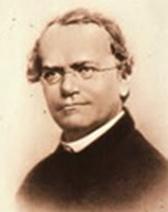
Gregor Mendel
The Founder of Genetics
Born on July 22, 1822
Died on January 6, 1884
Age at death: 62
Profession: Scientist
Place of Birth: Heinzendorf, Silesia (Austrian Empire; today Hynčice, Czech Republic)
Place of Death: Brünn (Brno), Moravia
Johann Gregor Mendel was an Austrian monk and scientist whose pioneering experiments on plant hybridization laid the foundations of modern genetics. Through systematic observation, controlled experimentation, and the use of statistical analysis, he uncovered the fundamental laws governing heredity. Although his discoveries were largely ignored during his lifetime, they later became one of the central pillars of modern biology.
Johann Gregor Mendel was born on 22 July 1822 in Heinzendorf, a rural village in Silesia within the Austrian Empire, a culturally mixed region where Czech and German were both spoken. He was the only son in a family of three children. His father worked as a farmer, while his mother came from a family with a long tradition of gardening. From an early age, Mendel became familiar with plant cultivation, learning practical agricultural skills that would later prove essential to his scientific work.
In 1833, Mendel began his formal education in Leipnik, followed a year later by secondary schooling in Troppau. His academic talent quickly became evident, and in 1840 he completed his secondary education with distinction. He then enrolled at the University of Olmütz, where he studied philosophy as preparation for an academic career.
Because of his family’s limited financial means, Mendel struggled to support himself during his studies and relied in part on his younger sister Theresia’s dowry. In 1843, acting on the recommendation of a physics professor, he entered the Augustinian monastery in Brünn. Upon joining the order, he took the name Gregor, a decision that provided him with both financial security and an intellectually stimulating environment.
Between 1844 and 1848, Mendel pursued theological studies while simultaneously attending courses in agriculture and natural sciences at the Philosophical Institute. Ordained as a priest in 1847, he briefly worked in a hospital before being appointed in 1849 as a substitute teacher in Znaim. During this period, he decided to dedicate himself to the teaching of natural sciences.
In 1850, Johann Gregor Mendel attempted the qualifying examinations required to become a certified secondary school teacher. When he failed to meet expectations in geology and zoology, his teaching career was temporarily interrupted. With the support of monastery authorities, he was sent to the University of Vienna to further his scientific education.
From 1851 to 1853, Mendel studied physics, botany, and natural sciences in Vienna, where he was also introduced to statistical methods that later became central to his research approach. The influence of Vienna’s scientific environment helped shape his analytical thinking and experimental discipline. In 1854, he returned to Brünn and was appointed as a substitute teacher of physics and natural history at the Technical School.
During this period, Mendel began the series of plant hybridization experiments that would secure his place in scientific history. He selected pea plants because of their clearly distinguishable traits and ease of controlled fertilization. By establishing pure-breeding lines and crossing them systematically, he was able to observe how specific characteristics were transmitted from one generation to the next.
Mendel discovered that when pure lines with contrasting traits were crossed, all individuals in the first filial generation (F1) exhibited only one of the traits. He concluded that this trait was dominant, while the alternative trait was recessive, regardless of whether it was inherited from the male or female parent. This insight led him to formulate what later became known as the Law of Dominance.
When Mendel allowed the F1 generation to self-pollinate, he obtained a second filial generation (F2) in which both dominant and recessive traits reappeared. He consistently observed a ratio of approximately three dominant individuals to one recessive individual. In one notable experiment, he counted 5,474 round peas and 1,850 wrinkled peas, a result strikingly close to a 3:1 ratio.
From these experiments, Johann Gregor Mendel concluded that hereditary traits are transmitted as discrete units and that each organism carries two such units for each characteristic, one inherited from each parent. During the formation of reproductive cells, these units separate, ensuring that each gamete carries only one unit. These conclusions later became known collectively as Mendel’s Laws of Inheritance.
Mendel conducted his experiments at a time when the scientific world was increasingly influenced by evolutionary ideas, particularly following the publication of Charles Darwin’s theory of natural selection. While Darwin focused on variation and adaptation over time, Mendel addressed the unresolved question of how traits were transmitted between generations. Although the two men never interacted directly, Mendel’s work provided the genetic mechanism that later strengthened evolutionary theory.
Despite the rigor of his research, Mendel’s findings, published in 1866, attracted little attention. The scientific community of the time lacked a clear understanding of chromosomes and cell division, making it difficult to appreciate the significance of his conclusions. Only decades later did advances in cytology provide the missing framework.
In the late nineteenth century, scientists such as Eduard Strasburger clarified the chromosomal processes involved in mitosis, while Eduard van Beneden demonstrated the significance of meiosis in sexual reproduction. Around the same period, August Weismann established that reproductive cells contain half the number of chromosomes found in somatic cells. Together, these discoveries confirmed that hereditary material is carried on chromosomes and behaves in ways that precisely match Mendel’s predictions.
In 1861, Mendel was appointed abbot of the monastery, a role that imposed heavy administrative responsibilities and sharply reduced the time he could devote to scientific research. He became involved in prolonged disputes with local authorities and the Ministry of Education over legislation affecting religious institutions. From 1876 onward, he also served on the board of a Moravian bank, further limiting his scientific activity.
Johann Gregor Mendel died on 6 January 1884 in Brünn, Moravia, without witnessing the recognition of his discoveries. In the early twentieth century, however, his work was rediscovered and universally acknowledged as the foundation of genetics. Today, Mendel is regarded as one of the most influential figures in the history of science, and his laws of heredity remain fundamental to biology, medicine, agriculture, and evolutionary theory.
Source: Biyografiler.com
Frequently asked questions about Gregor Mendel
Who is Gregor Mendel?, Gregor Mendel biography, Gregor Mendel life story, Gregor Mendel age, Gregor Mendel facts, Gregor Mendel birthplace, Gregor Mendel photos, Gregor Mendel videos, Gregor Mendel career
Related Biographies

Lamine Yamal
Professional footballer

Sam Altman
Entrepreneur, Investor, CEO

Kylian Mbappe
Professional footballer

Erling Haaland
Professional footballer

Alice Weidel
Politician, Economist

Giorgia Meloni
Politician, Journalist


Hongjoong
Singer, Rapper, Songwriter, Composer

Ludacris
Rapper, Actor

Kwon Eunbi
Singer

Sarah Wayne Callies
Actress, Screenwriter, Producer, Director

LaTavia Roberson
Singer, Actress, Entrepreneur
Lamine Yamal
Professional footballer

Kaia Gerber
Model, Actress
Giorgia Meloni
Politician, Journalist

Austin Abrams
Actor
Kylian Mbappe
Professional footballer

Eliezer Yudkowsky
Researcher, Writer