
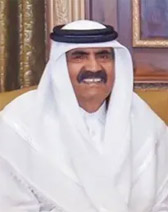
Hamad bin Khalifa Al Thani
The “Father Amir” who transformed natural-gas wealth into global diplomacy, media influence, aviation, investment, education, and sport
Born on January 1, 1952
Died on July 12, 2026
Age at death: 74
Profession: Statesman, Military Officer
Place of Birth: Doha, Qatar
Place of Death: Doha, Qatar
Hamad bin Khalifa Al Thani was a Qatari statesman and military officer who served as Emir of Qatar from 1995 to 2013. Officially known after his abdication as the “Father Amir,” he oversaw the transformation of Qatar from a relatively inward-looking Gulf monarchy into a wealthy and internationally influential state. His rule was defined by the rapid development of liquefied natural gas, the creation of Al Jazeera, the global expansion of Qatar Airways, the establishment of a powerful sovereign investment strategy, ambitious educational institutions, active regional diplomacy, and Qatar’s successful campaign to host the 2022 FIFA World Cup.
Early Life and Family Background
Hamad bin Khalifa Al Thani was born on 1 January 1952 in Doha, Qatar. He was a son of Khalifa bin Hamad Al Thani, who became Emir of Qatar in 1972. Raised in Doha, Hamad bin Khalifa Al Thani received his early education in Qatar before travelling to the United Kingdom for military training.
As a member of the ruling House of Al Thani, Hamad bin Khalifa Al Thani grew up within the political and institutional environment of a state that was still developing its modern administrative structure. Qatar had only recently entered the petroleum era, and the country’s future economic importance as a natural-gas producer had not yet been fully realized.
Military Education and Rise Through the Armed Forces
Hamad bin Khalifa Al Thani studied at the Royal Military Academy Sandhurst in Britain and graduated in 1971. After returning to Qatar, he joined the Qatar Armed Forces and was placed in command of a mobile military unit. He subsequently rose through the military hierarchy, eventually becoming commander-in-chief with the rank of major general.
His military career coincided with a period in which Qatar was seeking to modernize its defense establishment and strengthen its capacity as an independent Gulf state. Hamad bin Khalifa Al Thani played an important role in the expansion, institutional development, training, and modernization of the country’s armed forces.
In 1977, Hamad bin Khalifa Al Thani was appointed heir apparent and minister of defense. These appointments placed him at the center of both military and political decision-making. During the following years, his responsibilities expanded beyond defense to include national planning, economic policy, and the development of Qatar’s oil and natural-gas resources.
Becoming Emir of Qatar
On 27 June 1995, while his father Khalifa bin Hamad Al Thani was outside the country, Hamad bin Khalifa Al Thani assumed power in a bloodless palace coup. He became Emir of Qatar with the support of important members of the ruling family and state establishment. His father rejected the change and remained abroad for several years before the two were eventually reconciled.
The transfer of power marked a decisive break with the more cautious policies of the previous administration. Hamad bin Khalifa Al Thani pursued a more ambitious program of economic modernization, institutional development, international investment, media expansion, and independent foreign policy.
Rather than relying solely on Qatar’s existing oil revenues, the new emir placed the development of the country’s enormous offshore natural-gas reserves at the center of national strategy. This decision provided the financial foundation for Qatar’s later rise as one of the world’s wealthiest states and most important exporters of liquefied natural gas.
Natural Gas and Economic Transformation
The development of the North Field, one of the world’s largest natural-gas reserves, became the central economic project of Hamad bin Khalifa Al Thani’s reign. Qatar formed partnerships with major international energy companies, constructed liquefaction facilities, expanded export terminals, and developed the specialized shipping infrastructure required to supply Asian and European markets.
As liquefied natural-gas exports increased, state income rose dramatically. The new wealth financed large-scale investment in roads, hospitals, schools, universities, public institutions, urban development, cultural facilities, and international infrastructure. Qatar Foundation describes the period as one of exceptional economic, social, and cultural expansion, during which Qatar’s economy and international standing grew substantially.
Hamad bin Khalifa Al Thani used natural-gas income not only to raise domestic living standards but also to reduce the country’s long-term dependence on hydrocarbons. The government sought to convert finite energy revenue into financial assets, human capital, global commercial relationships, and diplomatic influence.
Al Jazeera and the Expansion of Media Influence
One of the most influential initiatives associated with Hamad bin Khalifa Al Thani was the creation of Al Jazeera. The Doha-based channel began broadcasting on 1 November 1996 and introduced a confrontational style of political discussion that differed sharply from the tightly controlled state television systems common across much of the Arab world.
Al Jazeera broadcast debates, interviews, opposition voices, and criticism of Arab governments and political leaders. Its reporting increased Qatar’s international visibility and gave the small state a degree of regional influence far beyond its geographic size. It also caused repeated diplomatic disputes, as governments accused the network of interference, biased reporting, or deliberately undermining their political authority.
The channel’s relationship with the Qatari state remained controversial. Supporters regarded it as an important break from traditional Arab broadcasting, while critics argued that its editorial priorities often aligned with Qatar’s wider foreign-policy objectives. Despite these debates, Al Jazeera became one of the most recognizable media organizations in the Arab world and a central instrument of Qatar’s international profile.
Qatar Airways and Global Connectivity
Hamad bin Khalifa Al Thani also supported the expansion of Qatar Airways. The carrier began with a limited regional network in 1994 and was relaunched in 1997 as part of a strategy to make Doha a major international aviation hub. The airline subsequently expanded its long-haul fleet and route network, developing into one of the world’s best-known international carriers.
The growth of Qatar Airways strengthened Qatar’s commercial links with Europe, Asia, Africa, the Middle East, and the Americas. It also became a major component of the country’s branding strategy, placing Qatar’s name before international passengers and linking Doha to global business and tourism markets.
Construction of Hamad International Airport began as part of the same long-term vision. Although the airport formally opened after Hamad bin Khalifa Al Thani had transferred power, it was developed during his reign and named in his honor. The airport became one of the most visible physical symbols of Qatar’s ambition to serve as an international transit, business, and aviation center.
Sovereign Wealth and International Investments
In 2005, Qatar established the Qatar Investment Authority to manage state reserves, generate long-term returns, diversify national wealth, and prepare the economy for a future beyond hydrocarbons. The institution developed into one of the world’s most active sovereign investment organizations, with holdings across real estate, finance, infrastructure, retail, technology, energy, and sport.
During and after Hamad bin Khalifa Al Thani’s reign, Qatari investment entities acquired prominent international assets. Among the most widely publicized was the purchase of the London department store Harrods. Qatar also invested extensively in British and European property, financial institutions, luxury retail, infrastructure, and major international companies.
These purchases were not merely commercial transactions. They gave Qatar economic relationships and institutional visibility in some of the world’s most influential markets. Supporters described the policy as prudent diversification, while critics viewed the scale of Qatari investment as a mechanism for obtaining political access and international influence.
Education, Research, and Qatar Foundation
Hamad bin Khalifa Al Thani and his second wife, Moza bint Nasser, made education and research central elements of Qatar’s modernization program. Together they established Qatar Foundation in 1995 with the goal of supporting education, science, community development, and the creation of a knowledge-based economy.
The foundation developed Education City in Doha, bringing branches and programs of international universities to Qatar. The wider complex also included schools, research institutes, cultural organizations, conference facilities, libraries, and technology initiatives.
Moza bint Nasser became one of the most visible public figures associated with these projects. Her work in education and social development complemented Hamad bin Khalifa Al Thani’s state-building agenda and helped promote an image of Qatar as a center for scholarship, research, culture, and international academic cooperation.
Independent and Multi-Directional Foreign Policy
Under Hamad bin Khalifa Al Thani, Qatar developed a foreign policy that combined close military and security relations with the United States with continued diplomatic and economic engagement with Iran. Qatar also maintained contacts with governments, opposition movements, Islamist organizations, Palestinian factions, and Western states that were frequently in conflict with one another.
This broad network of relationships allowed Qatar to present itself as a diplomatic intermediary. During the reign of Hamad bin Khalifa Al Thani, Doha became involved in mediation efforts concerning Lebanon, Sudan’s Darfur conflict, disputes among Palestinian groups, and other regional crises. Qatar’s ability to communicate with opposing sides increased its diplomatic relevance despite its small population and limited territory.
The policy also attracted criticism. Neighboring governments objected to Qatar’s contacts with the Muslim Brotherhood, Hamas, and other political movements. Qatar’s support for uprisings and opposition groups during the Arab Spring deepened tensions with several Arab states and contributed to disputes that continued after Hamad bin Khalifa Al Thani left office.
Supporters of Hamad bin Khalifa Al Thani argued that his diplomacy gave Qatar strategic flexibility and the ability to act as a mediator. Critics maintained that the same policy blurred the distinction between mediation and political sponsorship and sometimes placed Qatar on opposing sides of regional conflicts.
Constitutional and Institutional Changes
In domestic politics, Hamad bin Khalifa Al Thani introduced limited constitutional and electoral reforms while preserving the central authority of the emir and the ruling family. Qatar held its first elections for the Central Municipal Council in 1999. Women were permitted both to vote and to stand as candidates, an important development in the country’s political history.
A permanent constitution was approved in a public referendum in April 2003. It defined the functions of state institutions, provided for a consultative legislative structure, and formally recognized a range of rights. Nevertheless, executive authority remained concentrated in the monarchy, political parties were not permitted, and the emir retained extensive powers over government, defense, security, and national policy.
The reforms therefore represented controlled institutional modernization rather than a transition to parliamentary democracy. Admirers viewed them as gradual changes adapted to Qatari society, while critics argued that they did not fundamentally challenge the concentration of power within the ruling dynasty.
Sport as an Instrument of International Strategy
Sport became an increasingly important element of Qatar’s international promotion during the reign of Hamad bin Khalifa Al Thani. Doha hosted the 2006 Asian Games, an event that expanded the country’s capacity to organize major competitions and helped establish Qatar as an emerging global sports destination.
On 2 December 2010, Qatar was selected to host the 2022 FIFA World Cup. It became the first country in the Middle East and the first Arab state to stage the men’s tournament. The successful bid represented the most important result of the sports-diplomacy strategy developed during Hamad bin Khalifa Al Thani’s administration.
The tournament significantly increased Qatar’s global visibility but also generated intense controversy. Questions were raised about the bidding process, infrastructure costs, environmental conditions, migrant labor, workers’ rights, and broader human-rights issues. International scrutiny contributed to later labor reforms, although the International Labour Organization reported that further implementation and enforcement remained necessary.
For supporters, the World Cup demonstrated Qatar’s capacity to organize an event of extraordinary scale and presented the Arab world to a global audience. For critics, it illustrated the political use of sport and the social costs associated with rapid construction and international image-building.
Voluntary Abdication
On 25 June 2013, Hamad bin Khalifa Al Thani announced in a televised address that he was transferring power to his son, Sheikh Tamim bin Hamad Al Thani. The new emir was 33 years old when he assumed the throne.
The decision attracted international attention because voluntary abdication was highly unusual among the hereditary monarchies of the Gulf, where succession had more commonly followed the ruler’s death or removal. Hamad bin Khalifa Al Thani, who had himself taken power from his father in 1995, presented the transition as an opportunity for a new generation to assume responsibility for the state.
After leaving office, he became officially known as the “Father Amir.” He largely withdrew from everyday government responsibilities but continued to hold considerable symbolic importance as the ruler associated with Qatar’s economic transformation and international rise. His presence remained visible at major national and sporting occasions.
Marriages and Children
Hamad bin Khalifa Al Thani married three times. His wives were Maryam bint Muhammad Al Thani, Moza bint Nasser, and Noora bint Khalid Al Thani. The marriages produced a large royal family whose members became active in government, diplomacy, education, culture, sport, business, and charitable institutions.
Among his best-known children was Sheikh Tamim bin Hamad Al Thani, who succeeded him as Emir of Qatar in 2013. His other prominent children included Sheikh Abdullah bin Hamad Al Thani, who became Deputy Emir, and Sheikha Al Mayassa bint Hamad Al Thani, who became internationally influential through her leadership of Qatar Museums.
Several other children of Hamad bin Khalifa Al Thani occupied senior positions in national institutions, reinforcing the central role of the House of Al Thani in Qatar’s political and public life.
Public Controversies and Political Criticism
The rule of Hamad bin Khalifa Al Thani was associated with rapid modernization, but it was not without controversy. Critics focused on the limited nature of political participation, the absence of competitive party politics, restrictions on public dissent, and the continuing concentration of executive authority in the emir and ruling family.
His foreign policy was also divisive. Qatar’s engagement with Iran, Hamas, the Muslim Brotherhood, the Taliban, and various Arab opposition movements enabled mediation but created suspicion among regional governments and Western partners. The editorial direction of Al Jazeera was likewise praised for challenging authoritarian media systems and criticized for reflecting the strategic preferences of the Qatari leadership.
Qatar’s international investments and sports projects generated additional debate about political influence, reputation management, and “soft power.” These criticisms formed an important part of assessments of Hamad bin Khalifa Al Thani’s reign, alongside recognition of the extraordinary economic and diplomatic expansion achieved under his government.
Death
Hamad bin Khalifa Al Thani died on the morning of 12 July 2026 at the age of 74. The Amiri Diwan formally announced his death and declared four days of public mourning. Government offices and public institutions suspended work as Qatar observed the death of the former ruler. No official cause of death was initially disclosed.
Funeral prayers were held at the Imam Muhammad ibn Abd al-Wahhab Mosque in Doha. His son Sheikh Tamim bin Hamad Al Thani, members of the ruling family, senior officials, and large numbers of mourners attended the ceremonies. Hamad bin Khalifa Al Thani was subsequently buried at Lusail Cemetery, north of Doha.
Political and Historical Assessment
The historical importance of Hamad bin Khalifa Al Thani rests on his use of natural-gas wealth as the foundation of a much broader national strategy. During his reign, Qatar developed into a leading liquefied natural-gas exporter, accumulated major international investments, expanded its diplomatic relationships, created a globally influential media network, built an international airline, and invested heavily in education, culture, infrastructure, and sport.
His supporters described him as the architect of modern Qatar and credited him with giving a small state economic security, diplomatic independence, and global visibility. His critics emphasized authoritarian governance, controversial regional alliances, the political influence of state wealth, and the human and social questions surrounding Qatar’s rapid expansion.
Despite these competing interpretations, Hamad bin Khalifa Al Thani was one of the most consequential Arab rulers of the late twentieth and early twenty-first centuries. The institutions, investments, diplomatic methods, and international ambitions developed under his leadership continued to shape Qatar after his abdication and remained central to the country’s identity at the time of his death.
Major Offices and Positions
- 1971 – Began service in the Qatar Armed Forces
- 1977–1995 – Heir Apparent of Qatar
- 1977–1995 – Minister of Defense of Qatar
- 1995–2013 – Emir of Qatar
- 2013–2026 – Father Amir of Qatar
Source: Biyografiler.com
Frequently asked questions about Hamad bin Khalifa Al Thani
Who is Hamad bin Khalifa Al Thani?, Hamad bin Khalifa Al Thani biography, Hamad bin Khalifa Al Thani life story, Hamad bin Khalifa Al Thani age, Hamad bin Khalifa Al Thani facts, Hamad bin Khalifa Al Thani birthplace, Hamad bin Khalifa Al Thani photos, Hamad bin Khalifa Al Thani videos, Hamad bin Khalifa Al Thani career
Related Biographies


Lamine Yamal
Professional footballer

Sam Altman
Entrepreneur, Investor, CEO

Kylian Mbappe
Professional footballer

Alice Weidel
Politician, Economist

Erling Haaland
Professional footballer

Giorgia Meloni
Politician, Journalist


Hongjoong
Singer, Rapper, Songwriter, Composer

Ludacris
Rapper, Actor

Kwon Eunbi
Singer

Sarah Wayne Callies
Actress, Screenwriter, Producer, Director

LaTavia Roberson
Singer, Actress, Entrepreneur

Delcy Rodriguez
Politician, Lawyer, Diplomat

Mark Ruffalo
Actor

Amanda Seyfried
Actress, Model, Singer

Penelope Cruz
Actress

Robin Williams
Actor, Voice Actor, Producer, Public Speaker

El Greco
Painter