
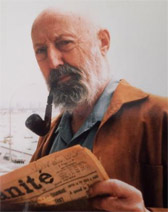
Armand Salacrou
A Major Voice of 20th-Century French Theatre
Born on August 9, 1899
Died on November 23, 1989
Age at death: 90
Profession: Screenwriter, Writer
Place of Birth: Rouen, France
Place of Death: Le Havre, France
Armand Salacrou was a French playwright, screenwriter, and writer whose career extended from the 1920s to the late 20th century. Known for plays that explored memory, time, moral responsibility, social injustice, and the existential conflicts of modern life, Armand Salacrou became one of the notable figures of French theatre between the interwar period and the post-war era. His work is often discussed in relation to the intellectual climate shaped by writers and thinkers such as Jean-Paul Sartre and Albert Camus.
Early Life and Education
Armand Salacrou, full name Armand Camille Salacrou, was born on August 9, 1899, in Rouen, France, to Camille Salacrou and Gabrielle Salacrou. He spent much of his childhood in Le Havre, a city that would remain closely connected to his personal identity and artistic imagination.
In 1917, Armand Salacrou moved to Paris, where he studied at the University of Paris Faculty of Medicine between 1917 and 1919. Although his formal education began in medicine, Paris exposed him to literature, theatre, journalism, and the intellectual currents of the early 20th century.
Journalism, Cinema, and Early Career
Before becoming fully established as a playwright, Armand Salacrou worked in journalism and cinema. Between 1921 and 1922, he wrote theatre criticism for L’Humanité and worked as a journalist for Internationale. These early experiences placed him close to political debate, cultural criticism, and the artistic tensions of post-war France.
From 1925 to 1927, Armand Salacrou worked in the film industry, and in 1929 he contributed to the film Monte Cristo. His involvement in cinema helped sharpen his understanding of dramatic structure, dialogue, and visual storytelling, which later influenced his stage writing.
Theatre Career and Artistic Development
Armand Salacrou began writing plays in the 1920s, a period when French theatre was being reshaped by avant-garde movements, political unrest, and new approaches to psychological drama. His early works showed surrealist influence, but he gradually developed a distinctive theatrical language centered on fractured time, memory, moral ambiguity, and social critique.
Between 1929 and 1932, he worked as secretary to Charles Dullin at the Théâtre de l’Atelier in Paris. Dullin, one of the major figures of modern French theatre, played an important role in Salacrou’s stage formation and helped connect him with the theatrical world of the period.
His major breakthrough came with Atlas-Hôtel, written in 1931. Later, L’Inconnue d’Arras became one of his most important works, especially for its innovative use of flashback and its exploration of memory, guilt, and identity.
Themes and Political Engagement
During the 1920s, Armand Salacrou showed interest in communism and used theatre as a way to examine social inequality, injustice, and political responsibility. Yet his writing was never limited to ideology. His best plays also confronted existential questions: freedom, guilt, memory, human choice, and the burden of the past.
In this sense, Armand Salacrou belongs to the wider French dramatic atmosphere that also produced the work of Jean-Paul Sartre, Albert Camus, and other writers concerned with human responsibility under historical pressure. His theatre often placed private conscience inside public crisis.
War, Resistance, and Post-War Drama
During the Nazi occupation of France, Armand Salacrou became involved in the clandestine French Resistance. This experience strongly influenced his post-war works, especially Les Nuits de la colère, which is associated with themes of occupation, moral courage, resistance, and sacrifice.
After the war, his drama increasingly reflected the ethical anxieties of a society forced to confront collaboration, survival, memory, and responsibility. His plays from this period helped define the moral seriousness of post-war French theatre.
Major Works and Recognition
Among Armand Salacrou’s most notable plays are Tour à terre, Patchouli, ou Les Désordres de l’amour, L’Inconnue d’Arras, La terre est ronde, Histoire de rire, Les Nuits de la colère, and Boulevard Durand. The latter is particularly known for its critique of capitalism and its emphasis on social justice.
Beyond theatre, Armand Salacrou contributed to cinema as a screenwriter and dialogue writer. His work connected French stage culture with the evolving language of film, placing him among the versatile literary figures of 20th-century France.
In 1963, Armand Salacrou served as jury president at the Cannes Film Festival, and in 1966 he returned as a jury member, reflecting his respected status in French cultural life.
Personal Life
Armand Salacrou married Lucienne Jeandet on June 7, 1922, and remained married to her until his death. The couple had two daughters.
Armand Salacrou died on November 23, 1989, in Le Havre, France, at the age of 90. He is remembered as an important figure in 20th-century French theatre, especially for his treatment of memory, conscience, social responsibility, and the moral conflicts of modern history.
Theatre Plays
1923 – Magasin d’accessoires
1923 – Histoire de cirque
1923 – Le Casseur d’assiettes
1923 – Les Trente Tombes de Judas
1924 – La Boule de Verre
1925 – Le Pont de l’Europe
1925 – Tour à terre
1927 – Patchouli, ou Les Désordres de l’amour
1929 – Atlas-Hôtel
1929 – Les Frénétiques
1931 – La Vie en Rose
1933 – Une femme libre
1933 – Poof
1935 – L’Inconnue d’Arras
1936 – Un homme comme les autres
1937 – La terre est ronde
1939 – Histoire de rire
1941 – La Marguerite
1944 – Les Fiancés du Havre
1945 – Le Soldat et la sorcière
1946 – Les Nuits de la colère
1946 – L’Archipel Lenoir, ou Il ne faut pas toucher aux choses inutiles
1946 – Pourquoi pas moi?
1950 – Dieu le savait, ou la Vie n’est pas sérieuse
1952 – Sens Interdit, ou Les Âges de la Vie
1953 – Les Invités du Bon Dieu
1953 – Une femme trop honnête, ou Tout est dans la façon de le dire
1954 – Le Miroir
1959 – Boulevard Durand
1964 – Comme les Chardons
1966 – La Rue Noire
Film Screenplays and Cinema Contributions
1928 – L’Occident – Assistant Director / Cinema Contribution
1929 – Le Comte de Monte Cristo / Monte Cristo – Screenwriter
1936 – Feu Mathias Pascal – Screenwriter
1941 – Foolish Husbands / Histoire de rire – Writer / Adaptation / Dialogue / Based on Play
1949 – Beauty and the Devil / La Beauté du diable – Screenwriter / Dialogue Writer
Source: Biyografiler.com
Frequently asked questions about Armand Salacrou
Who is Armand Salacrou?, Armand Salacrou biography, Armand Salacrou life story, Armand Salacrou age, Armand Salacrou facts, Armand Salacrou birthplace, Armand Salacrou photos, Armand Salacrou videos, Armand Salacrou career
Related Biographies

Lamine Yamal
Professional footballer

Sam Altman
Entrepreneur, Investor, CEO

Kylian Mbappe
Professional footballer

Alice Weidel
Politician, Economist

Erling Haaland
Professional footballer

Giorgia Meloni
Politician, Journalist


Hongjoong
Singer, Rapper, Songwriter, Composer

Ludacris
Rapper, Actor

Kwon Eunbi
Singer

Sarah Wayne Callies
Actress, Screenwriter, Producer, Director

LaTavia Roberson
Singer, Actress, Entrepreneur
Lamine Yamal
Professional footballer

Austin Abrams
Actor

Xi Jinping
Politician, Statesman, Head of State

Claudia Sheinbaum
President, Politician, Scientist, Academic

Colman Domingo
Actor, Director, Producer

Kaia Gerber
Model, Actress