
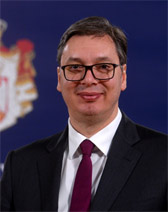
Aleksandar Vucic
Serbian politician who served as Prime Minister from 2014 to 2017 and President from May 31, 2017, to September 27, 2026. A founder and former leader of the Serbian Progressive Party, he resigned before the October 2026 parliamentary elections, in which his political alliance was defeated by a student-led movement.
Born on March 5, 1970
Age: 56
Profession: Former President
Place of Birth: Belgrade, Socialist Republic of Serbia, Yugoslavia (present-day Serbia)
Aleksandar Vučić, born on March 5, 1970, in Belgrade, is a Serbian politician who served as the fifth President of the Republic of Serbia from May 31, 2017, until his resignation on September 27, 2026. He previously served as Prime Minister from April 2014 to May 2017, First Deputy Prime Minister from 2012 to 2014, Minister of Defence from 2012 to 2013, and Minister of Information from 1998 to 2000. He began his political career in the nationalist Serbian Radical Party before helping establish the Serbian Progressive Party (SNS) in 2008. He chaired the SNS from 2012 to 2023 and remained a central figure in Serbian politics after relinquishing its formal leadership. During his presidency, Serbia pursued European Union membership while maintaining diplomatic and economic relations with Russia and China. His government faced sustained criticism over media freedom, corruption, and the concentration of political power. Following nationwide protests that began after the November 2024 Novi Sad railway station disaster, Vučić called early parliamentary elections for October 25, 2026. He resigned from the presidency in September to pursue a return to the premiership but acknowledged defeat after the student-backed opposition won the election.
Early Life and Education
Aleksandar Vučić was born on March 5, 1970, in Belgrade, then part of the Socialist Federal Republic of Yugoslavia. His father, Anđelko Vučić, was an economist, and his mother, Angelina Milovanov, worked as a journalist. He has a younger brother, Andrej Vučić.
He grew up in Belgrade and attended Branko Radičević Elementary School. In 1988, he graduated from Zemun Gymnasium and subsequently studied law at the University of Belgrade, graduating in 1994.
During his youth, Vučić spent time in Brighton, England, studying English. He also lived briefly in London, where he worked in commercial activities.
After returning to Yugoslavia, he worked as a journalist in Pale, a town in Bosnia and Herzegovina that became a political center of the Bosnian Serb leadership during the Bosnian War. During this period, he interviewed Radovan Karadžić and met military commander Ratko Mladić.
Early Political Career and Serbian Radical Party
In 1993, Aleksandar Vučić joined the Serbian Radical Party (SRS), a nationalist political organization led by Vojislav Šešelj.
He was elected to the Serbian National Assembly in the parliamentary elections held that year. In 1994, he became the party's secretary-general, a position he held until leaving the organization in 2008.
His political activities during the 1990s were associated with the Serbian nationalist movement during the wars accompanying the breakup of Yugoslavia.
In 1996, he was appointed director of the Pinki Sports and Business Centre in Zemun. He also became involved in local politics and parliamentary affairs.
Minister of Information Under Slobodan Milošević
In March 1998, Aleksandar Vučić became Minister of Information in the Serbian government led by Prime Minister Mirko Marjanović, during the presidency of Slobodan Milošević.
He held the position until 2000, a period that included the Kosovo War and NATO's bombing campaign against Yugoslavia in 1999.
During his ministerial tenure, Serbia adopted restrictive media legislation that imposed substantial financial penalties on newspapers and broadcasters accused of violating government regulations.
Independent journalists and opposition media organizations faced fines, restrictions, and closures. International press freedom organizations criticized the measures as instruments of political censorship.
The government also restricted the operations of foreign broadcasting organizations during the conflict.
Vučić subsequently acknowledged mistakes made during his earlier political career. In 2014, he stated that he was not ashamed to admit his political errors and maintained that his positions had changed.
His role in the Milošević-era information ministry remained a subject of criticism during his later political career.
Break with the Radical Party and Formation of SNS
Following the overthrow of Slobodan Milošević in October 2000, Aleksandar Vučić continued his political activities through the Serbian Radical Party.
He contested the Belgrade mayoral elections in 2004 and 2008 but was unsuccessful.
In September 2008, he left the Radical Party amid disagreements concerning its political direction and Serbia's relationship with the European Union.
Alongside Tomislav Nikolić, he helped establish the Serbian Progressive Party in October 2008.
The new party adopted a more moderate public position than the Serbian Radical Party, supporting economic development and European integration while maintaining nationalist positions on issues including Kosovo.
Following Nikolić's victory in the 2012 presidential election, Vučić became president of the SNS.
First Deputy Prime Minister and Minister of Defence
The Serbian Progressive Party entered government following the 2012 parliamentary elections.
On July 27, 2012, Aleksandar Vučić became First Deputy Prime Minister in the coalition government headed by Ivica Dačić. He also served as Minister of Defence from July 2012 until September 2013.
He participated in government initiatives addressing public finances, state administration, organized crime, and corruption.
During this period, Vučić increasingly became the principal political figure within the governing coalition.
He remained First Deputy Prime Minister until April 2014.
Prime Minister of Serbia
Following the parliamentary elections of March 2014, the Serbian Progressive Party and its allies secured a parliamentary majority.
Aleksandar Vučić became Prime Minister of Serbia on April 27, 2014, succeeding Ivica Dačić.
His government introduced fiscal consolidation measures, including reductions in public-sector salaries and pensions, as part of efforts to stabilize public finances.
It also promoted foreign investment, infrastructure development, and economic cooperation with international partners.
In foreign policy, the government continued negotiations concerning Serbia's proposed membership in the European Union while maintaining relations with Russia and China.
Vučić's administration also participated in EU-mediated discussions with Kosovo's authorities concerning the normalization of relations between Belgrade and Pristina.
After the parliamentary elections in April 2016, he began another term as prime minister in August of that year.
His second term ended in May 2017 following his election as President of Serbia.
Presidential Election and First Term
On April 2, 2017, Aleksandar Vučić won Serbia's presidential election in the first round, receiving approximately 55 percent of the vote.
He formally assumed office on May 31, 2017, succeeding Tomislav Nikolić. His ceremonial inauguration was held on June 23, 2017.
During his first presidential term, Vučić remained closely involved in government policy, party affairs, and Serbia's international relations.
He presented economic growth, infrastructure investment, military neutrality, and political stability as major priorities.
His government maintained cooperation with European institutions while developing trade and investment relationships with China and preserving connections with Russia.
Opposition parties, independent media organizations, and international monitoring bodies raised concerns about political pressure on journalists, unequal media access, and the concentration of authority around the presidency and the governing party.
Re-election in 2022 and Departure from SNS Leadership
On April 3, 2022, Aleksandar Vučić won a second presidential term with approximately 60 percent of the vote, receiving more than 2.2 million votes.
He began his second term on May 31, 2022.
During this period, Serbia continued balancing its European Union membership aspirations with economic and political relations with Russia and China.
Following Russia's invasion of Ukraine in February 2022, Serbia supported certain United Nations resolutions concerning Ukrainian territorial integrity but did not join the European Union's sanctions against Russia.
On May 26, 2023, Vučić announced his resignation as president of the Serbian Progressive Party.
The following day, Miloš Vučević, then Serbia's Minister of Defence, was elected party president.
Although Aleksandar Vučić no longer held the formal party leadership, he continued to exercise political influence over the SNS and the governing coalition.
Kosovo and Foreign Relations
Relations between Serbia and Kosovo remained one of the principal foreign-policy issues during Aleksandar Vučić's premiership and presidency.
Serbia does not recognize Kosovo's 2008 declaration of independence. Vučić participated in negotiations mediated by the European Union involving Kosovo's political leaders.
These discussions concerned the rights of Kosovo's Serb population, local government arrangements, security, and the normalization of relations.
His administration also pursued economic cooperation with regional states, including through the Open Balkan initiative, developed with Albania and North Macedonia.
Relations with the European Union remained complicated by disagreements over Kosovo, foreign-policy alignment, judicial reforms, and media freedom.
Student Protests and the Novi Sad Railway Station Disaster
On November 1, 2024, a concrete canopy collapsed at the railway station in Novi Sad, Serbia, resulting in sixteen deaths.
The disaster generated public allegations of negligence, corruption, and inadequate oversight of infrastructure projects.
Student organizations began protests demanding the publication of construction documents, independent investigations, and accountability for those responsible.
The demonstrations expanded during 2025 and 2026, drawing participants from universities, professional organizations, and local communities across Serbia.
Protesters also raised broader concerns about government transparency, media independence, and political influence over state institutions.
Vučić's government rejected accusations that it was responsible for systemic corruption and characterized some protest activities as politically motivated attempts to destabilize the country.
On January 28, 2025, Prime Minister Miloš Vučević announced his resignation amid the continuing demonstrations.
The protests nevertheless continued, and student organizations increasingly demanded early parliamentary elections.
Resignation from the Presidency in September 2026
On September 9, 2026, Aleksandar Vučić dissolved the National Assembly and called early parliamentary elections for October 25, 2026.
On September 27, 2026, he announced his resignation as President of Serbia, approximately seven months before the scheduled end of his second presidential term.
Vučić stated that he intended to participate in the parliamentary elections as a private citizen, seeking a possible return to the premiership.
On September 28, he formally transferred presidential duties to Ana Brnabić, Speaker of the National Assembly.
Under Serbia's constitutional arrangements, Brnabić became Acting President pending the election of a new head of state.
Vučić's resignation ended his presidency after nine years and four months, from May 31, 2017, to September 27, 2026.
October 2026 Parliamentary Election Defeat
Serbia held early parliamentary elections on October 25, 2026, following nearly two years of student-led demonstrations.
Aleksandar Vučić campaigned as the principal political figure of the SNS-led electoral alliance, seeking to return to government as prime minister.
Its principal challenger was the Student List, an opposition electoral movement that emerged from the anti-corruption protests following the Novi Sad railway station disaster.
After voting concluded, Vučić publicly acknowledged that his electoral alliance had lost.
On election night, he estimated that the Student List would obtain between 135 and 140 seats in the 250-member National Assembly, compared with approximately 105 seats for his alliance.
Results reported later in October indicated that the Student List had won approximately 53.7 percent of the vote and 141 parliamentary seats, while the SNS-led list received approximately 39.5 percent and 103 seats.
The result ended the parliamentary majority previously held by Vučić's political alliance. The formation of a new government and the election of a new president remained separate political processes.
Personal Life and Family
Aleksandar Vučić married Serbian journalist Ksenija Janković on July 27, 1997. The couple had two children, Danilo and Milica, before divorcing in 2011.
Ksenija Vučić died on January 29, 2022.
On December 14, 2013, Vučić married Tamara Đukanović, a diplomat employed by Serbia's Ministry of Foreign Affairs.
The couple have a son, Vukan Vučić, born in June 2017.
Vučić speaks Serbian, English, and Russian and has studied French and German.
He has expressed an interest in history, international relations, chess, basketball, and football.
Political Parties
1993–2008 – Serbian Radical Party (SRS; secretary-general from 1994 to 2008)
2008–Present – Serbian Progressive Party (SNS; co-founder and president from 2012 to May 2023)
Political Offices
1993 – Elected to the National Assembly of Serbia
1994–2008 – Secretary-General of the Serbian Radical Party
1996 – Director of the Pinki Sports and Business Centre, Zemun
1998–2000 – Minister of Information of Serbia
2008 – Co-founder of the Serbian Progressive Party
2012–2023 – President of the Serbian Progressive Party
July 27, 2012 – April 27, 2014 – First Deputy Prime Minister of Serbia
July 2012 – September 2013 – Minister of Defence of Serbia
April 27, 2014 – May 31, 2017 – Prime Minister of Serbia
May 31, 2017 – September 27, 2026 – President of Serbia
Presidential and Parliamentary Election Results
2017 – Serbian presidential election: Elected in the first round with approximately 55 percent of the vote
2022 – Serbian presidential election: Re-elected in the first round with approximately 60 percent of the vote
2026 – Serbian parliamentary election: The SNS-led alliance was defeated by the student-backed opposition; Vučić conceded defeat on October 25, 2026
Source: Biyografiler.com
Frequently asked questions about Aleksandar Vucic
Who is Aleksandar Vucic?, Aleksandar Vucic biography, Aleksandar Vucic life story, Aleksandar Vucic age, Aleksandar Vucic facts, Aleksandar Vucic birthplace, Aleksandar Vucic photos, Aleksandar Vucic videos, Aleksandar Vucic career

Lamine Yamal
Professional footballer

Kylian Mbappe
Professional footballer

Erling Haaland
Professional footballer

Keanu Reeves
Actor

Bad Bunny
Rapper, Songwriter

Ronaldinho
Professional footballer

Andre Gide
Novelist, Essayist

Andreas Papandreu
Former Prime Minister, Politician, Economist

Andrea Mantegna
Painter

Andrea del Verrocchio
Sculptor, Painter

Andrea del Sarto
Painter

Andrea Bargnani
Former Professional Basketball Player

Kyriakos Mitsotakis
Politician

Brad Pitt
Actor

Victor Wembanyama
Professional Basketball Player

Ursula von der Leyen
Politician, Physician

Elena Andreyevna Rybakina
Professional Tennis Player

Austin Abrams
Actor