
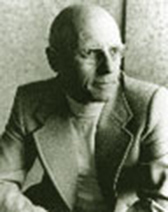
Michel Foucault
French philosopher who profoundly transformed modern thought through his analyses of madness, knowledge, and power
Born on October 15, 1926
Died on June 25, 1984
Age at death: 58
Profession: Philosopher, Social Theorist
Place of Birth: Poitiers, France
Place of Death: Paris, France
Michel Foucault was born on October 15, 1926, in Poitiers, France. His father was a surgeon who wished his son to follow the same professional path. After completing his education at Saint-Stanislas School, Foucault entered the prestigious Lycée Henri IV in Paris. In 1946, after previously failing the entrance examinations, he was admitted to the École Normale Supérieure as the fourth-ranked student.
During his school years, he became aware of his homosexuality and pursued philosophical studies under Maurice Merleau-Ponty. He earned his degree in philosophy in 1948, followed by a degree in psychology in 1950, and was awarded a diploma in psychopathology in 1952.
Beginning in 1954, Foucault taught French literature for four years at Uppsala University in Sweden, and for one year each at the Universities of Warsaw and Hamburg. In 1960, he returned to France as head of the Philosophy Department at Clermont-Ferrand University. That same year, he received his doctorate for his thesis published as Madness and Civilization. Also in 1960, Foucault met the philosophy student Daniel Defert, who was ten years younger than him. Defert’s political activism played a guiding role in Foucault’s work. Foucault later described their relationship as a long-lasting passion that at times resembled love.
Foucault’s second major work, The Order of Things, published in 1966, was a comparative study of economics, natural sciences, and linguistics. The book became a bestseller and played a crucial role in establishing his international reputation.
Between 1966 and 1968, Foucault traveled to Tunisia with Defert, after which they returned together to Paris. Foucault became head of the Philosophy Department at Paris-VIII University in Vincennes, while Defert began teaching sociology. Both were deeply influenced by the student movements of 1968. That same year, Foucault co-founded the Prison Information Group together with other intellectuals.
In 1969, he published The Archaeology of Knowledge. In 1970, he was elected Professor of the History of Systems of Thought at the Collège de France, one of the country’s most prestigious research institutions. In 1975, he published what is considered one of his most influential works, Discipline and Punish: The Birth of the Prison.
During the remaining years of his life, Foucault devoted himself to The History of Sexuality. The first volume was published in 1976. Although he did not complete the project in full, the second and third volumes were released shortly after his death in 1984.
Michel Foucault was primarily a philosopher who examined the enduring truths that structure societies. He was deeply influenced by the ideas of Friedrich Wilhelm Nietzsche and Martin Heidegger, while often engaging critically with the theories of Karl Marx and Sigmund Freud. His work addressed prisons, policing, insurance systems, madness, homosexuality, and social rights, consistently focusing on the effects of modernity on individuals and the power relations it produces.
Michel Foucault died on June 25, 1984, in Paris at the age of 58 due to complications related to HIV/AIDS.
Source: Biyografiler.com
Frequently asked questions about Michel Foucault
Who is Michel Foucault?, Michel Foucault biography, Michel Foucault life story, Michel Foucault age, Michel Foucault facts, Michel Foucault birthplace, Michel Foucault photos, Michel Foucault videos, Michel Foucault career
Related Biographies

Lamine Yamal
Professional footballer

Kylian Mbappe
Professional footballer

Erling Haaland
Professional footballer

Sam Altman
Entrepreneur, Investor, CEO

Austin Abrams
Actor

Bad Bunny
Rapper, Songwriter


Hongjoong
Singer, Rapper, Songwriter, Composer

Ludacris
Rapper, Actor

Kwon Eunbi
Singer

Sarah Wayne Callies
Actress, Screenwriter, Producer, Director

LaTavia Roberson
Singer, Actress, Entrepreneur

Adam Sandler
Actor

Cillian Murphy
Actor

Pedro Sanchez
Politician
Lamine Yamal
Professional footballer
Austin Abrams
Actor

Brad Pitt
Actor