
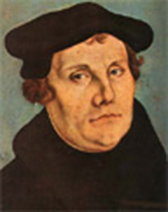
Martin Luther
Leader of the Protestant Reformation
Born on November 10, 1483
Died on February 17, 1546
Age at death: 63
Profession: Priest
Place of Birth: Eisleben, Germany
Place of Death: Eisleben, Germany
Martin Luther, the leader of the Religious Reformation, became the dynamic force behind the birth of Protestantism. His life and works played a decisive role in the emergence of creative forces in Western history and in the establishment of a freer form of religious belief.
Martin Luther was born on 10 November 1483 in Eisleben, Germany. While studying law at the University of Erfurt, he survived a near-death experience that plunged him into deep spiritual doubt about the salvation of his soul. As a result, he abandoned his legal studies and entered a monastery in Erfurt. There, he practiced severe forms of physical self-denial in an attempt to achieve divine unity. These methods, however, brought him no spiritual peace. His inner struggles intensified rather than diminished. Reflecting on this period later, he famously stated that if salvation could be achieved through monastic life, he would have attained it more than anyone.
Luther was ordained as a priest in 1507. In 1508, he began delivering lectures in philosophy at the newly founded University of Wittenberg. The following year, his lectures focused on interpretations of the Bible that increasingly diverged from established Church doctrine. By the early 16th century, Europe was witnessing an unprecedented degree of religious corruption. While the Italian Renaissance had entered a period of moral decline, Northern Europe was experiencing a spiritual awakening. The clergy, who survived on alms, had strayed far from their original ideals. Popes such as Pope Alexander VI and Pope Julius II frequently used religious authority for worldly ambitions.
In 1510, Martin Luther traveled to Rome, where the corruption he observed among high-ranking Church officials laid the groundwork for his eventual confrontation with the Catholic Church. Seven years later, on 1 November 1517, Luther, then a professor of theology, posted his Ninety-Five Theses on the door of the Wittenberg Castle Church. These theses opposed the Church’s practice of selling indulgences. Luther did not deny the Church’s authority to forgive sins; rather, he condemned the transformation of faith into a commercial enterprise.
The chief target of Luther’s criticism, a cleric named Johann Tetzel, accused him of heresy. Their debate quickly reached the Vatican. Initially dismissed by the papacy, the conflict escalated as Luther’s ideas spread across Europe. Soon after, the theologian Johann Eck openly attacked Luther, while Luther continued to refine and defend his views. Central to his doctrine was the belief that a person could not be judged by deeds alone, but by faith.
“Good works do not make a good person, but a good person does good works; nor do evil works make a person evil, but an evil person does evil works.”
According to Martin Luther, sin was an inevitable part of human existence. Salvation depended not on ritual acts, but on sincere faith and trust in God’s infinite mercy. A believer who truly trusted in salvation would ultimately attain it.
The Vatican could no longer ignore Luther. In 1520, Pope Leo X issued a papal bull declaring Luther’s teachings heretical and demanding that he recant within sixty days or face excommunication. Luther publicly burned the decree, openly defying papal authority. This act marked the first decisive challenge to papal supremacy and signaled the beginning of the Religious Reformation.
The Holy Roman Emperor Charles V convened the Diet of Worms to judge Luther. There, Luther boldly defended his ideas and refused to recant. Although a death sentence was declared, Luther disappeared, intensifying unrest among his supporters. In reality, he was hidden in Wartburg Castle under the protection of Frederick the Wise, Elector of Saxony. During his year in hiding, Luther devoted himself to writing and completed his translation of the Bible from Latin into German, a milestone that profoundly shaped the German language.
In his writings, Luther denounced the corruption of religious rituals, the hardships of monastic life, and the absurdity of confession practices. He argued that every believer could be a priest and that clergy should be permitted to marry. Upon leaving Wartburg, his ideas had already gained widespread support among German princes and the general population.
In 1525, the Peasants’ War erupted. Though driven primarily by economic causes, religious dissent played a significant role. The peasants expected Luther’s support, but he refused to side with them, leaving them isolated. As the Reformation increasingly merged with politics, the Diet of Speyer in 1526 initially tolerated the new beliefs. This tolerance was revoked three years later, prompting Luther’s followers to protest—thus giving rise to the term “Protestant.”
The conflict evolved into a struggle for power between Protestant princes and the Catholic Church. Settled in Wittenberg, Martin Luther broke his monastic vows in 1525 and married Catherine von Bora, a former nun from a noble family. Despite declining health, he worked relentlessly until the end of his life and never sought reconciliation with the Vatican, believing compromise would betray his principles.
Martin Luther died in 1546 at the age of sixty-three. When asked in his final moments whether he remained faithful to his beliefs, he answered affirmatively. His body was brought to Wittenberg with a grand funeral ceremony and buried in the church whose door he had nailed his theses to twenty-nine years earlier. Luther remains the central figure of the Religious Reformation and a guiding force that propelled medieval Europe toward the modern world.
Source: Biyografiler.com
Frequently asked questions about Martin Luther
Who is Martin Luther?, Martin Luther biography, Martin Luther life story, Martin Luther age, Martin Luther facts, Martin Luther birthplace, Martin Luther photos, Martin Luther videos, Martin Luther career

Lamine Yamal
Professional footballer

Kylian Mbappe
Professional footballer

Sam Altman
Entrepreneur, Investor, CEO

Erling Haaland
Professional footballer

Alice Weidel
Politician, Economist

Giorgia Meloni
Politician, Journalist


Hongjoong
Singer, Rapper, Songwriter, Composer

Ludacris
Rapper, Actor

Kwon Eunbi
Singer

Sarah Wayne Callies
Actress, Screenwriter, Producer, Director

LaTavia Roberson
Singer, Actress, Entrepreneur

John Healey
Politician
Lamine Yamal
Professional footballer

Snoop Dogg
Rapper, Singer, Actor

Florence Pugh
Actress

Austin Abrams
Actor

Leonardo DiCaprio
Actor