
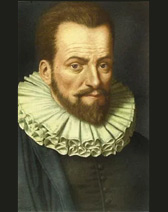
Simon Stevin
The Pioneer of Decimal Fractions and Measurement Systems
Born on ?? ??, 1548
Died on 1620
Age at death: 72
Profession: Mathematician, Engineer
Place of Birth: Brugge, Belgium
Place of Death: The Hague, Netherlands
Simon Stevin was an accountant and engineer who systematically introduced decimal fractions as part of a broader project to unify all systems of measurement under a decimal base. This achievement became one of the most important milestones made possible by the widespread adoption of the Hindu–Arabic numeral system.
Simon Stevin was born in 1548 in Brugge, Belgium. His mother was Cathelijne, and his father was Anthuenis Stevin (also known as Anton Stevin). His parents were not married; however, his mother later married a man engaged in the carpet and silk trade, thereby joining a Calvinist household. Although it is assumed that Stevin was raised according to Calvinist traditions, little is known about his early childhood or formal education.
As a follower of Calvinism, Simon Stevin fled Brugge in 1571 to escape religious persecution against Protestants carried out by Catholic Spanish authorities. He moved to Antwerp, where he worked as an accountant and cashier for a commercial firm. Between 1571 and 1577, he traveled extensively across Northern Europe, visiting Prussia, Poland, Denmark, Norway, Sweden, and other regions, gaining practical knowledge that later influenced his applied scientific work.
In 1577, Simon Stevin returned to Brugge and served as a tax clerk for the Bruges city council until 1581. This period coincided with intense religious and political conflict. Catholics and Calvinists alternated control of the city, sometimes opposing one another and at other times cooperating against the authority of King Philip II of Spain. Between 1578 and 1584, Brugge was governed by Calvinists, during which Catholic clergy and officials loyal to Spanish rule were imprisoned.
In 1581, Simon Stevin moved to Leiden in the Netherlands. Two years later, in 1583, he enrolled at Leiden University, marking a decisive turning point in his intellectual life. There, he developed strong connections with the Dutch scientific and political elite and began producing his most influential works.
A Flemish mathematician, physicist, and military engineer, Simon Stevin made fundamental theoretical and practical contributions across multiple disciplines. As part of his vision to standardize all measurement systems, he introduced the systematic use of decimal fractions. Although decimal fractions had previously appeared in the work of the medieval Islamic scholar Al-Uqlidisi in 952 and were later developed by Al-Kashi in his 1427 treatise *Miftah al-Hisab*, Stevin’s decisive contribution was to integrate decimal fractions into everyday scientific, engineering, and administrative practice in Europe.
Simon Stevin’s work had a direct influence on contemporary mathematicians and scientists. His decimal notation and applied mathematical approach strongly impacted John Napier, who later refined and popularized decimal notation alongside logarithmic computation. Through Napier’s work, Stevin’s ideas became embedded in astronomy, navigation, and advanced calculation.
Stevin was responsible for numerous innovations in applied science. He played a pioneering role in mathematics, physics, hydrology, and military engineering. His book *De Driehouckhandel* made significant contributions to trigonometry and emphasized its practical applications in surveying, navigation, and engineering.
In 1586, Simon Stevin carried out experiments in hydraulic engineering aimed at controlling floods in Dutch canal systems by using windmills to pump water. These works contributed directly to the Netherlands’ long-term mastery of water management. In the summer of 1600, he designed and demonstrated a wind-powered land vehicle for Maurice of Orange, showcasing the potential of wind energy beyond maritime use.
Stevin’s mechanical and engineering ideas formed part of a broader intellectual current that later influenced figures such as Blaise Pascal and Gottfried Wilhelm Leibniz, both of whom advanced mechanical calculation and formalized mathematical systems that built upon Stevin’s applied methods.
In 1612, Simon Stevin moved to The Hague, where he purchased a house. Two years earlier, in 1610, he had married Catherine Krai. The couple had several children: Hendrick Stevin, Levina Stevin, Susanna Stevin, and Frederic Stevin.
Simon Stevin died in February 1620 in The Hague, Netherlands, at the age of seventy-two. His legacy endures as a central figure in the transition from medieval mathematics to modern applied science, firmly establishing decimal notation as a universal standard and bridging theory with practical engineering.
Source: Biyografiler.com
Frequently asked questions about Simon Stevin
Who is Simon Stevin?, Simon Stevin biography, Simon Stevin life story, Simon Stevin age, Simon Stevin facts, Simon Stevin birthplace, Simon Stevin photos, Simon Stevin videos, Simon Stevin career
Related Biographies


Lamine Yamal
Professional footballer

Kylian Mbappe
Professional footballer

Erling Haaland
Professional footballer

Sam Altman
Entrepreneur, Investor, CEO

Bad Bunny
Rapper, Songwriter

Brad Pitt
Actor


Hongjoong
Singer, Rapper, Songwriter, Composer

Ludacris
Rapper, Actor

Kwon Eunbi
Singer

Sarah Wayne Callies
Actress, Screenwriter, Producer, Director

LaTavia Roberson
Singer, Actress, Entrepreneur
Lamine Yamal
Professional footballer
Brad Pitt
Actor

Stephen King
Novelist, Screenwriter

Keanu Reeves
Actor

Taylor Swift
Singer, Musician, Songwriter
Sam Altman
Entrepreneur, Investor, CEO