
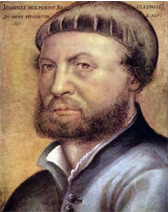
Hans Holbein
Master of Renaissance Portraiture and Court Realism
Born on ?? ??, 1497
Died on 1543
Age at death: 46
Profession: Painter
Place of Birth: Augsburg, Germany
Place of Death: London, England
Hans Holbein was one of the greatest portrait painters of the 16th century. He is renowned for his meticulous naturalism, precise draftsmanship, and for portraying figures from the English royal court—most notably King Henry VIII of England—with an impartial and penetrating realism.
Hans Holbein was born in 1497 in Augsburg, Germany, into a family of distinguished artists. His father, Hans Holbein the Elder, and his uncle Sigmund Holbein were well known for their works in the Late Gothic style. His brother Ambrosius Holbein was also a painter and printmaker, but died prematurely in 1519 before reaching artistic maturity.
Holbein received his earliest artistic training from his father. In 1515, he moved with his brother to Basel, Switzerland, where he worked under the painter Hans Herbster. During these early years, he produced mural paintings and religious works, designed stained-glass windows, and created illustrations for printed books. In 1517, he worked in Lucerne, producing interior and exterior wall paintings for the merchant Jakob von Hertenstein. He was also commissioned to paint murals for the mayor’s residence, including portraits of the mayor and his wife.
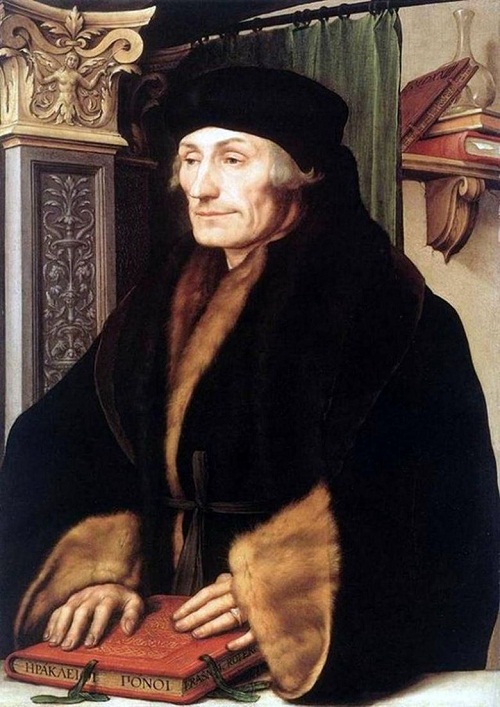
This portrait of the Dutch humanist Desiderius Erasmus exemplifies Holbein’s ability to unite psychological insight with compositional clarity. Shown as a scholar absorbed in thought, Erasmus appears calm, introspective, and intellectually authoritative. These portraits were instrumental in spreading Holbein’s reputation throughout Europe.
At this time, Hans Holbein collaborated with the Dutch humanist scholar Desiderius Erasmus. He produced a celebrated series of pen-and-ink marginal illustrations for Erasmus’ book *The Praise of Folly*, which significantly enhanced his reputation among European intellectual circles. In 1518, Holbein traveled to northern Italy, absorbing Renaissance influences before returning to Basel in 1519, where he joined the painters’ guild and acquired Basel citizenship.
In 1519, before his formal acceptance into the Basel painters’ guild, Holbein married a widow, Elsbeth Binsenstock-Schmid, who already had a son named Franz. The couple had several children together, including Philipp (born 1520), Katharina (born 1526), and later Jacob and Küngold. In 1523, Holbein painted a series of portraits of Desiderius Erasmus, works that played a crucial role in spreading his fame throughout Europe.
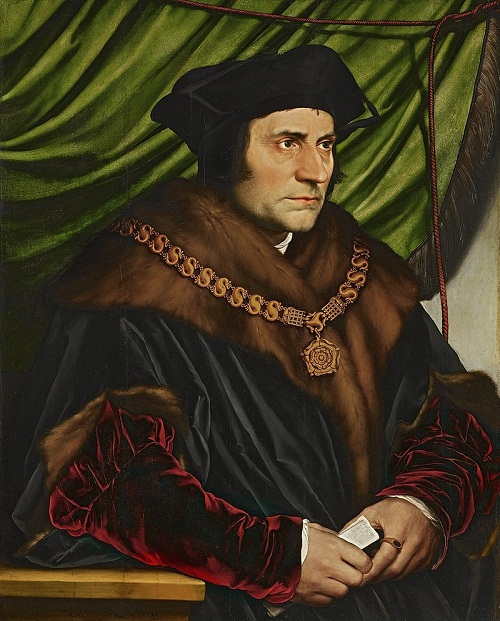
In this portrait, Hans Holbein captures the intellectual depth and moral gravity of the English statesman, writer, and humanist Thomas More. The restrained color palette, fur-lined robe, and contemplative expression reflect More’s scholarly identity and inner resolve during a turbulent political and religious era.
In 1526, at the age of twenty-nine, Hans Holbein traveled to England on the recommendation of Erasmus to seek new patronage. He achieved immediate success, producing some of his most powerful portraits during this period. Among them were two major works depicting the statesman, writer, and humanist Thomas More, including a portrait of More alone and another portraying him with his family.
One of Holbein’s most celebrated paintings, created in London in 1533 and now housed in the National Gallery, is *The Ambassadors*. The work depicts the French ambassador Jean de Dinteville and the Bishop of Lavaur, Georges de Selve. Rich in symbolism, the painting includes an anamorphic skull—visible only from a specific angle—representing mortality and the concept of “Memento Mori.” Scholars interpret the painting as a profound meditation on knowledge, religion, illusion, and the transience of life, deeply rooted in Northern Renaissance intellectual traditions.
The table between the two figures is filled with objects symbolizing both celestial and earthly concerns. Scientific instruments related to astronomy and navigation occupy the upper shelf, while items reflecting worldly interests—including a lute with a broken string, an arithmetic book, and a hymnbook associated with Martin Luther—appear on the lower shelf. The painting also features a richly patterned Ottoman carpet, later known as the “Holbein carpet,” symbolizing Europe’s extensive trade networks.
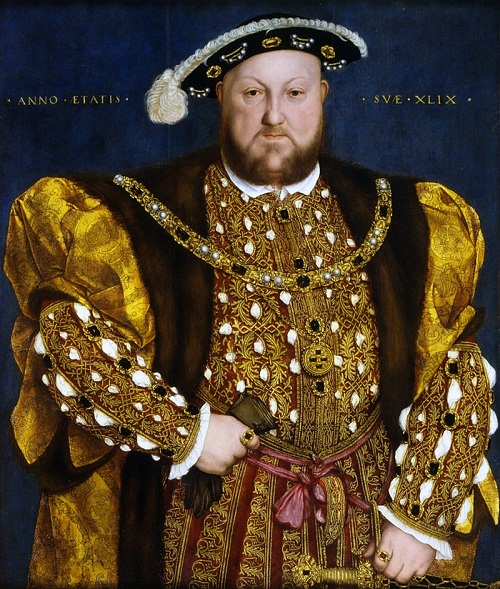
This iconic portrait by Hans Holbein defines the enduring visual image of Henry VIII of England. Depicted frontally and with monumental authority, the king’s stance, lavish costume, and direct gaze project absolute power, wealth, and royal confidence. The image played a crucial role in shaping Henry’s political persona across Europe.
After returning to Basel for four years in 1528, Hans Holbein permanently resumed his career in England in 1532 under the patronage of Anne Boleyn and Thomas Cromwell. In 1535, he officially entered the service of King Henry VIII of England. As court painter, Holbein produced royal portraits, ceremonial decorations, and designs for jewelry, tableware, and other luxury objects. He also designed armor for the king, demonstrating his versatility beyond painting.
In 1540, Holbein completed one of his most iconic images of Henry VIII, a portrait that helped define the enduring visual image of the English monarch. Around this period, he also painted the French poet Nicholas Bourbon, who had fled France after being imprisoned for supporting religious reform. Bourbon praised Holbein by declaring that the artist surpassed the legendary ancient painter Apelles.
Throughout his career, Hans Holbein displayed extraordinary attention to detail and an unmatched ability to observe nature. He rendered the human body with organic realism and conveyed the psychological presence of his sitters with exceptional clarity. His portraits combined objective realism with symbolic depth, setting new standards for Renaissance portraiture.
Hans Holbein died of plague in London between 7 October and 29 November 1543 at the age of forty-six. Although some of his works were lost after his death, many survived and were later collected. By the 19th century, he was firmly recognized as one of the greatest portrait masters in art history. Today, a significant portion of his surviving works is preserved in museums in Basel, reflecting his lasting impact on European art.
Source: Biyografiler.com
Frequently asked questions about Hans Holbein
Who is Hans Holbein?, Hans Holbein biography, Hans Holbein life story, Hans Holbein age, Hans Holbein facts, Hans Holbein birthplace, Hans Holbein photos, Hans Holbein videos, Hans Holbein career
Related Biographies

Lamine Yamal
Professional footballer

Erling Haaland
Professional footballer

Austin Abrams
Actor

Keanu Reeves
Actor

Kylian Mbappe
Professional footballer

Bad Bunny
Rapper, Songwriter


Hongjoong
Singer, Rapper, Songwriter, Composer

Ludacris
Rapper, Actor

Kwon Eunbi
Singer

Sarah Wayne Callies
Actress, Screenwriter, Producer, Director

LaTavia Roberson
Singer, Actress, Entrepreneur

Demi Moore
Actress

Kristrun Frostadottir
Politician, Economist

Leonardo DiCaprio
Actor

Ilya Sutskever
Computer Scientist, Researcher

Sharon Stone
Actress, Former Model
Keanu Reeves
Actor